

 HE letter of Mulla Husayn
decided the Bab to undertake His contemplated pilgrimage to Hijaz.
Entrusting His wife to His mother, and committing
them both to the care and protection of His maternal
uncle, He joined the company of the pilgrims of Fars
who were preparing to leave Shiraz for Mecca and Medina.(1) Quddus was His only companion, and the Ethiopian servant His personal attendant. He first proceeded to Bushihr, the
seat of His uncle's business, where in former days He, in
close association with him, had lived the life of a humble
merchant. Having there completed the preliminary arrangements
for His long and arduous voyage, He embarked on a
sailing vessel, which, after two months of slow, stormy, and
unsteady sailing, landed Him upon the shores of that sacred
land.(2) High seas and the complete absence of comfort could
I have heard Haji Abu'l-Hasan-i-Shirazi, who was travelling
in the same vessel as the Bab, describe the circumstances
of that memorable voyage: "During the entire period of approximately
two months," he asserted, "from the day we
embarked at Bushihr to the day when we landed at Jaddih,
the port of Hijaz, whenever by day or night I chanced to
meet either the Bab or Quddus, I invariably found them
together, both absorbed in their work. The Bab seemed to
be dictating, and Quddus was busily engaged in taking down
whatever fell from His lips. Even at a time when panic
seemed to have seized the passengers of that storm-tossed
vessel, they would be seen pursuing their labours with unperturbed
confidence and calm. Neither the violence of the
elements nor the tumult of the people around them could
either ruffle the serenity of their countenance or turn them
from their purpose."
The Bab Himself, in the Persian Bayan,
(1) refers to the
The peoples of the West, among whom the first evidences
of this great Industrial Revolution have appeared, are, alas,
as yet wholly unaware of the Source whence this mighty
stream, this great motive power, proceeds--a force that has
revolutionised every aspect of their material life. Their own
history testifies to the fact that in the year which witnessed
the dawn of this glorious Revelation, there suddenly appeared
evidences of an industrial and economic revolution that the
people themselves declare to have been unprecedented in the
history of mankind. In their concern for the details of the
working and adjustments of this newly conceived machinery,
they have gradually lost sight of the Source and object of
this tremendous power which the Almighty has committed to
their charge. They seem to have sorely misused this power
and misunderstood its function. Designed to confer upon
the people of the West the blessings of peace and of happiness,
it has been utilised by them to promote the interests of destruction
and war.
Upon His arrival in Jaddih, the Bab donned the pilgrim's
garb, mounted a camel, and set out on His journey to Mecca.
Quddus, however, notwithstanding the repeatedly expressed
desire of his Master, preferred to accompany Him on foot
all the way from Jaddih to that holy city. Holding in his
hand the bridle of the camel upon which the Bab was riding,
he walked along joyously and prayerfully, ministering to his
Master's needs, wholly indifferent to the fatigues of his
arduous march. Every night, from eventide until the break
of day, Quddus, sacrificing comfort and sleep, would continue
with unrelaxing vigilance to watch beside his Beloved, ready
to provide for His wants and to ensure the means of His
protection and safety.
One day, when the Bab had dismounted close to a well
in order to offer His morning prayer, a roving Bedouin suddenly
appeared on the horizon, drew near to Him, and,
snatching the saddlebag that had been lying on the ground
beside Him, and which contained His writings and papers,
vanished into the unknown desert. His Ethiopian servant
set out to pursue him, but was prevented by his Master, who,
as He was praying, motioned to him with His hand to give
up his pursuit. "Had I allowed you," the Bab later on affectionately
assured him, "you would surely have overtaken
and punished him. But this was not to be. The papers and
writings which that bag contained are destined to reach,
through the instrumentality of this Arab, such places as we
could never have succeeded in attaining. Grieve not, therefore,
at his action, for this was decreed by God, the Ordainer,
the Almighty." Many a time afterwards did the Bab on
similar occasions seek to comfort His friends by such reflections.
By words such as these He turned the bitterness of
regret and of resentment into radiant acquiescence in the
Divine purpose and into joyous submission to God's will.
On the day of Arafat,(1) the Bab, seeking the quiet seclusion
of His cell, devoted His whole time to meditation and
worship. On the following day, the day of Nahr, after He
had offered the feast-day prayer, He proceeded to Muna,
where, according to ancient custom, He purchased nineteen
lambs of the choicest breed, of which He sacrificed nine in
HE letter of Mulla Husayn
decided the Bab to undertake His contemplated pilgrimage to Hijaz.
Entrusting His wife to His mother, and committing
them both to the care and protection of His maternal
uncle, He joined the company of the pilgrims of Fars
who were preparing to leave Shiraz for Mecca and Medina.(1) Quddus was His only companion, and the Ethiopian servant His personal attendant. He first proceeded to Bushihr, the
seat of His uncle's business, where in former days He, in
close association with him, had lived the life of a humble
merchant. Having there completed the preliminary arrangements
for His long and arduous voyage, He embarked on a
sailing vessel, which, after two months of slow, stormy, and
unsteady sailing, landed Him upon the shores of that sacred
land.(2) High seas and the complete absence of comfort could
I have heard Haji Abu'l-Hasan-i-Shirazi, who was travelling
in the same vessel as the Bab, describe the circumstances
of that memorable voyage: "During the entire period of approximately
two months," he asserted, "from the day we
embarked at Bushihr to the day when we landed at Jaddih,
the port of Hijaz, whenever by day or night I chanced to
meet either the Bab or Quddus, I invariably found them
together, both absorbed in their work. The Bab seemed to
be dictating, and Quddus was busily engaged in taking down
whatever fell from His lips. Even at a time when panic
seemed to have seized the passengers of that storm-tossed
vessel, they would be seen pursuing their labours with unperturbed
confidence and calm. Neither the violence of the
elements nor the tumult of the people around them could
either ruffle the serenity of their countenance or turn them
from their purpose."
The Bab Himself, in the Persian Bayan,
(1) refers to the
The peoples of the West, among whom the first evidences
of this great Industrial Revolution have appeared, are, alas,
as yet wholly unaware of the Source whence this mighty
stream, this great motive power, proceeds--a force that has
revolutionised every aspect of their material life. Their own
history testifies to the fact that in the year which witnessed
the dawn of this glorious Revelation, there suddenly appeared
evidences of an industrial and economic revolution that the
people themselves declare to have been unprecedented in the
history of mankind. In their concern for the details of the
working and adjustments of this newly conceived machinery,
they have gradually lost sight of the Source and object of
this tremendous power which the Almighty has committed to
their charge. They seem to have sorely misused this power
and misunderstood its function. Designed to confer upon
the people of the West the blessings of peace and of happiness,
it has been utilised by them to promote the interests of destruction
and war.
Upon His arrival in Jaddih, the Bab donned the pilgrim's
garb, mounted a camel, and set out on His journey to Mecca.
Quddus, however, notwithstanding the repeatedly expressed
desire of his Master, preferred to accompany Him on foot
all the way from Jaddih to that holy city. Holding in his
hand the bridle of the camel upon which the Bab was riding,
he walked along joyously and prayerfully, ministering to his
Master's needs, wholly indifferent to the fatigues of his
arduous march. Every night, from eventide until the break
of day, Quddus, sacrificing comfort and sleep, would continue
with unrelaxing vigilance to watch beside his Beloved, ready
to provide for His wants and to ensure the means of His
protection and safety.
One day, when the Bab had dismounted close to a well
in order to offer His morning prayer, a roving Bedouin suddenly
appeared on the horizon, drew near to Him, and,
snatching the saddlebag that had been lying on the ground
beside Him, and which contained His writings and papers,
vanished into the unknown desert. His Ethiopian servant
set out to pursue him, but was prevented by his Master, who,
as He was praying, motioned to him with His hand to give
up his pursuit. "Had I allowed you," the Bab later on affectionately
assured him, "you would surely have overtaken
and punished him. But this was not to be. The papers and
writings which that bag contained are destined to reach,
through the instrumentality of this Arab, such places as we
could never have succeeded in attaining. Grieve not, therefore,
at his action, for this was decreed by God, the Ordainer,
the Almighty." Many a time afterwards did the Bab on
similar occasions seek to comfort His friends by such reflections.
By words such as these He turned the bitterness of
regret and of resentment into radiant acquiescence in the
Divine purpose and into joyous submission to God's will.
On the day of Arafat,(1) the Bab, seeking the quiet seclusion
of His cell, devoted His whole time to meditation and
worship. On the following day, the day of Nahr, after He
had offered the feast-day prayer, He proceeded to Muna,
where, according to ancient custom, He purchased nineteen
lambs of the choicest breed, of which He sacrificed nine in
 the sacred
shrine were unable to perform that rite in their
usual garments. Draped in a
light, loose-fitting tunic, they
joined in the celebration of the
festival. The Bab, however,
refused, as a mark of deference,
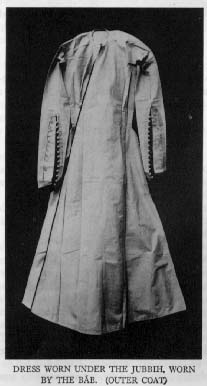
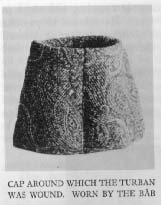
to discard either His turban or
cloak. Dressed in His usual
attire, He, with the utmost
dignity and calm, and with extreme
simplicity and reverence,
compassed the Ka'bih and performed
all the prescribed rites of worship.
On the last day of His pilgrimage
to Mecca, the Bab met Mirza Muhit-i-Kirmani.
He stood facing the Black Stone, when the Bab approached
him and, taking his hand in His, addressed him in these
words: "O Muhit! You regard yourself as one of the most
outstanding figures of the shaykhi community and a distinguished
exponent of its teachings. In your heart you
even claim to be one of the direct successors and rightful
inheritors of those twin great Lights, those Stars that have
heralded the morn of Divine guidance. Behold, we are both
now standing within this most sacred shrine. Within its
hallowed precincts, He whose Spirit dwells in this place can
cause Truth immediately to be known and distinguished
from falsehood, and righteousness from error. Verily I
declare, none besides Me in this day, whether in the East
or in the West, can claim to be the Gate that leads men to
the knowledge of God. My proof is none other than that
proof whereby the truth of the Prophet Muhammad was
established. Ask Me whatsoever you please; now, at this
very moment, I pledge Myself to reveal such verses as can
demonstrate the truth of My mission. You must choose
either to submit yourself unreservedly to My Cause or to
repudiate it entirely. You have no other alternative. If
you choose to reject My message, I will not let go your hand
until you pledge your word to declare publicly your repudiation
the sacred
shrine were unable to perform that rite in their
usual garments. Draped in a
light, loose-fitting tunic, they
joined in the celebration of the
festival. The Bab, however,
refused, as a mark of deference,
to discard either His turban or
cloak. Dressed in His usual
attire, He, with the utmost
dignity and calm, and with extreme
simplicity and reverence,
compassed the Ka'bih and performed
all the prescribed rites of worship.
On the last day of His pilgrimage
to Mecca, the Bab met Mirza Muhit-i-Kirmani.
He stood facing the Black Stone, when the Bab approached
him and, taking his hand in His, addressed him in these
words: "O Muhit! You regard yourself as one of the most
outstanding figures of the shaykhi community and a distinguished
exponent of its teachings. In your heart you
even claim to be one of the direct successors and rightful
inheritors of those twin great Lights, those Stars that have
heralded the morn of Divine guidance. Behold, we are both
now standing within this most sacred shrine. Within its
hallowed precincts, He whose Spirit dwells in this place can
cause Truth immediately to be known and distinguished
from falsehood, and righteousness from error. Verily I
declare, none besides Me in this day, whether in the East
or in the West, can claim to be the Gate that leads men to
the knowledge of God. My proof is none other than that
proof whereby the truth of the Prophet Muhammad was
established. Ask Me whatsoever you please; now, at this
very moment, I pledge Myself to reveal such verses as can
demonstrate the truth of My mission. You must choose
either to submit yourself unreservedly to My Cause or to
repudiate it entirely. You have no other alternative. If
you choose to reject My message, I will not let go your hand
until you pledge your word to declare publicly your repudiation
 This peremptory challenge, thrust so unexpectedly by the
Bab upon Mirza Muhit-i-Kirmani, profoundly distressed
him. He was overpowered by its directness, its compelling
The Bab, who listened attentively to his words, and who
was well aware of his helplessness and poverty of soul, answered
and said: "Verily I say, the Truth is even now known
and distinguished from falsehood. O shrine of the Prophet
of God, and you, O Quddus, who have believed in Me! I
take you both, in this hour, as My witnesses. You have
seen and heard that which has come to pass between Me and
him. I call upon you to testify thereunto, and God, verily,
is, beyond and above you, My sure and ultimate Witness.
He is the All-Seeing, the All-Knowing, the All-Wise. O
Muhit! Set forth whatsoever perplexes your mind, and I
will, by the aid of God, unloose My tongue and undertake to
resolve your problems, so that you may testify to the excellence
of My utterance and realise that no one besides Me
is able to manifest My wisdom."
Mirza Muhit responded to the invitation of the Bab and
submitted to Him his questions. Pleading the necessity of
his immediate departure for Medina, he expressed the hope
of receiving, ere his departure from that city, the text of the
promised reply. "I will grant your request," the Bab assured
him. On My way to Medina I shall, with the assistance
of God, reveal My answer to your questions. If I meet you
Mirza Muhit, ere his departure, again expressed his firm
resolve to redeem his solemn pledge. "I shall never depart
from Medina," he assured the Bab, "whatever may betide,
until I have fulfilled my covenant with You." As the mote
which is driven before the gale, he, unable to withstand the
sweeping majesty of the Revelation proclaimed by the Bab,
fled in terror from before His face. He tarried awhile in Medina
and, faithless to his pledge and disregardful of the admonitions
of his conscience, left for Karbila.
The Bab, faithful to His promise, revealed, on His way
from Mecca to Medina, His written reply to the questions
that had perplexed the mind of Mirza Muhit, and gave it the
name of Sahifiyi-i-Baynu'l-Haramayn.(2) Mirza Muhit, who
received it in the early days of his arrival in Karbila, remained
unmoved by its tone and refused to recognise the precepts
which it inculcated. His attitude towards the Faith was one
of concealed and persistent opposition. At times he professed
to be a follower and supporter of that notorious adversary of
the Bab, Haji Mirza Karim Khan, and occasionally claimed
for himself the station of an independent leader. Nearing
the end of his days, whilst residing in Iraq, he, feigning submission
to Baha'u'llah, expressed, through one of the Persian
princes who dwelt in Baghdad, a desire to meet Him. He
requested that his proposed interview be regarded as strictly
confidential. "Tell him," was Baha'u'llah's reply, "that in
the days of My retirement in the mountains of Sulaymaniyyih,
I, in a certain ode which I composed, set forth the essential
requirements from every wayfarer who treads the path of
search in his quest of Truth. Share with him this verse from
that ode: `If thine aim be to cherish thy life, approach not
our court; but if sacrifice be thy heart's desire, come and let
others come with thee. For such is the way of Faith, if in
No sooner had the Bab performed the last of the observances
in connection with His pilgrimage to Mecca than
he addressed an epistle to the Sherif of that holy city, wherein
He set forth, in clear and unmistakable terms, the distinguishing
features of His mission, and called upon him to arise
and embrace His Cause. This epistle, together with selections
from His other writings, He delivered to Quddus, and instructed
him to present them to the Sherif. The latter, however,
too absorbed in his own material pursuits to incline his
ear to the words which had been addressed to him by the
Bab, failed to respond to the call of the Divine Message.
Haji Niyaz-i-Baghdadi has been heard to relate the following:
"In the year 1267 A.H.,(1) I undertook a pilgrimage to that
holy city, where I was privileged to meet the Sherif. In the
course of his conversation with me, he said: `I recollect that
in the year '60, during the season of pilgrimage, a youth came
to visit me. He presented to me a sealed book which I
readily accepted but was too much occupied at that time to
read. A few days later I met again that same youth, who
asked me whether I had any reply to make to his offer.
Pressure of work had again detained me from considering
the contents of that book. I was therefore unable to give him
a satisfactory reply. When the season of pilgrimage was
over, one day, as I was sorting out my letters, my eyes fell
accidentally upon that book. I opened it and found, in its
introductory pages, a moving and exquisitely written homily
which was followed by verses the tone and language of which
bore a striking resemblance to the Qur'an. All that I gathered
from the perusal of the book was that among the people of
Persia a man of the seed of Fatimih and descendant of the
family of Hashim, had raised a new call, and was announcing
This peremptory challenge, thrust so unexpectedly by the
Bab upon Mirza Muhit-i-Kirmani, profoundly distressed
him. He was overpowered by its directness, its compelling
The Bab, who listened attentively to his words, and who
was well aware of his helplessness and poverty of soul, answered
and said: "Verily I say, the Truth is even now known
and distinguished from falsehood. O shrine of the Prophet
of God, and you, O Quddus, who have believed in Me! I
take you both, in this hour, as My witnesses. You have
seen and heard that which has come to pass between Me and
him. I call upon you to testify thereunto, and God, verily,
is, beyond and above you, My sure and ultimate Witness.
He is the All-Seeing, the All-Knowing, the All-Wise. O
Muhit! Set forth whatsoever perplexes your mind, and I
will, by the aid of God, unloose My tongue and undertake to
resolve your problems, so that you may testify to the excellence
of My utterance and realise that no one besides Me
is able to manifest My wisdom."
Mirza Muhit responded to the invitation of the Bab and
submitted to Him his questions. Pleading the necessity of
his immediate departure for Medina, he expressed the hope
of receiving, ere his departure from that city, the text of the
promised reply. "I will grant your request," the Bab assured
him. On My way to Medina I shall, with the assistance
of God, reveal My answer to your questions. If I meet you
Mirza Muhit, ere his departure, again expressed his firm
resolve to redeem his solemn pledge. "I shall never depart
from Medina," he assured the Bab, "whatever may betide,
until I have fulfilled my covenant with You." As the mote
which is driven before the gale, he, unable to withstand the
sweeping majesty of the Revelation proclaimed by the Bab,
fled in terror from before His face. He tarried awhile in Medina
and, faithless to his pledge and disregardful of the admonitions
of his conscience, left for Karbila.
The Bab, faithful to His promise, revealed, on His way
from Mecca to Medina, His written reply to the questions
that had perplexed the mind of Mirza Muhit, and gave it the
name of Sahifiyi-i-Baynu'l-Haramayn.(2) Mirza Muhit, who
received it in the early days of his arrival in Karbila, remained
unmoved by its tone and refused to recognise the precepts
which it inculcated. His attitude towards the Faith was one
of concealed and persistent opposition. At times he professed
to be a follower and supporter of that notorious adversary of
the Bab, Haji Mirza Karim Khan, and occasionally claimed
for himself the station of an independent leader. Nearing
the end of his days, whilst residing in Iraq, he, feigning submission
to Baha'u'llah, expressed, through one of the Persian
princes who dwelt in Baghdad, a desire to meet Him. He
requested that his proposed interview be regarded as strictly
confidential. "Tell him," was Baha'u'llah's reply, "that in
the days of My retirement in the mountains of Sulaymaniyyih,
I, in a certain ode which I composed, set forth the essential
requirements from every wayfarer who treads the path of
search in his quest of Truth. Share with him this verse from
that ode: `If thine aim be to cherish thy life, approach not
our court; but if sacrifice be thy heart's desire, come and let
others come with thee. For such is the way of Faith, if in
No sooner had the Bab performed the last of the observances
in connection with His pilgrimage to Mecca than
he addressed an epistle to the Sherif of that holy city, wherein
He set forth, in clear and unmistakable terms, the distinguishing
features of His mission, and called upon him to arise
and embrace His Cause. This epistle, together with selections
from His other writings, He delivered to Quddus, and instructed
him to present them to the Sherif. The latter, however,
too absorbed in his own material pursuits to incline his
ear to the words which had been addressed to him by the
Bab, failed to respond to the call of the Divine Message.
Haji Niyaz-i-Baghdadi has been heard to relate the following:
"In the year 1267 A.H.,(1) I undertook a pilgrimage to that
holy city, where I was privileged to meet the Sherif. In the
course of his conversation with me, he said: `I recollect that
in the year '60, during the season of pilgrimage, a youth came
to visit me. He presented to me a sealed book which I
readily accepted but was too much occupied at that time to
read. A few days later I met again that same youth, who
asked me whether I had any reply to make to his offer.
Pressure of work had again detained me from considering
the contents of that book. I was therefore unable to give him
a satisfactory reply. When the season of pilgrimage was
over, one day, as I was sorting out my letters, my eyes fell
accidentally upon that book. I opened it and found, in its
introductory pages, a moving and exquisitely written homily
which was followed by verses the tone and language of which
bore a striking resemblance to the Qur'an. All that I gathered
from the perusal of the book was that among the people of
Persia a man of the seed of Fatimih and descendant of the
family of Hashim, had raised a new call, and was announcing
 From Mecca the Bab proceeded to Medina. It was the
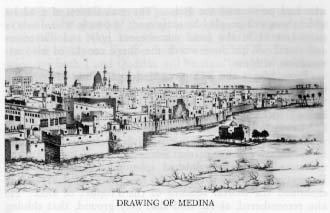
first day of the month of Muharram, in the year 1261 A.H.,(1)
when He found Himself on the way to that holy city. As
He approached it, He called to mind the stirring events that
had immortalised the name of Him who had lived and died
within its walls. Those scenes which bore eloquent testimony
to the creative power of that immortal Genius seemed to be
re-enacted, with undiminished splendour, before His eyes.
He prayed as He drew nigh unto that holy sepulchre which
enshrined the mortal remains of the Prophet of God. He
also remembered, as He trod that holy ground, that shining
Herald of His own Dispensation. He knew that in the
cemetery of Baqi', in a place not far distant from the shrine
of Muhammad, there had been laid to rest Shaykh Ahmad-i-Ahsa'i,
the harbinger of His own Revelation, who, after a
life of onerous service, had decided to spend the evening of
his days within the precincts of that hallowed shrine. There
came to Him also the vision of those holy men, those pioneers
and martyrs of the Faith, who had fallen gloriously on the
field of battle, and who, with their life-blood, had sealed the
triumph of the Cause of God. Their sacred dust seemed as
if reanimated by the gentle tread of His feet. Their shades
seemed to have been stirred by the reviving breath of His
presence. They looked to Him as if they had arisen at His
approach, were hastening towards Him, and were voicing their
welcome. They seemed to be addressing to Him this fervent
plea: `Repair not unto Thy native land, we beseech Thee,
O Thou Beloved of our hearts! Abide Thou in our midst,
for here, far from the tumult of Thine enemies who are lying
in wait for Thee, Thou shalt be safe and secure. We are
fearful for Thee. We dread the plottings and machinations
of Thy foes. We tremble at the thought that their deeds
might bring eternal damnation to their souls." "Fear not,"
the Bab's indomitable Spirit replied: "I am come into this
From Mecca the Bab proceeded to Medina. It was the
first day of the month of Muharram, in the year 1261 A.H.,(1)
when He found Himself on the way to that holy city. As
He approached it, He called to mind the stirring events that
had immortalised the name of Him who had lived and died
within its walls. Those scenes which bore eloquent testimony
to the creative power of that immortal Genius seemed to be
re-enacted, with undiminished splendour, before His eyes.
He prayed as He drew nigh unto that holy sepulchre which
enshrined the mortal remains of the Prophet of God. He
also remembered, as He trod that holy ground, that shining
Herald of His own Dispensation. He knew that in the
cemetery of Baqi', in a place not far distant from the shrine
of Muhammad, there had been laid to rest Shaykh Ahmad-i-Ahsa'i,
the harbinger of His own Revelation, who, after a
life of onerous service, had decided to spend the evening of
his days within the precincts of that hallowed shrine. There
came to Him also the vision of those holy men, those pioneers
and martyrs of the Faith, who had fallen gloriously on the
field of battle, and who, with their life-blood, had sealed the
triumph of the Cause of God. Their sacred dust seemed as
if reanimated by the gentle tread of His feet. Their shades
seemed to have been stirred by the reviving breath of His
presence. They looked to Him as if they had arisen at His
approach, were hastening towards Him, and were voicing their
welcome. They seemed to be addressing to Him this fervent
plea: `Repair not unto Thy native land, we beseech Thee,
O Thou Beloved of our hearts! Abide Thou in our midst,
for here, far from the tumult of Thine enemies who are lying
in wait for Thee, Thou shalt be safe and secure. We are
fearful for Thee. We dread the plottings and machinations
of Thy foes. We tremble at the thought that their deeds
might bring eternal damnation to their souls." "Fear not,"
the Bab's indomitable Spirit replied: "I am come into this



|