
 HE visit of the Bab to Medina
marked the concluding stage of His pilgrimage to Hijaz. From thence
He returned to Jaddih, and by way of the sea
regained His native land. He landed at Bushihr
nine lunar months after He had embarked on His pilgrimage
from that port. In the same khan(1) which He had previously
occupied, He received His friends and relatives, who had
come to greet and welcome Him. While still in Bushihr, He
summoned Quddus to His presence and with the utmost
kindness bade him depart for Shiraz. "The days of your
companionship with Me," He told him, "are drawing to a
close. The hour of separation has struck, a separation which
no reunion will follow except in the Kingdom of God, in the
presence of the King of Glory. In this world of dust, no
more than nine fleeting months of association with Me have
been allotted to you. On the shores of the Great Beyond,
however, in the realm of immortality, joy of eternal reunion
awaits us. The hand of destiny will ere long plunge you
into an ocean of tribulation for His sake. I, too, will follow
you; I, too, will be immersed beneath its depths. Rejoice
with exceeding gladness, for you have been chosen as the
standard-bearer of the host of affliction, and are standing
in the vanguard of the noble army that will suffer martyrdom
in His name. In the streets of Shiraz, indignities will be
heaped upon you, and the severest injuries will afflict your
body. You will survive the ignominious behaviour of your
foes, and will attain the presence of Him who is the one object
of our adoration and love. In His presence you will forget
all the harm and disgrace that shall have befallen you. The
hosts of the Unseen will hasten forth to assist you, and will
Quddus, with feelings of unshakable determination to
carry out the expressed wishes of his Master, set out from
Bushihr. Arriving at Shiraz, he was affectionately welcomed
by Haji Mirza Siyyid Ali, who received him in his own home
and eagerly enquired after the health and doings of his
beloved Kinsman. Finding him receptive to the call of the
new Message, Quddus acquainted him with the nature of
the Revelation with which that Youth had already fired his
soul. The Bab's maternal uncle, as a result of the endeavours
exerted by Quddus, was the first, after the Letters of the
Living, to embrace the Cause in Shiraz. As the full significance
of the new-born Faith had remained as yet undivulged,
he was unaware of the full extent of its implications and
glory. His conversation with Quddus, however, removed
the veil from his eyes. So steadfast became his faith, and so
profound grew his love for the Bab, that he consecrated his
whole life to His service. With unrelaxing vigilance he arose
to defend His Cause and to shield His person. In his sustained
endeavours, he scorned fatigue and was disdainful of
death. Though recognised as an outstanding figure among
the business men of that city, he never allowed material considerations
to interfere with his spiritual responsibility of safeguarding
the person, and advancing the Cause, of his beloved
Kinsman. He persevered in his task until the hour when, joining
the company of the Seven Martyrs of Tihran, he, in circumstances
of exceptional heroism, laid down his life for Him.
The next person whom Quddus met in Shiraz was Ismu'llahu'l-Asdaq,
Mulla Sadiq-i-Khurasani, to whom he entrusted
the copy of the Khasa'il-i-Sab'ih, and stressed the necessity
of putting into effect immediately all its provisions. Among
its precepts was the emphatic injunction of the Bab to every
loyal believer to add the following words to the traditional
formula of the adhan:(1) "I bear
witness that He whose name is Ali-Qabl-i-Muhammad(2) is the servant of
the Baqiyyatu'- The populace re-echoed the protestations of these divines,
and arose to reinforce their clamour. The whole city had
been aroused, and public order was, as a result, seriously
threatened. The governor of the province of Fars, Husayn
Khan-i-Iravani, surnamed Ajudan-Bashi, and generally designated
in those days as Sahib-Ikhtiyar,(1) found it necessary
to intervene and to enquire into the cause of this sudden
commotion. He was informed that a disciple of a young
man named Siyyid-i-Bab, who had just returned from His
pilgrimage to Mecca and Medina and was now living in
Bushihr, had arrived in Shiraz and was propagating the
teachings of his Master. "This disciple," Husayn Khan was
further informed, "claims that his teacher is the author of a
new revelation and is the revealer of a book which he asserts
is divinely inspired. Mulla Sadiq-i-Khurasani has embraced
that faith, and is fearlessly summoning the multitude to the
acceptance of that message. He declares its recognition to
be the first obligation of every loyal and pious follower of
shi'ah Islam."
Husayn Khan ordered the arrest of both Quddus and
Mulla Sadiq. The police authorities, to whom they were
delivered, were instructed to bring them handcuffed into the
presence of the governor. The police also delivered into the
hands of Husayn Khan the copy of the Qayyumu'l-Asma',
which they had seized from Mulla Sadiq while he was reading
aloud its passages to an excited congregation. Quddus,
owing to his youthful appearance and unconventional dress,
was at first ignored by Husayn Khan, who preferred to direct
That cruel and impious ruler was sorely displeased with
such an answer. He reviled and cursed him, ordered his
attendants to strip him of his garments and to scourge him
with a thousand lashes. He then commanded that the
beards of both Quddus and Mulla Sadiq should be burned,
their noses be pierced, that through this incision a cord should
be passed, and with this halter they should be led through
the streets of the city.(3) "It will be an object lesson to the people of Shiraz," Husayn Khan declared, "who will know
what the penalty of heresy will be." Mulla Sadiq, calm and
self-possessed and with eyes upraised to heaven, was heard
reciting this prayer: "O Lord, our God! We have indeed
heard the voice of One that called. He called us to the
An eye-witness of this revolting episode, an unbeliever
residing in Shiraz, related to me the following: "I was present
when Mulla Sadiq was being scourged. I watched his persecutors
each in turn apply the lash to his bleeding shoulders,
and continue the strokes until he became exhausted. No
one believed that Mulla Sadiq, so advanced in age and so
frail in body, could possibly survive fifty such savage strokes.
We marvelled at his fortitude when we found that, although
the number of the strokes of the scourge he had received had
already exceeded nine hundred, his face still retained its
original serenity and calm. A smile was upon his face, as
he held his hand before his mouth. He seemed utterly indifferent
to the blows that were being showered upon him.
When he was being expelled from the city, I succeeded in
approaching him, and asked him why he held his hand before
his mouth. I expressed surprise at the smile upon his countenance.
He emphatically replied: `The first seven strokes
were severely painful; to the rest I seemed to have grown
indifferent. I was wondering whether the strokes that followed
were being actually applied to my own body. A feeling
Husayn Khan's anger was not appeased by this atrocious
and most undeserved chastisement. His wanton and capricious
cruelty found further vent in the assault which he
now directed against the person of the Bab.(1) He despatched
to Bushihr a mounted escort of his own trusted guard, with
emphatic instructions to arrest the Bab and to bring Him in
chains to Shiraz. The leader of that escort, a member of the
Nusayri community, better known as the sect of Aliyu'llahi,
related the following: "Having completed the third
stage of our journey to Bushihr, we encountered, in the
midst of the wilderness a youth who wore a green sash and
a small turban after the manner of the siyyids who are in
the trading profession. He was on horseback, and was followed
by an Ethiopian servant who was in charge of his
belongings. As we approached him, he saluted us and enquired
as to our destination. I thought it best to conceal
from him the truth, and replied that in this vicinity we had
been commanded by the governor of Fars to conduct a certain
enquiry. He smilingly observed: `The governor has sent you
to arrest Me. Here am I; do with Me as you please. By
The Bab straightway resumed His journey to Shiraz.
Free and unfettered, He went before His escort, which followed
Him in an attitude of respectful devotion. By the
magic of His words, He had disarmed the hostility of His
guards and transmuted their proud arrogance into humility
and love. Reaching the city, they proceeded directly to the
seat of the government. Whosoever observed the cavalcade
marching through the streets could not help but marvel at
this most unusual spectacle. Immediately Husayn Khan
was informed of the arrival of the Bab, he summoned Him
to his presence. He received Him with the utmost insolence
and bade Him occupy a seat facing him in the centre of the
room. He publicly rebuked Him, and in abusive language
denounced His conduct. "Do you realise," he angrily protested,
"what a great mischief you have kindled? Are you
aware what a disgrace you have become to the holy Faith of
Islam and to the august person of our sovereign? Are you
not the man who claims to be the author of a new revelation
which annuls the sacred precepts of the Qur'an?" The Bab
calmly replied: "`If any bad man come unto you with
news, clear up the matter at once, lest through ignorance ye
harm others, and be speedily constrained to repent of what
ye have done.'"(1) These words inflamed the wrath of Husayn
Khan. "What!" he exclaimed. "Dare you ascribe to us
evil, ignorance, and folly?" Turning to his attendant, he
bade him strike the Bab in the face. So violent was the
blow, that the Bab's turban fell to the ground. Shaykh
Abu-Turab, the Imam-Jum'ih of Shiraz, who was present
at that meeting and who strongly disapproved of the conduct
of Husayn Khan, ordered that the Bab's turban be replaced
upon His head, and invited Him to be seated by his side.
Turning to the governor, the Imam-Jum'ih explained to him
the circumstances connected with the revelation of the verse
of the Qur'an which the Bab had quoted, and sought by this
means to calm his fury. "This verse which this youth has
Haji Mirza Siyyid Ali, his heart filled with gratitude to
God, conducted the Bab to His home and committed Him
to the loving care of His revered mother. He rejoiced at
this family reunion and was greatly relieved by the deliverance
of his dear and precious Kinsman from the grasp of that
malignant tyrant. In the quiet of His own home, the Bab
led for a time a life of undisturbed retirement. No one except
His wife, His mother, and His uncles had any intercourse
with Him. Meanwhile the mischief-makers were busily
pressing Shaykh Abu-Turab to summon the Bab to the
Masjid-i-Vakil and to call upon Him to fulfil His pledge.
HE visit of the Bab to Medina
marked the concluding stage of His pilgrimage to Hijaz. From thence
He returned to Jaddih, and by way of the sea
regained His native land. He landed at Bushihr
nine lunar months after He had embarked on His pilgrimage
from that port. In the same khan(1) which He had previously
occupied, He received His friends and relatives, who had
come to greet and welcome Him. While still in Bushihr, He
summoned Quddus to His presence and with the utmost
kindness bade him depart for Shiraz. "The days of your
companionship with Me," He told him, "are drawing to a
close. The hour of separation has struck, a separation which
no reunion will follow except in the Kingdom of God, in the
presence of the King of Glory. In this world of dust, no
more than nine fleeting months of association with Me have
been allotted to you. On the shores of the Great Beyond,
however, in the realm of immortality, joy of eternal reunion
awaits us. The hand of destiny will ere long plunge you
into an ocean of tribulation for His sake. I, too, will follow
you; I, too, will be immersed beneath its depths. Rejoice
with exceeding gladness, for you have been chosen as the
standard-bearer of the host of affliction, and are standing
in the vanguard of the noble army that will suffer martyrdom
in His name. In the streets of Shiraz, indignities will be
heaped upon you, and the severest injuries will afflict your
body. You will survive the ignominious behaviour of your
foes, and will attain the presence of Him who is the one object
of our adoration and love. In His presence you will forget
all the harm and disgrace that shall have befallen you. The
hosts of the Unseen will hasten forth to assist you, and will
Quddus, with feelings of unshakable determination to
carry out the expressed wishes of his Master, set out from
Bushihr. Arriving at Shiraz, he was affectionately welcomed
by Haji Mirza Siyyid Ali, who received him in his own home
and eagerly enquired after the health and doings of his
beloved Kinsman. Finding him receptive to the call of the
new Message, Quddus acquainted him with the nature of
the Revelation with which that Youth had already fired his
soul. The Bab's maternal uncle, as a result of the endeavours
exerted by Quddus, was the first, after the Letters of the
Living, to embrace the Cause in Shiraz. As the full significance
of the new-born Faith had remained as yet undivulged,
he was unaware of the full extent of its implications and
glory. His conversation with Quddus, however, removed
the veil from his eyes. So steadfast became his faith, and so
profound grew his love for the Bab, that he consecrated his
whole life to His service. With unrelaxing vigilance he arose
to defend His Cause and to shield His person. In his sustained
endeavours, he scorned fatigue and was disdainful of
death. Though recognised as an outstanding figure among
the business men of that city, he never allowed material considerations
to interfere with his spiritual responsibility of safeguarding
the person, and advancing the Cause, of his beloved
Kinsman. He persevered in his task until the hour when, joining
the company of the Seven Martyrs of Tihran, he, in circumstances
of exceptional heroism, laid down his life for Him.
The next person whom Quddus met in Shiraz was Ismu'llahu'l-Asdaq,
Mulla Sadiq-i-Khurasani, to whom he entrusted
the copy of the Khasa'il-i-Sab'ih, and stressed the necessity
of putting into effect immediately all its provisions. Among
its precepts was the emphatic injunction of the Bab to every
loyal believer to add the following words to the traditional
formula of the adhan:(1) "I bear
witness that He whose name is Ali-Qabl-i-Muhammad(2) is the servant of
the Baqiyyatu'- The populace re-echoed the protestations of these divines,
and arose to reinforce their clamour. The whole city had
been aroused, and public order was, as a result, seriously
threatened. The governor of the province of Fars, Husayn
Khan-i-Iravani, surnamed Ajudan-Bashi, and generally designated
in those days as Sahib-Ikhtiyar,(1) found it necessary
to intervene and to enquire into the cause of this sudden
commotion. He was informed that a disciple of a young
man named Siyyid-i-Bab, who had just returned from His
pilgrimage to Mecca and Medina and was now living in
Bushihr, had arrived in Shiraz and was propagating the
teachings of his Master. "This disciple," Husayn Khan was
further informed, "claims that his teacher is the author of a
new revelation and is the revealer of a book which he asserts
is divinely inspired. Mulla Sadiq-i-Khurasani has embraced
that faith, and is fearlessly summoning the multitude to the
acceptance of that message. He declares its recognition to
be the first obligation of every loyal and pious follower of
shi'ah Islam."
Husayn Khan ordered the arrest of both Quddus and
Mulla Sadiq. The police authorities, to whom they were
delivered, were instructed to bring them handcuffed into the
presence of the governor. The police also delivered into the
hands of Husayn Khan the copy of the Qayyumu'l-Asma',
which they had seized from Mulla Sadiq while he was reading
aloud its passages to an excited congregation. Quddus,
owing to his youthful appearance and unconventional dress,
was at first ignored by Husayn Khan, who preferred to direct
That cruel and impious ruler was sorely displeased with
such an answer. He reviled and cursed him, ordered his
attendants to strip him of his garments and to scourge him
with a thousand lashes. He then commanded that the
beards of both Quddus and Mulla Sadiq should be burned,
their noses be pierced, that through this incision a cord should
be passed, and with this halter they should be led through
the streets of the city.(3) "It will be an object lesson to the people of Shiraz," Husayn Khan declared, "who will know
what the penalty of heresy will be." Mulla Sadiq, calm and
self-possessed and with eyes upraised to heaven, was heard
reciting this prayer: "O Lord, our God! We have indeed
heard the voice of One that called. He called us to the
An eye-witness of this revolting episode, an unbeliever
residing in Shiraz, related to me the following: "I was present
when Mulla Sadiq was being scourged. I watched his persecutors
each in turn apply the lash to his bleeding shoulders,
and continue the strokes until he became exhausted. No
one believed that Mulla Sadiq, so advanced in age and so
frail in body, could possibly survive fifty such savage strokes.
We marvelled at his fortitude when we found that, although
the number of the strokes of the scourge he had received had
already exceeded nine hundred, his face still retained its
original serenity and calm. A smile was upon his face, as
he held his hand before his mouth. He seemed utterly indifferent
to the blows that were being showered upon him.
When he was being expelled from the city, I succeeded in
approaching him, and asked him why he held his hand before
his mouth. I expressed surprise at the smile upon his countenance.
He emphatically replied: `The first seven strokes
were severely painful; to the rest I seemed to have grown
indifferent. I was wondering whether the strokes that followed
were being actually applied to my own body. A feeling
Husayn Khan's anger was not appeased by this atrocious
and most undeserved chastisement. His wanton and capricious
cruelty found further vent in the assault which he
now directed against the person of the Bab.(1) He despatched
to Bushihr a mounted escort of his own trusted guard, with
emphatic instructions to arrest the Bab and to bring Him in
chains to Shiraz. The leader of that escort, a member of the
Nusayri community, better known as the sect of Aliyu'llahi,
related the following: "Having completed the third
stage of our journey to Bushihr, we encountered, in the
midst of the wilderness a youth who wore a green sash and
a small turban after the manner of the siyyids who are in
the trading profession. He was on horseback, and was followed
by an Ethiopian servant who was in charge of his
belongings. As we approached him, he saluted us and enquired
as to our destination. I thought it best to conceal
from him the truth, and replied that in this vicinity we had
been commanded by the governor of Fars to conduct a certain
enquiry. He smilingly observed: `The governor has sent you
to arrest Me. Here am I; do with Me as you please. By
The Bab straightway resumed His journey to Shiraz.
Free and unfettered, He went before His escort, which followed
Him in an attitude of respectful devotion. By the
magic of His words, He had disarmed the hostility of His
guards and transmuted their proud arrogance into humility
and love. Reaching the city, they proceeded directly to the
seat of the government. Whosoever observed the cavalcade
marching through the streets could not help but marvel at
this most unusual spectacle. Immediately Husayn Khan
was informed of the arrival of the Bab, he summoned Him
to his presence. He received Him with the utmost insolence
and bade Him occupy a seat facing him in the centre of the
room. He publicly rebuked Him, and in abusive language
denounced His conduct. "Do you realise," he angrily protested,
"what a great mischief you have kindled? Are you
aware what a disgrace you have become to the holy Faith of
Islam and to the august person of our sovereign? Are you
not the man who claims to be the author of a new revelation
which annuls the sacred precepts of the Qur'an?" The Bab
calmly replied: "`If any bad man come unto you with
news, clear up the matter at once, lest through ignorance ye
harm others, and be speedily constrained to repent of what
ye have done.'"(1) These words inflamed the wrath of Husayn
Khan. "What!" he exclaimed. "Dare you ascribe to us
evil, ignorance, and folly?" Turning to his attendant, he
bade him strike the Bab in the face. So violent was the
blow, that the Bab's turban fell to the ground. Shaykh
Abu-Turab, the Imam-Jum'ih of Shiraz, who was present
at that meeting and who strongly disapproved of the conduct
of Husayn Khan, ordered that the Bab's turban be replaced
upon His head, and invited Him to be seated by his side.
Turning to the governor, the Imam-Jum'ih explained to him
the circumstances connected with the revelation of the verse
of the Qur'an which the Bab had quoted, and sought by this
means to calm his fury. "This verse which this youth has
Haji Mirza Siyyid Ali, his heart filled with gratitude to
God, conducted the Bab to His home and committed Him
to the loving care of His revered mother. He rejoiced at
this family reunion and was greatly relieved by the deliverance
of his dear and precious Kinsman from the grasp of that
malignant tyrant. In the quiet of His own home, the Bab
led for a time a life of undisturbed retirement. No one except
His wife, His mother, and His uncles had any intercourse
with Him. Meanwhile the mischief-makers were busily
pressing Shaykh Abu-Turab to summon the Bab to the
Masjid-i-Vakil and to call upon Him to fulfil His pledge.
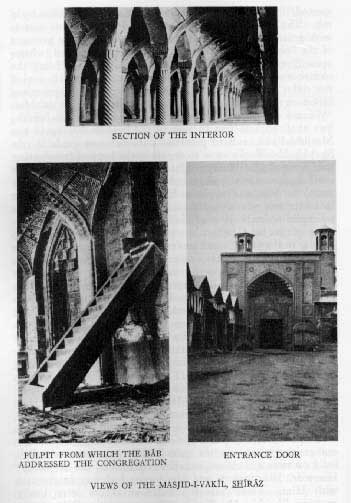 The Bab, accompanied by Haji Mirza Siyyid Ali, arrived
at the Masjid at a time when the Imam-Jum'ih had just
ascended the pulpit and was preparing to deliver his sermon.
As soon as his eyes fell upon the Bab, he publicly welcomed
Him, requested Him to ascend the pulpit, and called upon
Him to address the congregation. The Bab, responding to
his invitation, advanced towards him and, standing on the
first step of the staircase, prepared to address the people.
"Come up higher," interjected the Imam-Jum'ih. Complying
with his wish, the Bab ascended two more steps. As He was
standing, His head hid the breast of Shaykh Abu-Turab,
who was occupying the pulpit-top. He began by prefacing
His public declaration with an introductory discourse. No
sooner had He uttered the opening words of "Praise be to
God, who hath in truth created the heavens and the earth,"
than a certain siyyid known as Siyyidi-Shish-Pari, whose
function was to carry the mace before the Imam-Jum'ih,
insolently shouted: "Enough of this idle chatter! Declare,
now and immediately, the thing you intend to say." The
Imam-Jum'ih greatly resented the rudeness of the siyyid's
The Bab regained His home and for some time was able
to lead, in the privacy of His house, and in close association
with His family and kinsmen, a life of comparative tranquillity.
In those days He celebrated the advent of the
first Naw-Ruz since He had declared His Mission. That
festival fell, in that year, on the tenth day of the month of
Rabi'u'l-Avval, 1261 A.H.(1)
A few among those who were present on that memorable
occasion in the Masjid-i-Vakil, and had listened to the statements
of the Bab, were greatly impressed by the masterly
manner in which that Youth had, by His unaided efforts,
succeeded in silencing His formidable opponents. Soon after
this event, they were each led to apprehend the reality of
His Mission and to recognise its glory. Among them was
Shaykh Ali Mirza, the nephew of this same Imam-Jum'ih,
a young man who had just attained the age of maturity.
The seed implanted in his heart grew and developed, until
in the year 1267 A.H.(2) he was privileged to meet Baha'u'llah
in Iraq. That visit filled him with enthusiasm and joy.
Returning greatly refreshed to his native land, he resumed
with redoubled energy his labours for the Cause. From that
year until the present time, he has persevered in his task,
and has achieved distinction by the uprightness of his character
and whole-hearted devotion to his government and
country. Recently a letter addressed by him to Baha'u'llah
has reached the Holy Land, in which he expresses his keen
satisfaction at the progress of the Cause in Persia. "I am
mute with wonder," he writes, "when I behold the evidences
of God's unconquerable power manifested among the people
of my country. In a land which has for years so savagely
persecuted the Faith, a man who for forty years has been
known throughout Persia as a Babi, has been made the sole
arbitrator in a case of dispute which involves, on the one
hand, the Zillu's-Sultan, the tyrannical son of the Shah and a
sworn enemy of the Cause, and, on the other, Mirza Fath-'Ali
Khan, the Sahib-i-Divan. It has been publicly announced
that whatsoever be the verdict of this Babi, the same should
be unreservedly accepted by both parties and should be unhesitatingly
enforced."
A certain Muhammad-Karim who was among the congregation
that Friday was likewise attracted by the Bab's
remarkable behaviour on that occasion. What he saw and
heard on that day brought about his immediate conversion.
Persecution drove him out of Persia to Iraq, where, in the
presence of Baha'u'llah, he continually deepened his understanding
and faith. Later on he was bidden by Him to return
to Shiraz and to endeavour to the best of his ability to propagate
the Cause. There he remained and laboured to the end
of his life.
Still another was Mirza Aqay-i-Rikab-Saz. He became
so enamoured of the Bab on that day that no persecution,
however severe and prolonged, was able either to shake his
convictions or to obscure the radiance of his love. He, too,
attained the presence of Baha'u'llah in Iraq. In answer to
the questions which he asked regarding the interpretation of
the Disconnected Letters of the Qur'an and the meaning of
the Verse of Nur, he was favoured with an expressly written
Tablet revealed by the pen of Baha'u'llah. In His path he
eventually suffered martyrdom.
Among them also was Mirza Rahim-i-Khabbaz, who distinguished
himself by his fearlessness and fiery ardour. He
relaxed not in his efforts until the hour of his death.
Haji Abu'l-Hasan-i-Bazzaz, who, as a fellow-traveller of
the Bab during His pilgrimage to Hijaz, had but dimly recognised
the overpowering majesty of His Mission, was, on that
memorable Friday, profoundly shaken and completely transformed.
He bore the Bab such love that tears of an overpowering
devotion continually flowed from his eyes. All who
knew him admired the uprightness of his conduct and praised
his benevolence and candour. He, as well as his two sons,
has proved by his deeds the tenacity of his faith, and has won
the esteem of his fellow-believers.
And yet another of those who felt the fascination of the
Bab on that day was the late Haji Muhammad-Bisat, a man
well-versed in the metaphysical teachings of Islam and a
great admirer of both Shaykh Ahmad and Siyyid Kazim.
He was of a kindly disposition and was gifted with a keen
sense of humour. He had won the friendship of the Imam-Jum'ih,
The Naw-Ruz of that year, which heralded the advent
of a new springtime, was also symbolic of that spiritual rebirth,
the first stirring of which could already be discerned
throughout the length and breadth of the land. A number of
the most eminent and learned among the people of that
country emerged from the wintry desolation of heedlessness,
and were quickened by the reviving breath of the new-born
Revelation. The seeds which the Hand of Omnipotence had
implanted in their hearts germinated into blossoms of the
purest and loveliest fragrance.(1) As the breeze of His loving-kindness
and tender mercy wafted over these blossoms, the
penetrating power of their perfume spread far and wide over
the face of all that land. It diffused itself even beyond
the confines of Persia. It reached Karbila and reanimated the
souls of those who were waiting in expectation for the return
The receipt of this unexpected intelligence created a considerable
stir among those who had been eagerly awaiting
the arrival of the Bab at Karbila. It agitated their minds
and tested their loyalty. "What of His promise to us?"
whispered a few of the discontented among them. "Does
He regard the breaking of His pledge as the interposition of
the will of God?" The others, unlike those waverers, became
more steadfast in their faith and clung with added determination
to the Cause. Faithful to their Master, they joyously
responded to His invitation, ignoring entirely the criticisms
and protestations of those who had faltered in their faith.
On their way to Isfahan they met, in the city of Kangavar,
Mulla Husayn with his brother and nephew, who were his
companions on his previous visit to Shiraz, and who were
proceeding to Karbila. They were greatly delighted by this
unexpected encounter, and requested Mulla Husayn to prolong
his stay in Kangavar, with which request he readily
complied. Mulla Husayn, who, while in that city, led the
companions of the Bab in the Friday congregational prayer,
was held in such esteem and reverence by his fellow-disciples
that a number of those present, who later on, in Shiraz, revealed
their disloyalty to the Faith, were moved with envy.
Among them were Mulla Javad-i-Baraghani and Mulla
Abdu'l-'Aliy-i-Harati, both of whom feigned submission
to the Revelation of the Bab in the hope of satisfying their
ambition for leadership. They both strove secretly to undermine
the enviable position achieved by Mulla Husayn.
Through their hints and insinuations, they persistently endeavoured
to challenge his authority and disgrace his name.
I have heard Mirza Ahmad-i-Katib, better known in those
days as Mulla Abdu'l-Karim, who had been the travelling
companion of Mulla Javad from Qazvin, relate the following:
" Mulla Javad often alluded in his conversation with me to
Mulla Husayn. His repeated and disparaging remarks,
couched in artful language, impelled me to cease my association
with him. Every time I determined to sever my
Mulla Husayn decided to join the company of his friends
and to proceed with them to Isfahan. Travelling alone, at
about a farsakh's(1) distance in advance of his companions, he,
as soon as he paused at nightfall to offer his prayer, would
be overtaken by them and would, in their company, complete
his devotions. He would be the first to resume the journey,
and would again be joined by that devoted band at the hour
of dawn, when he once more would break his march to offer
his prayer. Only when pressed by his friends would he
consent to observe the congregational form of worship. On
such occasions he would sometimes follow the lead of one of
his companions. Such was the devotion which he had kindled
in those hearts that a number of his fellow-travellers would
dismount from their steeds and, offering them to those who
were journeying on foot, would themselves follow him,
utterly indifferent to the strain and fatigues of the march.
As they approached the outskirts of Isfahan, Mulla Husayn,
fearing that the sudden entry of so large a group of
people might excite the curiosity and suspicion of its inhabitants,
advised those who were travelling with him to disperse
and to enter the gates in small and inconspicuous numbers.
A few days after their arrival, there reached them the news
that Shiraz was in a state of violent agitation, that all manner
of intercourse with the Bab had been forbidden, and that their
projected visit to that city would be fraught with the gravest
danger. Mulla Husayn, quite undaunted by this sudden
intelligence, decided to proceed to Shiraz. He acquainted
only a few of his trusted companions with his intention. Discarding
his robes and turban, and wearing the jubbih (2) and
kulah of the people of Khurasan, he, disguising himself as a
horseman of Hizarih and Quchan and accompanied by his
brother and nephew, set out at an unexpected hour for the
The first group to reach the city and meet the Bab, a few
days after the arrival of Mulla Husayn, consisted of Mirza
Muhammad-'Aliy-i-Nahri, Mirza Hadi, his brother; Mulla
Abdu'l-Karim-i-Qazvini, Mulla Javad-i-Baraghani, Mulla
Abdu'l-'Aliy-i-Harati, and Mirza Ibrahim-i-Shirazi. In the
course of their association with Him, the last three of the
group gradually betrayed their blindness of heart and demonstrated
the baseness of their character. The manifold evidences
of the Bab's increasing favour towards Mulla Husayn
aroused their anger and excited the smouldering fire of their
jealousy. In their impotent rage, they resorted to the abject
weapons of fraud and of calumny. Unable at first to manifest
openly their hostility to Mulla Husayn, they sought by every
crafty device to beguile the minds and damp the affections
of his devoted admirers. Their unseemly behaviour alienated
the sympathy of the believers and precipitated their separation
from the company of the faithful. Expelled by their
very acts from the bosom of the Faith, they leagued themselves
with its avowed enemies and proclaimed their utter
rejection of its claims and principles. So great was the mischief
which they stirred up among the people of that city
that they were eventually expelled by the civil authorities,
One night after their expulsion from Shiraz, the Bab, who
was visiting the home of Haji Mirza Siyyid Ali, where He
had summoned to meet Him Mirza Muhammad-'Aliy-i-Nahri,
Mirza Hadi, and Mulla Abdu'l-Karim-i-Qazvini,
turned suddenly to the last-named and said: " Abdu'l-Karim,
are you seeking the Manifestation?" These words,
uttered with calm and extreme gentleness, had a startling
effect upon him. He paled at this sudden interrogation and
burst into tears. He threw himself at the feet of the Bab
in a state of profound agitation. The Bab took him lovingly
in His arms, kissed his forehead, and invited him to be seated
by His side. In a tone of tender affection, He succeeded in
appeasing the tumult of his heart.
As soon as they had regained their home, Mirza Muhammad-'Ali
and his brother enquired of Mulla Abdu'l-Karim
the reason for the violent perturbation which had
suddenly seized him. "Hear me," he answered; "I will relate
to you the tale of a strange experience, a tale which I have
shared with no one until now. When I attained the age of
maturity, I felt, while I lived in Qazvin, a profound yearning
to unravel the mystery of God and to apprehend the nature
of His saints and prophets. Nothing short of the acquisition
of learning, I realised, could enable me to achieve my goal.
I succeeded in obtaining the consent of my father and uncles
to the abandonment of my business, and plunged immediately
into study and research. I occupied a room in one of
the madrisihs of Qazvin, and concentrated my efforts on the
"No sooner had Mulla Abdu'l-Karim spoken these words
and departed than his disciples came forward and heartily
congratulated me on my accomplishments. I returned,
greatly elated, to my home. Upon my arrival I discovered
that both my father and my elder uncle, Haji Husayn-'Ali,
both of whom were greatly esteemed throughout Qazvin,
were preparing a feast in my honour, with which they intended
to celebrate the completion of my studies. I requested them
to postpone the invitation they had extended to the notables
of Qazvin until further notice from me. They gladly consented,
believing that in my eagerness for such a festival I
would not unduly postpone it. That night I repaired to my
library and, in the privacy of my cell, pondered the following
thoughts in my heart: Had you not fondly imagined, I said
to myself, that only the sanctified in spirit could ever hope
to attain the station of an authoritative expounder of the
"I remained absorbed in my thoughts until dawn. That
night I neither ate nor slept. At times I would commune
with God: `Thou seest me, O my Lord, and Thou beholdest
my plight. Thou knowest that I cherish no other desire except
Thy holy will and pleasure. I am lost in bewilderment
at the thought of the multitude of sects into which Thy holy
Faith hath fallen. I am deeply perplexed when I behold the
"I immediately decided to consult Haji Allah-Vardi,
father of Muhammad-Javad-i-Farhadi, a man known throughout
Qazvin for his deep spiritual insight. When I related
to him my vision, he smiled and with extraordinary precision
described to me the distinguishing features of the siyyid who
had appeared to me. `That noble figure,' he added, `was
none other than Haji Siyyid Kazim-i-Rashti, who is now in
Karbila and who may be seen expounding every day to his
disciples the sacred teachings of Islam. Those who listen
to his discourse are refreshed and edified by his utterance.
I can never describe the impression which his words exert
upon his hearers.' I joyously arose and, expressing to him
my feelings of profound appreciation, retired to my home and
started forthwith on my journey to Karbila. My old fellow-disciples
came and entreated me either to call in person on
the learned Mulla Abdu'l-Karim, who had expressed a desire
to meet me, or to allow him to come to my house. `I feel
the impulse,' I replied, `to visit the shrine of the Imam Husayn
at Karbila. I have vowed to start immediately on that
pilgrimage. I cannot postpone my departure. I will, if
possible, visit him for a few moments when I start to leave
the city. If I cannot, I would beg him to excuse me and to
pray in my behalf that I may be guided on the straight path.'
"I confidentially acquainted my relatives with the nature
of my vision and its interpretation. I informed them of my
projected visit to Karbila. My words to them that very day
"My brother, Abdu'l-Hamid [who later quaffed the cup
of martyrdom in Tihran], accompanied me on my journey
to Karbila. There I met Siyyid Kazim and was amazed to
hear him discourse to his assembled disciples under exactly
the same circumstances as he had appeared to me in my
vision. I was astounded when I discovered, upon my arrival,
that he was expounding the meaning of the same verse which
he, when he appeared to me, was explaining to his disciples.
As I sat and listened to him, I was greatly impressed by the
force of his argument and the profundity of his thoughts.
He graciously received me and showed me the utmost kindness.
My brother and I both felt an inner joy we had never
before experienced. At the hour of dawn we would hasten
to his home, and would accompany him on his visit to the
shrine of the Imam Husayn.
"I spent the entire winter in close companionship with
him. During the whole of that period, I faithfully attended
his classes. Every time I listened to his speech, I heard him
describe a particular aspect of the manifestation of the promised
Qa'im. This theme constituted the sole subject of his
discourses. Whichever verse or tradition he happened to
be expounding, he would invariably conclude his commentary
on it with a particular reference to the advent of the promised
Revelation. `The promised One,' he would openly and repeatedly
declare, lives in the midst of this people. The appointed
time for His appearance is fast approaching. Prepare
the way for Him, and purify yourselves so that you may recognise
His beauty. Not until I depart from this world will the
day-star of His countenance be revealed. It behoves you
after my departure to arise and seek Him. You should not
rest for one moment until you find Him.'
"After the celebration of Naw-Ruz, Siyyid Kazim bade
me depart from Karbila. `Rest assured, O Abdu'l-Karim,'
he told me as he bade me farewell, `you are of those who, in
the Day of His Revelation, will arise for the triumph of His
Cause. You will, I hope, remember me on that blessed Day.'
I besought him to allow me to remain in Karbila, pleading
"Immediately upon my arrival, I undertook to carry out
the counsel of Siyyid Kazim. With the instructions he had
given me, I was able to silence every malicious opposer. I
devoted my days to the transaction of my business; at night
I would regain my home and, in the quiet of my chamber,
would consecrate my time to meditation and prayer. With
tearful eyes I would commune with God and would beseech
Him, saying: `Thou hast, by the mouth of Thine inspired
servant, promised that I shall attain unto Thy Day, and shall
behold Thy Revelation. Thou hast, through him, assured
me that I shall be among those who will arise for the triumph
of Thy Cause. How long wilt Thou withhold from me Thy
promise? When will the hand of Thy loving-kindness unlock
to me the door of Thy grace, and confer upon me Thy everlasting
bounty?' Every night I would renew this prayer and
would continue in my supplications until the break of day.
"One night, on the eve of the day of Arafih, in the year
1255 A.H.(1) I was so wrapt in prayer that I seemed to have
fallen into a trance. There appeared before me a bird, white
as the snow, which hovered above my head and alighted upon
the twig of a tree beside me. In accents of indescribable
sweetness, that bird voiced these words: `Are you seeking
the Manifestation, O Abdu'l-Karim? Lo, the year '60.'
Immediately after, the bird flew away and vanished. The
mystery of those words greatly agitated me. The memory
of the beauty of that vision lingered long in my mind. I
seemed to have tasted all the delights of Paradise. My joy
was irrepressible.
"The mystic message of that bird had penetrated my
soul and was continually on my lips. I revolved it constantly
in my mind. I shared it with no one, fearing lest its sweetness
forsake me. A few years later, the Call from Shiraz reached
my ears. The day I heard it, I hastened to that city. On
In the early days of the year 1265 A.H.,(1) I set out, at the
age of eighteen, from my native village of Zarand for Qum,
where I chanced to meet Siyyid Isma'il-i-Zavari'i, surnamed
Dhabih, who later on, while in Baghdad, offered up his life
as a sacrifice in the path of Baha'u'llah. Through him I was
led to recognise the new Revelation. He was then preparing
to leave for Mazindaran and had determined to join the
heroic defenders of the fort of Shaykh Tabarsi. He had intended
to take me with him, together with Mirza Fathu'llah-i-Hakkak,
a lad of my age, who was a resident of Qum. As
circumstances interfered with his plan, he promised before
his departure that he would communicate with us from
Tihran and would ask us to join him. In the course of his
conversation with Mirza Fathu'llah and me, he related to
us the account of Mulla Abdu'l-Karim's marvellous experience.
I was seized with an ardent desire to meet him. When
I subsequently arrived at Tihran and met Siyyid Isma'il in
the Madrisiy-i-Daru'sh-Shafay-i-Masjid-i-Shah, I was introduced
by him to this same Mulla Abdu'l-Karim, who was
then living in that same madrisih. In those days we were
informed that the struggle of Shaykh Tabarsi had come to
an end, and that those companions of the Bab who had
gathered in Tihran and were contemplating joining their
brethren had each returned to his own province unable to
achieve his goal. Mulla Abdu'l-Karim remained in the
The Bab, accompanied by Haji Mirza Siyyid Ali, arrived
at the Masjid at a time when the Imam-Jum'ih had just
ascended the pulpit and was preparing to deliver his sermon.
As soon as his eyes fell upon the Bab, he publicly welcomed
Him, requested Him to ascend the pulpit, and called upon
Him to address the congregation. The Bab, responding to
his invitation, advanced towards him and, standing on the
first step of the staircase, prepared to address the people.
"Come up higher," interjected the Imam-Jum'ih. Complying
with his wish, the Bab ascended two more steps. As He was
standing, His head hid the breast of Shaykh Abu-Turab,
who was occupying the pulpit-top. He began by prefacing
His public declaration with an introductory discourse. No
sooner had He uttered the opening words of "Praise be to
God, who hath in truth created the heavens and the earth,"
than a certain siyyid known as Siyyidi-Shish-Pari, whose
function was to carry the mace before the Imam-Jum'ih,
insolently shouted: "Enough of this idle chatter! Declare,
now and immediately, the thing you intend to say." The
Imam-Jum'ih greatly resented the rudeness of the siyyid's
The Bab regained His home and for some time was able
to lead, in the privacy of His house, and in close association
with His family and kinsmen, a life of comparative tranquillity.
In those days He celebrated the advent of the
first Naw-Ruz since He had declared His Mission. That
festival fell, in that year, on the tenth day of the month of
Rabi'u'l-Avval, 1261 A.H.(1)
A few among those who were present on that memorable
occasion in the Masjid-i-Vakil, and had listened to the statements
of the Bab, were greatly impressed by the masterly
manner in which that Youth had, by His unaided efforts,
succeeded in silencing His formidable opponents. Soon after
this event, they were each led to apprehend the reality of
His Mission and to recognise its glory. Among them was
Shaykh Ali Mirza, the nephew of this same Imam-Jum'ih,
a young man who had just attained the age of maturity.
The seed implanted in his heart grew and developed, until
in the year 1267 A.H.(2) he was privileged to meet Baha'u'llah
in Iraq. That visit filled him with enthusiasm and joy.
Returning greatly refreshed to his native land, he resumed
with redoubled energy his labours for the Cause. From that
year until the present time, he has persevered in his task,
and has achieved distinction by the uprightness of his character
and whole-hearted devotion to his government and
country. Recently a letter addressed by him to Baha'u'llah
has reached the Holy Land, in which he expresses his keen
satisfaction at the progress of the Cause in Persia. "I am
mute with wonder," he writes, "when I behold the evidences
of God's unconquerable power manifested among the people
of my country. In a land which has for years so savagely
persecuted the Faith, a man who for forty years has been
known throughout Persia as a Babi, has been made the sole
arbitrator in a case of dispute which involves, on the one
hand, the Zillu's-Sultan, the tyrannical son of the Shah and a
sworn enemy of the Cause, and, on the other, Mirza Fath-'Ali
Khan, the Sahib-i-Divan. It has been publicly announced
that whatsoever be the verdict of this Babi, the same should
be unreservedly accepted by both parties and should be unhesitatingly
enforced."
A certain Muhammad-Karim who was among the congregation
that Friday was likewise attracted by the Bab's
remarkable behaviour on that occasion. What he saw and
heard on that day brought about his immediate conversion.
Persecution drove him out of Persia to Iraq, where, in the
presence of Baha'u'llah, he continually deepened his understanding
and faith. Later on he was bidden by Him to return
to Shiraz and to endeavour to the best of his ability to propagate
the Cause. There he remained and laboured to the end
of his life.
Still another was Mirza Aqay-i-Rikab-Saz. He became
so enamoured of the Bab on that day that no persecution,
however severe and prolonged, was able either to shake his
convictions or to obscure the radiance of his love. He, too,
attained the presence of Baha'u'llah in Iraq. In answer to
the questions which he asked regarding the interpretation of
the Disconnected Letters of the Qur'an and the meaning of
the Verse of Nur, he was favoured with an expressly written
Tablet revealed by the pen of Baha'u'llah. In His path he
eventually suffered martyrdom.
Among them also was Mirza Rahim-i-Khabbaz, who distinguished
himself by his fearlessness and fiery ardour. He
relaxed not in his efforts until the hour of his death.
Haji Abu'l-Hasan-i-Bazzaz, who, as a fellow-traveller of
the Bab during His pilgrimage to Hijaz, had but dimly recognised
the overpowering majesty of His Mission, was, on that
memorable Friday, profoundly shaken and completely transformed.
He bore the Bab such love that tears of an overpowering
devotion continually flowed from his eyes. All who
knew him admired the uprightness of his conduct and praised
his benevolence and candour. He, as well as his two sons,
has proved by his deeds the tenacity of his faith, and has won
the esteem of his fellow-believers.
And yet another of those who felt the fascination of the
Bab on that day was the late Haji Muhammad-Bisat, a man
well-versed in the metaphysical teachings of Islam and a
great admirer of both Shaykh Ahmad and Siyyid Kazim.
He was of a kindly disposition and was gifted with a keen
sense of humour. He had won the friendship of the Imam-Jum'ih,
The Naw-Ruz of that year, which heralded the advent
of a new springtime, was also symbolic of that spiritual rebirth,
the first stirring of which could already be discerned
throughout the length and breadth of the land. A number of
the most eminent and learned among the people of that
country emerged from the wintry desolation of heedlessness,
and were quickened by the reviving breath of the new-born
Revelation. The seeds which the Hand of Omnipotence had
implanted in their hearts germinated into blossoms of the
purest and loveliest fragrance.(1) As the breeze of His loving-kindness
and tender mercy wafted over these blossoms, the
penetrating power of their perfume spread far and wide over
the face of all that land. It diffused itself even beyond
the confines of Persia. It reached Karbila and reanimated the
souls of those who were waiting in expectation for the return
The receipt of this unexpected intelligence created a considerable
stir among those who had been eagerly awaiting
the arrival of the Bab at Karbila. It agitated their minds
and tested their loyalty. "What of His promise to us?"
whispered a few of the discontented among them. "Does
He regard the breaking of His pledge as the interposition of
the will of God?" The others, unlike those waverers, became
more steadfast in their faith and clung with added determination
to the Cause. Faithful to their Master, they joyously
responded to His invitation, ignoring entirely the criticisms
and protestations of those who had faltered in their faith.
On their way to Isfahan they met, in the city of Kangavar,
Mulla Husayn with his brother and nephew, who were his
companions on his previous visit to Shiraz, and who were
proceeding to Karbila. They were greatly delighted by this
unexpected encounter, and requested Mulla Husayn to prolong
his stay in Kangavar, with which request he readily
complied. Mulla Husayn, who, while in that city, led the
companions of the Bab in the Friday congregational prayer,
was held in such esteem and reverence by his fellow-disciples
that a number of those present, who later on, in Shiraz, revealed
their disloyalty to the Faith, were moved with envy.
Among them were Mulla Javad-i-Baraghani and Mulla
Abdu'l-'Aliy-i-Harati, both of whom feigned submission
to the Revelation of the Bab in the hope of satisfying their
ambition for leadership. They both strove secretly to undermine
the enviable position achieved by Mulla Husayn.
Through their hints and insinuations, they persistently endeavoured
to challenge his authority and disgrace his name.
I have heard Mirza Ahmad-i-Katib, better known in those
days as Mulla Abdu'l-Karim, who had been the travelling
companion of Mulla Javad from Qazvin, relate the following:
" Mulla Javad often alluded in his conversation with me to
Mulla Husayn. His repeated and disparaging remarks,
couched in artful language, impelled me to cease my association
with him. Every time I determined to sever my
Mulla Husayn decided to join the company of his friends
and to proceed with them to Isfahan. Travelling alone, at
about a farsakh's(1) distance in advance of his companions, he,
as soon as he paused at nightfall to offer his prayer, would
be overtaken by them and would, in their company, complete
his devotions. He would be the first to resume the journey,
and would again be joined by that devoted band at the hour
of dawn, when he once more would break his march to offer
his prayer. Only when pressed by his friends would he
consent to observe the congregational form of worship. On
such occasions he would sometimes follow the lead of one of
his companions. Such was the devotion which he had kindled
in those hearts that a number of his fellow-travellers would
dismount from their steeds and, offering them to those who
were journeying on foot, would themselves follow him,
utterly indifferent to the strain and fatigues of the march.
As they approached the outskirts of Isfahan, Mulla Husayn,
fearing that the sudden entry of so large a group of
people might excite the curiosity and suspicion of its inhabitants,
advised those who were travelling with him to disperse
and to enter the gates in small and inconspicuous numbers.
A few days after their arrival, there reached them the news
that Shiraz was in a state of violent agitation, that all manner
of intercourse with the Bab had been forbidden, and that their
projected visit to that city would be fraught with the gravest
danger. Mulla Husayn, quite undaunted by this sudden
intelligence, decided to proceed to Shiraz. He acquainted
only a few of his trusted companions with his intention. Discarding
his robes and turban, and wearing the jubbih (2) and
kulah of the people of Khurasan, he, disguising himself as a
horseman of Hizarih and Quchan and accompanied by his
brother and nephew, set out at an unexpected hour for the
The first group to reach the city and meet the Bab, a few
days after the arrival of Mulla Husayn, consisted of Mirza
Muhammad-'Aliy-i-Nahri, Mirza Hadi, his brother; Mulla
Abdu'l-Karim-i-Qazvini, Mulla Javad-i-Baraghani, Mulla
Abdu'l-'Aliy-i-Harati, and Mirza Ibrahim-i-Shirazi. In the
course of their association with Him, the last three of the
group gradually betrayed their blindness of heart and demonstrated
the baseness of their character. The manifold evidences
of the Bab's increasing favour towards Mulla Husayn
aroused their anger and excited the smouldering fire of their
jealousy. In their impotent rage, they resorted to the abject
weapons of fraud and of calumny. Unable at first to manifest
openly their hostility to Mulla Husayn, they sought by every
crafty device to beguile the minds and damp the affections
of his devoted admirers. Their unseemly behaviour alienated
the sympathy of the believers and precipitated their separation
from the company of the faithful. Expelled by their
very acts from the bosom of the Faith, they leagued themselves
with its avowed enemies and proclaimed their utter
rejection of its claims and principles. So great was the mischief
which they stirred up among the people of that city
that they were eventually expelled by the civil authorities,
One night after their expulsion from Shiraz, the Bab, who
was visiting the home of Haji Mirza Siyyid Ali, where He
had summoned to meet Him Mirza Muhammad-'Aliy-i-Nahri,
Mirza Hadi, and Mulla Abdu'l-Karim-i-Qazvini,
turned suddenly to the last-named and said: " Abdu'l-Karim,
are you seeking the Manifestation?" These words,
uttered with calm and extreme gentleness, had a startling
effect upon him. He paled at this sudden interrogation and
burst into tears. He threw himself at the feet of the Bab
in a state of profound agitation. The Bab took him lovingly
in His arms, kissed his forehead, and invited him to be seated
by His side. In a tone of tender affection, He succeeded in
appeasing the tumult of his heart.
As soon as they had regained their home, Mirza Muhammad-'Ali
and his brother enquired of Mulla Abdu'l-Karim
the reason for the violent perturbation which had
suddenly seized him. "Hear me," he answered; "I will relate
to you the tale of a strange experience, a tale which I have
shared with no one until now. When I attained the age of
maturity, I felt, while I lived in Qazvin, a profound yearning
to unravel the mystery of God and to apprehend the nature
of His saints and prophets. Nothing short of the acquisition
of learning, I realised, could enable me to achieve my goal.
I succeeded in obtaining the consent of my father and uncles
to the abandonment of my business, and plunged immediately
into study and research. I occupied a room in one of
the madrisihs of Qazvin, and concentrated my efforts on the
"No sooner had Mulla Abdu'l-Karim spoken these words
and departed than his disciples came forward and heartily
congratulated me on my accomplishments. I returned,
greatly elated, to my home. Upon my arrival I discovered
that both my father and my elder uncle, Haji Husayn-'Ali,
both of whom were greatly esteemed throughout Qazvin,
were preparing a feast in my honour, with which they intended
to celebrate the completion of my studies. I requested them
to postpone the invitation they had extended to the notables
of Qazvin until further notice from me. They gladly consented,
believing that in my eagerness for such a festival I
would not unduly postpone it. That night I repaired to my
library and, in the privacy of my cell, pondered the following
thoughts in my heart: Had you not fondly imagined, I said
to myself, that only the sanctified in spirit could ever hope
to attain the station of an authoritative expounder of the
"I remained absorbed in my thoughts until dawn. That
night I neither ate nor slept. At times I would commune
with God: `Thou seest me, O my Lord, and Thou beholdest
my plight. Thou knowest that I cherish no other desire except
Thy holy will and pleasure. I am lost in bewilderment
at the thought of the multitude of sects into which Thy holy
Faith hath fallen. I am deeply perplexed when I behold the
"I immediately decided to consult Haji Allah-Vardi,
father of Muhammad-Javad-i-Farhadi, a man known throughout
Qazvin for his deep spiritual insight. When I related
to him my vision, he smiled and with extraordinary precision
described to me the distinguishing features of the siyyid who
had appeared to me. `That noble figure,' he added, `was
none other than Haji Siyyid Kazim-i-Rashti, who is now in
Karbila and who may be seen expounding every day to his
disciples the sacred teachings of Islam. Those who listen
to his discourse are refreshed and edified by his utterance.
I can never describe the impression which his words exert
upon his hearers.' I joyously arose and, expressing to him
my feelings of profound appreciation, retired to my home and
started forthwith on my journey to Karbila. My old fellow-disciples
came and entreated me either to call in person on
the learned Mulla Abdu'l-Karim, who had expressed a desire
to meet me, or to allow him to come to my house. `I feel
the impulse,' I replied, `to visit the shrine of the Imam Husayn
at Karbila. I have vowed to start immediately on that
pilgrimage. I cannot postpone my departure. I will, if
possible, visit him for a few moments when I start to leave
the city. If I cannot, I would beg him to excuse me and to
pray in my behalf that I may be guided on the straight path.'
"I confidentially acquainted my relatives with the nature
of my vision and its interpretation. I informed them of my
projected visit to Karbila. My words to them that very day
"My brother, Abdu'l-Hamid [who later quaffed the cup
of martyrdom in Tihran], accompanied me on my journey
to Karbila. There I met Siyyid Kazim and was amazed to
hear him discourse to his assembled disciples under exactly
the same circumstances as he had appeared to me in my
vision. I was astounded when I discovered, upon my arrival,
that he was expounding the meaning of the same verse which
he, when he appeared to me, was explaining to his disciples.
As I sat and listened to him, I was greatly impressed by the
force of his argument and the profundity of his thoughts.
He graciously received me and showed me the utmost kindness.
My brother and I both felt an inner joy we had never
before experienced. At the hour of dawn we would hasten
to his home, and would accompany him on his visit to the
shrine of the Imam Husayn.
"I spent the entire winter in close companionship with
him. During the whole of that period, I faithfully attended
his classes. Every time I listened to his speech, I heard him
describe a particular aspect of the manifestation of the promised
Qa'im. This theme constituted the sole subject of his
discourses. Whichever verse or tradition he happened to
be expounding, he would invariably conclude his commentary
on it with a particular reference to the advent of the promised
Revelation. `The promised One,' he would openly and repeatedly
declare, lives in the midst of this people. The appointed
time for His appearance is fast approaching. Prepare
the way for Him, and purify yourselves so that you may recognise
His beauty. Not until I depart from this world will the
day-star of His countenance be revealed. It behoves you
after my departure to arise and seek Him. You should not
rest for one moment until you find Him.'
"After the celebration of Naw-Ruz, Siyyid Kazim bade
me depart from Karbila. `Rest assured, O Abdu'l-Karim,'
he told me as he bade me farewell, `you are of those who, in
the Day of His Revelation, will arise for the triumph of His
Cause. You will, I hope, remember me on that blessed Day.'
I besought him to allow me to remain in Karbila, pleading
"Immediately upon my arrival, I undertook to carry out
the counsel of Siyyid Kazim. With the instructions he had
given me, I was able to silence every malicious opposer. I
devoted my days to the transaction of my business; at night
I would regain my home and, in the quiet of my chamber,
would consecrate my time to meditation and prayer. With
tearful eyes I would commune with God and would beseech
Him, saying: `Thou hast, by the mouth of Thine inspired
servant, promised that I shall attain unto Thy Day, and shall
behold Thy Revelation. Thou hast, through him, assured
me that I shall be among those who will arise for the triumph
of Thy Cause. How long wilt Thou withhold from me Thy
promise? When will the hand of Thy loving-kindness unlock
to me the door of Thy grace, and confer upon me Thy everlasting
bounty?' Every night I would renew this prayer and
would continue in my supplications until the break of day.
"One night, on the eve of the day of Arafih, in the year
1255 A.H.(1) I was so wrapt in prayer that I seemed to have
fallen into a trance. There appeared before me a bird, white
as the snow, which hovered above my head and alighted upon
the twig of a tree beside me. In accents of indescribable
sweetness, that bird voiced these words: `Are you seeking
the Manifestation, O Abdu'l-Karim? Lo, the year '60.'
Immediately after, the bird flew away and vanished. The
mystery of those words greatly agitated me. The memory
of the beauty of that vision lingered long in my mind. I
seemed to have tasted all the delights of Paradise. My joy
was irrepressible.
"The mystic message of that bird had penetrated my
soul and was continually on my lips. I revolved it constantly
in my mind. I shared it with no one, fearing lest its sweetness
forsake me. A few years later, the Call from Shiraz reached
my ears. The day I heard it, I hastened to that city. On
In the early days of the year 1265 A.H.,(1) I set out, at the
age of eighteen, from my native village of Zarand for Qum,
where I chanced to meet Siyyid Isma'il-i-Zavari'i, surnamed
Dhabih, who later on, while in Baghdad, offered up his life
as a sacrifice in the path of Baha'u'llah. Through him I was
led to recognise the new Revelation. He was then preparing
to leave for Mazindaran and had determined to join the
heroic defenders of the fort of Shaykh Tabarsi. He had intended
to take me with him, together with Mirza Fathu'llah-i-Hakkak,
a lad of my age, who was a resident of Qum. As
circumstances interfered with his plan, he promised before
his departure that he would communicate with us from
Tihran and would ask us to join him. In the course of his
conversation with Mirza Fathu'llah and me, he related to
us the account of Mulla Abdu'l-Karim's marvellous experience.
I was seized with an ardent desire to meet him. When
I subsequently arrived at Tihran and met Siyyid Isma'il in
the Madrisiy-i-Daru'sh-Shafay-i-Masjid-i-Shah, I was introduced
by him to this same Mulla Abdu'l-Karim, who was
then living in that same madrisih. In those days we were
informed that the struggle of Shaykh Tabarsi had come to
an end, and that those companions of the Bab who had
gathered in Tihran and were contemplating joining their
brethren had each returned to his own province unable to
achieve his goal. Mulla Abdu'l-Karim remained in the



|