
 HE first journey Baha'u'llah
undertook for the purpose of promoting the Revelation announced by
the Bab was to His ancestral home in Nur, in the
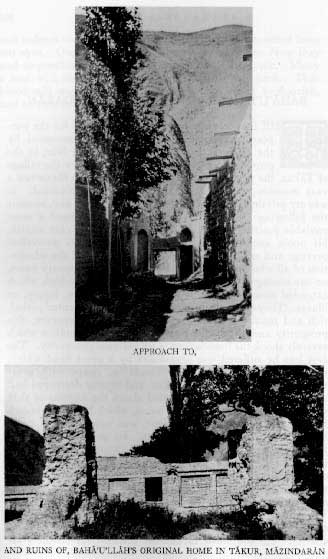
province of Mazindaran. He set out for the village
of Takur, the personal estate of His father, where He owned a
vast mansion, royally furnished and superbly situated. It
was my privilege to hear Baha'u'llah Himself, one day, recount
the following: "The late Vazir, My father, enjoyed a most
enviable position among his countrymen. His vast wealth,
his noble ancestry, his artistic attainments, his unrivalled
prestige and exalted rank made him the object of the admiration
of all who knew him. For a period of over twenty years,
no one among the wide circle of his family and kindred, which
extended over Nur and Tihran, suffered distress, injury, or
illness. They enjoyed, during a long and uninterrupted period,
rich and manifold blessings. Quite suddenly, however, this
prosperity and glory gave way to a series of calamities which
severely shook the foundations of his material prosperity. The
first loss he suffered was occasioned by a great flood which,
rising in the mountains of Mazindaran, swept with great
violence over the village of Takur, and utterly destroyed half
the mansion of the Vazir, situated above the fortress of that
village. The best part of that house, which had been known
for the solidity of its foundations, was utterly wiped away
by the fury of the roaring torrent. Its precious articles of
furniture were destroyed, and its elaborate ornamentation
irretrievably ruined. This was shortly followed by the loss
of various State positions which the Vazir occupied, and by
the repeated assaults directed against him by his envious
adversaries. Despite this sudden change of fortune, the
Vazir maintained his dignity and calm, and continued, within
the restricted limits of his means, his acts of benevolence and
charity. He continued to exercise towards his faithless associates
Baha'u'llah had already, prior to the declaration of the
Bab, visited the district of Nur, at a time when the celebrated
mujtahid Mirza Muhammad Taqiy-i-Nuri was at the height
of his authority and influence. Such was the eminence of his
position, that they who sat at his feet regarded themselves
each as the authorised exponent of the Faith and Law of
Islam. The mujtahid was addressing a company of over
two hundred of such disciples, and was expatiating upon a
dark passage of the reported utterances of the imams, when
Baha'u'llah, followed by a number of His companions, passed
by that place, and paused for a while to listen to his discourse.
The mujtahid asked his disciples to elucidate an abstruse
theory relating to the metaphysical aspects of the Islamic
teachings. As they all confessed their inability to explain
it, Baha'u'llah was moved to give, in brief but convincing
language, a lucid exposition of that theory. The mujtahid
was greatly annoyed at the incompetence of his disciples.
"For years I have been instructing you," he angrily exclaimed,
"and have patiently striven to instil into your minds
the profoundest truths and the noblest principles of the
Faith. And yet you allow, after all these years of persistent
study, this youth, a wearer of the kulah,(1) who has had no
share in scholarly training, and who is entirely unfamiliar
with your academic learning, to demonstrate his superiority
over you!
Later on, when Baha'u'llah had departed, the mujtahid
related to his disciples two of his recent dreams, the circumstances
of which he believed were of the utmost significance.
"In my first dream," he said, "I was standing in the midst
of a vast concourse of people, all of whom seemed to be
pointing to a certain house in which they said the Sahibu'z-Zaman
dwelt. Frantic with joy, I hastened in my dream
to attain His presence. When I reached the house, I was,
to my great surprise, refused admittance. `The promised
"In my second dream," the mujtahid continued, "I found
myself in a place where I beheld around me a number of coffers,
each of which, it was stated, belonged to Baha'u'llah. As
I opened them, I found them to be filled with books. Every
word and letter recorded in these books was set with the most
HE first journey Baha'u'llah
undertook for the purpose of promoting the Revelation announced by
the Bab was to His ancestral home in Nur, in the
province of Mazindaran. He set out for the village
of Takur, the personal estate of His father, where He owned a
vast mansion, royally furnished and superbly situated. It
was my privilege to hear Baha'u'llah Himself, one day, recount
the following: "The late Vazir, My father, enjoyed a most
enviable position among his countrymen. His vast wealth,
his noble ancestry, his artistic attainments, his unrivalled
prestige and exalted rank made him the object of the admiration
of all who knew him. For a period of over twenty years,
no one among the wide circle of his family and kindred, which
extended over Nur and Tihran, suffered distress, injury, or
illness. They enjoyed, during a long and uninterrupted period,
rich and manifold blessings. Quite suddenly, however, this
prosperity and glory gave way to a series of calamities which
severely shook the foundations of his material prosperity. The
first loss he suffered was occasioned by a great flood which,
rising in the mountains of Mazindaran, swept with great
violence over the village of Takur, and utterly destroyed half
the mansion of the Vazir, situated above the fortress of that
village. The best part of that house, which had been known
for the solidity of its foundations, was utterly wiped away
by the fury of the roaring torrent. Its precious articles of
furniture were destroyed, and its elaborate ornamentation
irretrievably ruined. This was shortly followed by the loss
of various State positions which the Vazir occupied, and by
the repeated assaults directed against him by his envious
adversaries. Despite this sudden change of fortune, the
Vazir maintained his dignity and calm, and continued, within
the restricted limits of his means, his acts of benevolence and
charity. He continued to exercise towards his faithless associates
Baha'u'llah had already, prior to the declaration of the
Bab, visited the district of Nur, at a time when the celebrated
mujtahid Mirza Muhammad Taqiy-i-Nuri was at the height
of his authority and influence. Such was the eminence of his
position, that they who sat at his feet regarded themselves
each as the authorised exponent of the Faith and Law of
Islam. The mujtahid was addressing a company of over
two hundred of such disciples, and was expatiating upon a
dark passage of the reported utterances of the imams, when
Baha'u'llah, followed by a number of His companions, passed
by that place, and paused for a while to listen to his discourse.
The mujtahid asked his disciples to elucidate an abstruse
theory relating to the metaphysical aspects of the Islamic
teachings. As they all confessed their inability to explain
it, Baha'u'llah was moved to give, in brief but convincing
language, a lucid exposition of that theory. The mujtahid
was greatly annoyed at the incompetence of his disciples.
"For years I have been instructing you," he angrily exclaimed,
"and have patiently striven to instil into your minds
the profoundest truths and the noblest principles of the
Faith. And yet you allow, after all these years of persistent
study, this youth, a wearer of the kulah,(1) who has had no
share in scholarly training, and who is entirely unfamiliar
with your academic learning, to demonstrate his superiority
over you!
Later on, when Baha'u'llah had departed, the mujtahid
related to his disciples two of his recent dreams, the circumstances
of which he believed were of the utmost significance.
"In my first dream," he said, "I was standing in the midst
of a vast concourse of people, all of whom seemed to be
pointing to a certain house in which they said the Sahibu'z-Zaman
dwelt. Frantic with joy, I hastened in my dream
to attain His presence. When I reached the house, I was,
to my great surprise, refused admittance. `The promised
"In my second dream," the mujtahid continued, "I found
myself in a place where I beheld around me a number of coffers,
each of which, it was stated, belonged to Baha'u'llah. As
I opened them, I found them to be filled with books. Every
word and letter recorded in these books was set with the most When, in the year '60, Baha'u'llah arrived in Nur, He
discovered that the celebrated mujtahid who on His previous
visit had wielded such immense power had passed away.
The vast number of his devotees had shrunk into a mere
handful of dejected disciples who, under the leadership of
his successor, Mulla Muhammad, were striving to uphold
the traditions of their departed leader. The enthusiasm which
greeted Baha'u'llah's arrival sharply contrasted with the
None dared to contend with His views except His uncle
Aziz, who ventured to oppose Him, challenging His statements
and aspersing their truth. When those who heard
him sought to silence this opponent and to injure him, Baha'u'llah
intervened in his behalf, and advised them to leave
him in the hands of God. Alarmed, he sought the aid of the
mujtahid of Nur, Mulla Muhammad, and appealed to him
to lend him immediate assistance. "O vicegerent of the
Prophet of God!" he said. "Behold what has befallen the
Faith. A youth, a layman, attired in the garb of nobility,
has come to Nur, has invaded the strongholds of orthodoxy,
and disrupted the holy Faith of Islam. Arise, and resist his
onslaught. Whoever attains his presence falls immediately
under his spell, and is enthralled by the power of his utterance.
I know not whether he is a sorcerer, or whether he mixes
with his tea some mysterious substance that makes every
man who drinks the tea fall a victim to its charm." The
Those who attained the presence of Baha'u'llah and heard
Him expound the Message proclaimed by the Bab were so
much impressed by the earnestness of His appeal that they
forthwith arose to disseminate that same Message among
the people of Nur and to extol the virtues of its distinguished
Promoter. The disciples of Mulla Muhammad meanwhile
endeavoured to persuade their teacher to proceed to Takur,
to visit Baha'u'llah in person, to ascertain from Him the nature
of this new Revelation, and to enlighten his followers regarding
its character and purpose. To their earnest entreaty the
mujtahid returned an evasive answer. His disciples, however,
refused to admit the validity of the objections he raised.
They urged that the first obligation imposed upon a man of
his position, whose function was to preserve the integrity of
shi'ah Islam, was to enquire into the nature of every movement
that tended to affect the interests of their Faith. Mulla
Muhammad eventually decided to delegate two of his eminent
lieutenants, Mulla Abbas and Mirza Abu'l-Qasim, both
sons-in-law and trusted disciples of the late mujtahid, Mirza
Muhammad-Taqi, to visit Baha'u'llah and to determine the
true character of the Message He had brought. He pledged
himself to endorse unreservedly whatever conclusions they
might arrive at, and to recognise their decision in such matters
as final.
When, in the year '60, Baha'u'llah arrived in Nur, He
discovered that the celebrated mujtahid who on His previous
visit had wielded such immense power had passed away.
The vast number of his devotees had shrunk into a mere
handful of dejected disciples who, under the leadership of
his successor, Mulla Muhammad, were striving to uphold
the traditions of their departed leader. The enthusiasm which
greeted Baha'u'llah's arrival sharply contrasted with the
None dared to contend with His views except His uncle
Aziz, who ventured to oppose Him, challenging His statements
and aspersing their truth. When those who heard
him sought to silence this opponent and to injure him, Baha'u'llah
intervened in his behalf, and advised them to leave
him in the hands of God. Alarmed, he sought the aid of the
mujtahid of Nur, Mulla Muhammad, and appealed to him
to lend him immediate assistance. "O vicegerent of the
Prophet of God!" he said. "Behold what has befallen the
Faith. A youth, a layman, attired in the garb of nobility,
has come to Nur, has invaded the strongholds of orthodoxy,
and disrupted the holy Faith of Islam. Arise, and resist his
onslaught. Whoever attains his presence falls immediately
under his spell, and is enthralled by the power of his utterance.
I know not whether he is a sorcerer, or whether he mixes
with his tea some mysterious substance that makes every
man who drinks the tea fall a victim to its charm." The
Those who attained the presence of Baha'u'llah and heard
Him expound the Message proclaimed by the Bab were so
much impressed by the earnestness of His appeal that they
forthwith arose to disseminate that same Message among
the people of Nur and to extol the virtues of its distinguished
Promoter. The disciples of Mulla Muhammad meanwhile
endeavoured to persuade their teacher to proceed to Takur,
to visit Baha'u'llah in person, to ascertain from Him the nature
of this new Revelation, and to enlighten his followers regarding
its character and purpose. To their earnest entreaty the
mujtahid returned an evasive answer. His disciples, however,
refused to admit the validity of the objections he raised.
They urged that the first obligation imposed upon a man of
his position, whose function was to preserve the integrity of
shi'ah Islam, was to enquire into the nature of every movement
that tended to affect the interests of their Faith. Mulla
Muhammad eventually decided to delegate two of his eminent
lieutenants, Mulla Abbas and Mirza Abu'l-Qasim, both
sons-in-law and trusted disciples of the late mujtahid, Mirza
Muhammad-Taqi, to visit Baha'u'llah and to determine the
true character of the Message He had brought. He pledged
himself to endorse unreservedly whatever conclusions they
might arrive at, and to recognise their decision in such matters
as final.
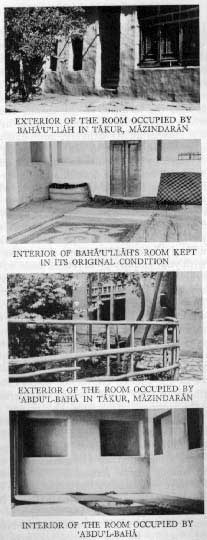 On being informed, upon their arrival in Takur, that Baha'u'llah
had departed for His winter resort, the representatives
of Mulla Muhammad decided to leave for that place. When
they arrived, they found Baha'u'llah engaged in revealing a
commentary on the opening Surih of the Qur'an, entitled
"The Seven Verses of Repetition." As they sat and listened
to His discourse, the loftiness of the theme, the persuasive
eloquence which characterised its presentation, as well as the
extraordinary manner of its delivery, profoundly impressed
them. Mulla Abbas, unable to contain himself, arose from
his seat and, urged by an impulse he could not resist, walked
back and stood still beside the door in an attitude of reverent
submissiveness. The charm of the discourse to which he was
listening had fascinated him. "You behold my condition,"
he told his companion as he stood trembling with emotion
and with eyes full of tears. "I am powerless to question
Baha'u'llah. The questions I had planned to ask Him have
vanished suddenly from my memory. You are free either
to proceed with your enquiry or to return alone to our teacher
and inform him of the state in which I find myself. Tell
him from me that Abbas can never again return to him.
He can no longer forsake this threshold." Mirza Abu'l-Qasim
was likewise moved to follow the example of his companion.
"I have ceased to recognise my teacher," was his reply. "This
very moment, I have vowed to God to dedicate the remaining
days of my life to the service of Baha'u'llah, my true and
only Master."
The news of the sudden conversion of the chosen envoys
of the mujtahid of Nur spread with bewildering rapidity
throughout the district. It roused the people from their
lethargy. Ecclesiastical dignitaries, State officials, traders,
and peasants all flocked to the residence of Baha'u'llah. A
considerable number among them willingly espoused His
Cause. In their admiration for Him, a number of the most
distinguished among them remarked: "We see how the
people of Nur have risen and rallied round you. We witness
on every side evidences of their exultation. If Mulla Muhammad
were also to join them, the triumph of this Faith
would be completely assured." "I am come to Nur," Baha'u'llah
replied, "solely for the purpose of proclaiming the
Desirous of giving effect to His words, Baha'u'llah, accompanied
by a number of His companions, proceeded immediately
to that village. Mulla Muhammad most ceremoniously
received Him. "I have not come to this place,"
Baha'u'llah observed, "to pay you an official or formal visit.
My purpose is to enlighten you regarding a new and wondrous
Message, divinely inspired and fulfilling the promise given to
Islam. Whosoever has inclined his ear to this Message has
felt its irresistible power, and has been transformed by the
potency of its grace. Tell Me whatsoever perplexes your
mind, or hinders you from recognising the Truth." Mulla
Muhammad disparagingly remarked: "I undertake no action
unless I first consult the Qur'an. I have invariably, on such
occasions, followed the practice of invoking the aid of God
and His blessings; of opening at random His sacred Book,
and of consulting the first verse of the particular page upon
which my eyes chance to fall. From the nature of that
verse I can judge the wisdom and the advisability of my
contemplated course of action." Finding that Baha'u'llah
was not inclined to refuse him his request, the mujtahid called
for a copy of the Qur'an, opened and closed it again, refusing
to reveal the nature of the verse to those who were present.
All he said was this: "I have consulted the Book of God, and
deem it inadvisable to proceed further with this matter."
A few agreed with him; the rest, for the most part, did not
fail to recognise the fear which those words implied. Baha'u'llah,
disinclined to cause him further embarrassment, arose
and, asking to be excused, bade him a cordial farewell.
One day, in the course of one of His riding excursions into
the country, Baha'u'llah, accompanied by His companions,
saw, seated by Me roadside, a lonely youth. His hair was
dishevelled, and he wore the dress of a dervish. By the side
of a brook he had kindled a fire, and was cooking his food
Baha'u'llah's visit to Nur had produced the most far-reaching
results, and had lent a remarkable impetus to the
spread of the new-born Revelation. By His magnetic eloquence,
by the purity of His life, by the dignity of His bearing,
by the unanswerable logic of His argument, and by the many
evidences of His loving-kindness, Baha'u'llah had won the
hearts of the people of Nur, had stirred their souls, and had
enrolled them under the standard of the Faith. Such was
the effect of words and deeds, as He went about preaching
the Cause and revealing its glory to His countrymen in Nur,
that the very stones and trees of that district seemed to have
When Baha'u'llah was still a child, the Vazir, His father,
dreamed a dream. Baha'u'llah appeared to him swimming
in a vast, limitless ocean. His body shone upon the waters
with a radiance that illumined the sea. Around His head,
which could distinctly be seen above the waters, there radiated,
in all directions, His long, jet-black locks, floating in
great profusion above the waves. As he dreamed, a multitude
of fishes gathered round Him, each holding fast to the
extremity of one hair. Fascinated by the effulgence of His
face, they followed Him in whatever direction He swam.
Great as was their number, and however firmly they clung
to His locks, not one single hair seemed to have been detached
from His head, nor did the least injury affect His
person. Free and unrestrained, He moved above the waters
and they all followed Him.
The Vazir, greatly impressed by this dream, summoned
a soothsayer, who had achieved fame in that region, and
asked him to interpret it for him. This man, as if inspired
by a premonition of the future glory of Baha'u'llah, declared:
"The limitless ocean that you have seen in your dream, O
That soothsayer was subsequently taken to see Baha'u'llah.
He looked intently upon His face, and examined carefully
His features. He was charmed by His appearance, and
extolled every trait of His countenance. Every expression
in that face revealed to his eyes a sign of His concealed glory.
So great was his admiration, and so profuse his praise of
Baha'u'llah, that the Vazir, from that day, became even
more passionately devoted to his son. The words spoken by
that soothsayer served to fortify his hopes and confidence
in Him. Like Jacob, he desired only to ensure the welfare
of his beloved Joseph, and to surround Him with his loving
protection.
Haji Mirza Aqasi, the Grand Vazir of Muhammad Shah,
though completely alienated from Baha'u'llah's father, showed
his son every mark of consideration and favour. So great
was the esteem which the Haji professed for Him, that Mirza
Aqa Khan-i-Nuri, the I'timadu'd-Dawlih, who afterwards
succeeded Haji Mirza Aqasi, felt envious. He resented the
superiority which Baha'u'llah, as a mere youth, was accorded
over him. The seeds of jealousy were, from that time, implanted
in his breast. Though still a youth, and while his
father is yet alive, he thought, he is given precedence in the
presence of the Grand Vazir. What will, I wonder, happen
to me when this young man shall have succeeded his father?
After the death of the Vazir, Haji Mirza Aqasi continued
to show the utmost consideration to Baha'u'llah. He would
visit Him in His home, and would address Him as though
He were his own son. The sincerity of his devotion, however,
was very soon put to the test. One day, as he was passing
through the village of Quch-Hisar, which belonged to Baha'u'llah,
On a number of other occasions, Baha'u'llah's ascendancy
over His opponents was likewise vindicated and recognised.
These personal triumphs achieved by Him served to enhance
His position, and spread abroad His fame. All classes of
men marvelled at His miraculous success in emerging unscathed
from the most perilous encounters. Nothing short
of Divine protection, they thought, could have ensured His
safety on such occasions. Not once did Baha'u'llah, beset
though He was by the gravest perils, submit to the arrogance,
the greed, and the treachery of those around Him. In His
constant association, during those days, with the highest
dignitaries of the realm, whether ecclesiastical or State officials,
He was never content simply to accede to the views
they expressed or the claims they advanced. He would, at
their gatherings, fearlessly champion the cause of truth,
would assert the rights of the downtrodden, defending the
weak and protecting the innocent.
On being informed, upon their arrival in Takur, that Baha'u'llah
had departed for His winter resort, the representatives
of Mulla Muhammad decided to leave for that place. When
they arrived, they found Baha'u'llah engaged in revealing a
commentary on the opening Surih of the Qur'an, entitled
"The Seven Verses of Repetition." As they sat and listened
to His discourse, the loftiness of the theme, the persuasive
eloquence which characterised its presentation, as well as the
extraordinary manner of its delivery, profoundly impressed
them. Mulla Abbas, unable to contain himself, arose from
his seat and, urged by an impulse he could not resist, walked
back and stood still beside the door in an attitude of reverent
submissiveness. The charm of the discourse to which he was
listening had fascinated him. "You behold my condition,"
he told his companion as he stood trembling with emotion
and with eyes full of tears. "I am powerless to question
Baha'u'llah. The questions I had planned to ask Him have
vanished suddenly from my memory. You are free either
to proceed with your enquiry or to return alone to our teacher
and inform him of the state in which I find myself. Tell
him from me that Abbas can never again return to him.
He can no longer forsake this threshold." Mirza Abu'l-Qasim
was likewise moved to follow the example of his companion.
"I have ceased to recognise my teacher," was his reply. "This
very moment, I have vowed to God to dedicate the remaining
days of my life to the service of Baha'u'llah, my true and
only Master."
The news of the sudden conversion of the chosen envoys
of the mujtahid of Nur spread with bewildering rapidity
throughout the district. It roused the people from their
lethargy. Ecclesiastical dignitaries, State officials, traders,
and peasants all flocked to the residence of Baha'u'llah. A
considerable number among them willingly espoused His
Cause. In their admiration for Him, a number of the most
distinguished among them remarked: "We see how the
people of Nur have risen and rallied round you. We witness
on every side evidences of their exultation. If Mulla Muhammad
were also to join them, the triumph of this Faith
would be completely assured." "I am come to Nur," Baha'u'llah
replied, "solely for the purpose of proclaiming the
Desirous of giving effect to His words, Baha'u'llah, accompanied
by a number of His companions, proceeded immediately
to that village. Mulla Muhammad most ceremoniously
received Him. "I have not come to this place,"
Baha'u'llah observed, "to pay you an official or formal visit.
My purpose is to enlighten you regarding a new and wondrous
Message, divinely inspired and fulfilling the promise given to
Islam. Whosoever has inclined his ear to this Message has
felt its irresistible power, and has been transformed by the
potency of its grace. Tell Me whatsoever perplexes your
mind, or hinders you from recognising the Truth." Mulla
Muhammad disparagingly remarked: "I undertake no action
unless I first consult the Qur'an. I have invariably, on such
occasions, followed the practice of invoking the aid of God
and His blessings; of opening at random His sacred Book,
and of consulting the first verse of the particular page upon
which my eyes chance to fall. From the nature of that
verse I can judge the wisdom and the advisability of my
contemplated course of action." Finding that Baha'u'llah
was not inclined to refuse him his request, the mujtahid called
for a copy of the Qur'an, opened and closed it again, refusing
to reveal the nature of the verse to those who were present.
All he said was this: "I have consulted the Book of God, and
deem it inadvisable to proceed further with this matter."
A few agreed with him; the rest, for the most part, did not
fail to recognise the fear which those words implied. Baha'u'llah,
disinclined to cause him further embarrassment, arose
and, asking to be excused, bade him a cordial farewell.
One day, in the course of one of His riding excursions into
the country, Baha'u'llah, accompanied by His companions,
saw, seated by Me roadside, a lonely youth. His hair was
dishevelled, and he wore the dress of a dervish. By the side
of a brook he had kindled a fire, and was cooking his food
Baha'u'llah's visit to Nur had produced the most far-reaching
results, and had lent a remarkable impetus to the
spread of the new-born Revelation. By His magnetic eloquence,
by the purity of His life, by the dignity of His bearing,
by the unanswerable logic of His argument, and by the many
evidences of His loving-kindness, Baha'u'llah had won the
hearts of the people of Nur, had stirred their souls, and had
enrolled them under the standard of the Faith. Such was
the effect of words and deeds, as He went about preaching
the Cause and revealing its glory to His countrymen in Nur,
that the very stones and trees of that district seemed to have
When Baha'u'llah was still a child, the Vazir, His father,
dreamed a dream. Baha'u'llah appeared to him swimming
in a vast, limitless ocean. His body shone upon the waters
with a radiance that illumined the sea. Around His head,
which could distinctly be seen above the waters, there radiated,
in all directions, His long, jet-black locks, floating in
great profusion above the waves. As he dreamed, a multitude
of fishes gathered round Him, each holding fast to the
extremity of one hair. Fascinated by the effulgence of His
face, they followed Him in whatever direction He swam.
Great as was their number, and however firmly they clung
to His locks, not one single hair seemed to have been detached
from His head, nor did the least injury affect His
person. Free and unrestrained, He moved above the waters
and they all followed Him.
The Vazir, greatly impressed by this dream, summoned
a soothsayer, who had achieved fame in that region, and
asked him to interpret it for him. This man, as if inspired
by a premonition of the future glory of Baha'u'llah, declared:
"The limitless ocean that you have seen in your dream, O
That soothsayer was subsequently taken to see Baha'u'llah.
He looked intently upon His face, and examined carefully
His features. He was charmed by His appearance, and
extolled every trait of His countenance. Every expression
in that face revealed to his eyes a sign of His concealed glory.
So great was his admiration, and so profuse his praise of
Baha'u'llah, that the Vazir, from that day, became even
more passionately devoted to his son. The words spoken by
that soothsayer served to fortify his hopes and confidence
in Him. Like Jacob, he desired only to ensure the welfare
of his beloved Joseph, and to surround Him with his loving
protection.
Haji Mirza Aqasi, the Grand Vazir of Muhammad Shah,
though completely alienated from Baha'u'llah's father, showed
his son every mark of consideration and favour. So great
was the esteem which the Haji professed for Him, that Mirza
Aqa Khan-i-Nuri, the I'timadu'd-Dawlih, who afterwards
succeeded Haji Mirza Aqasi, felt envious. He resented the
superiority which Baha'u'llah, as a mere youth, was accorded
over him. The seeds of jealousy were, from that time, implanted
in his breast. Though still a youth, and while his
father is yet alive, he thought, he is given precedence in the
presence of the Grand Vazir. What will, I wonder, happen
to me when this young man shall have succeeded his father?
After the death of the Vazir, Haji Mirza Aqasi continued
to show the utmost consideration to Baha'u'llah. He would
visit Him in His home, and would address Him as though
He were his own son. The sincerity of his devotion, however,
was very soon put to the test. One day, as he was passing
through the village of Quch-Hisar, which belonged to Baha'u'llah,
On a number of other occasions, Baha'u'llah's ascendancy
over His opponents was likewise vindicated and recognised.
These personal triumphs achieved by Him served to enhance
His position, and spread abroad His fame. All classes of
men marvelled at His miraculous success in emerging unscathed
from the most perilous encounters. Nothing short
of Divine protection, they thought, could have ensured His
safety on such occasions. Not once did Baha'u'llah, beset
though He was by the gravest perils, submit to the arrogance,
the greed, and the treachery of those around Him. In His
constant association, during those days, with the highest
dignitaries of the realm, whether ecclesiastical or State officials,
He was never content simply to accede to the views
they expressed or the claims they advanced. He would, at
their gatherings, fearlessly champion the cause of truth,
would assert the rights of the downtrodden, defending the
weak and protecting the innocent.


|