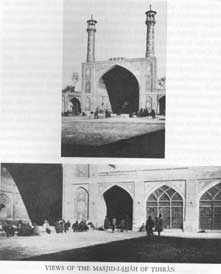

 HE news of the tragic fate which had befallen the
heroes of Tabarsi brought immeasurable sorrow
to the heart of the Bab. Confined it His prison-castle
of Chihriq, severed from the little band of
His struggling disciples, He watched with keen anxiety the
progress of their labours and prayed with unremitting zeal
for their victory. How great was His sorrow when, in the
early days of Sha'ban in the year 1265 A.H.,
(1) He came to
learn of the trials that had beset their path, of the agony they
had suffered, of the betrayal to which an exasperated enemy
had felt compelled to resort, and of the abominable butchery
with which their career had ended.
"The Bab was heart-broken," His
amanuensis, Siyyid
Husayn-i-'Aziz, subsequently related, "at the receipt of this
unexpected intelligence. He was crushed with grief, a grief
that stilled His voice and silenced His pen. For nine days
He refused to meet any of His friends. I myself, though His
close and constant attendant, was refused admittance. Whatever
meat or drink we offered Him, He was disinclined to
touch. Tears rained continually from His eyes, and expressions
of anguish dropped unceasingly from His lips.
I could hear Him, from behind the curtain, give vent to His
feelings of sadness as He communed, in the privacy of His
cell, with His Beloved. I attempted to jot down the effusions
of His sorrow as they poured forth from His wounded heart.
Suspecting that I was attempting to preserve the lamentations
He uttered, He bade me destroy whatever I had recorded.
Nothing remains of the moans and cries with which
that heavy-laden heart sought to relieve itself of the pangs
that had seized it. For a period of five months He languished,
immersed in an ocean of despondency and sorrow."
With the advent of Muharram in the year
1266 A.H.,(1)
the Bab again resumed the work He had been compelled to
interrupt. The first page He wrote was dedicated to the
memory of Mulla Husayn. In the visiting Tablet revealed
in his honour, He extolled, in moving terms, the unswerving
fidelity with which he served Quddus throughout the siege
of the fort of Tabarsi. He lavished His eulogies on his magnanimous
conduct, recounted his exploits, and asserted his
undoubted reunion in the world beyond with the leader whom
he had so nobly served. He too, He wrote, would soon join
those twin immortals, each of whom had, by his life and
death, shed imperishable lustre on the Faith of God. For one
whole week the Bab continued to write His praises of Quddus,
of Mulla Husayn, and of His other companions who had
gained the crown of martyrdom at Tabarsi.
No sooner had He completed His
eulogies of those who
had immortalised their names in the defence of the fort,
than He summoned, on the day of Ashura,
(2)Mulla Adi-Guzal,
(3)
one of the believers of Maraghih, who for the last
two months had been acting as His attendant instead of
Siyyid Hasan, the brother of Siyyid Husayn-i-'Aziz. He
affectionately received him, bestowed upon him the name
Sayyah, entrusted to his care the visiting Tablets He had
revealed in memory of the martyrs of Tabarsi, and bade him
perform, on His behalf, a pilgrimage to that spot. "Arise,"
He urged him, "and with complete detachment proceed, in
the guise of a traveller, to Mazindaran, and there visit, on
My behalf, the spot which enshrines the bodies of those immortals
who, with their blood, have sealed their faith in My
Cause. As you approach the precincts of that hallowed
ground, put off your shoes and, bowing your head in reverence
to their memory, invoke their names and prayerfully
make the circuit of their shrine. Bring back to Me, as a
remembrance of your visit, a handful of that holy earth which
covers the remains of My beloved ones, Quddus and Mulla
Faithful to the instructions he had
received, Sayyah set
out on his pilgrimage to Mazindaran. He reached his destination
on the first day of Rabi'u'l-Avval in the year 1266
A.H.,(1) and by the ninth day
of that same month,(2) the first
anniversary of the martyrdom of Mulla Husayn, he had
performed his visit and acquitted himself of the mission with
which he had been entrusted. From thence he proceeded
to Tihran.
I have heard Aqay-i-Kalim, who received
Sayyah at the
entrance of Baha'u'llah's home in Tihran, relate the following:
"It was the depth of winter when Sayyah, returning from his
pilgrimage, came to visit Baha'u'llah. Despite the cold and
snow of a rigorous winter, he appeared attired in the garb
of a dervish, poorly clad, barefooted, and dishevelled. His
heart was set afire with the flame that pilgrimage had kindled.
No sooner had Siyyid Yahyay-i-Darabi, surnamed Vahid,
who was then a guest in the home of Baha'u'llah, been informed
of the return of Sayyah from the fort of Tabarsi,
than he, oblivious of the pomp and circumstance to which
a man of his position had been accustomed, rushed forward
and flung himself at the feet of the pilgrim. Holding his legs,
which had been covered with mud to the knees, in his arms,
he kissed them devoutly. I was amazed that day at the many
evidences of loving solicitude which Baha'u'llah evinced
towards Vahid. He showed him such favours as I had never
seen Him extend to anyone. The manner of His conversation
left no doubt in me that this same Vahid would ere long distinguish
himself by deeds no less remarkable than those which had
immortalised the defenders of the fort of Tabarsi."
Sayyah tarried a few days in that home.
He was, however,
unable to perceive, as did Vahid, the nature of that
power which lay latent in his Host. Though himself the recipient
of the utmost favour from Baha'u'llah, he failed to
apprehend the significance of the blessings that were being
showered upon him. I have heard him recount his experiences,
during his sojourn in Famagusta: "Baha'u'llah overwhelmed
Ere the departure of Sayyah from Tihran,
Baha'u'llah
entrusted him with an epistle, the text of which He had
dictated to Mirza Yahya,(1) and
sent it in his name. Shortly
after, a reply, penned in the Bab's own handwriting, in
which He commits Mirza Yahya to the care of Baha'u'llah
and urges that attention be paid to his education and training,
was received. That communication the people of the
Bayan(2) have misconstrued as
an evidence of the exaggerated
claims(3) which they have
advanced in favour of their leader.
Although the text of that reply is absolutely devoid of such
pretensions, and does not, beyond the praise it bestows upon
Baha'u'llah and the request it makes for the upbringing of
Mirza Yahya, contain any reference to his alleged position,
yet his followers have idly imagined that that letter constitutes
an assertion of the authority with which they have
invested him.(4)
At this stage of my narrative, when I
have already recounted
the outstanding events that occurred in the course
My father oftentimes took me with him to
Qum, where
I became acquainted with the teachings of Islam and the
ways and manners of its leaders. He was a devout follower
of that Faith, and was closely associated with the ecclesiastical
leaders who congregated in that city. I watched him as he
prayed at the Masjid-i-Imam-Hasan and performed, with
scrupulous care and extreme piety, all the rites and ceremonies
prescribed by his Faith. I heard the preaching of several
eminent mujtahids who had arrived from Najaf, attended
their lectures, and listened to their disputations. Gradually
I came to perceive their insincerity and to loathe the baseness
of their character. Eager as I was to ascertain the trustworthiness
of the creeds and dogmas which they strove to
impose upon me, I could neither find the time nor obtain the
I was in the village of Rubat-Karim, on a
visit to my
maternal uncle, when, on the twelfth day after Naw-Ruz,
in the year 1263 A.H.,(1) I
accidentally overheard, in the masjid
of that village, a conversation between two men which first
made me acquainted with the Revelation of the Bab. "Have
you heard," one of them remarked, "that the Siyyid-i-Bab
has been conducted to the village of Kinar-Gird and is on his
way to Tihran?" Finding his friend ignorant of that episode,
he proceeded to relate the whole story of the Bab, giving a
detailed account of the circumstances attending His Declaration,
of His arrest in Shiraz, His departure for Isfahan, the
reception which both the Imam-Jum'ih and Manuchihr
Khan had extended to Him, the prodigies and wonders He
had manifested, and the verdict that the ulamas of Isfahan
had pronounced against Him. Every detail of that story
excited my curiosity and stirred in me a keen admiration for
a Man who could throw such a spell over His countrymen.
His light seemed to have flooded my soul; I felt as if I were
already a convert to His Cause.
From Rubat-Karim I returned to Zarand.
My father
remarked Upon my restlessness, and expressed his surprise
at my behaviour. I had lost my appetite and sleep, and was
determined to conceal the secret of my inner agitation from
my father, lest its disclosure might interfere with the eventual
realisation of my hopes. I remained in that state until a
certain Siyyid Husayn-i-Zavari'i arrived at Zarand and was
able to enlighten me on a subject which had become the
ruling passion of my life. Our acquaintance speedily ripened
into a friendship which encouraged me to share with him the
longings of my heart. To my great surprise, I found him
already enthralled by the secret of the theme which I had
begun to disclose to him. "One of my cousins," he proceeded
to relate, "Siyyid Isma'il-i-Zavari'i by name, convinced me
of the truth of the Message proclaimed by the Siyyid-i-Bab.
The story which this Siyyid Husayn-i-Zavari'i related to
me served to allay my agitation. He shared with me the copy
of the "Risaliy-i-'Adliyyih" he had brought with him, the
reading of which imparted strength and refreshment to my
soul. In those days I was a pupil of a siyyid who taught me
the Qur'an and whose incapacity to enlighten me on the
tenets of his Faith became more and more evident in my
eyes. Siyyid Husayn, whom I asked for further information
about the Cause, advised me to meet Siyyid Isma'il-i-Zavari'i,
whose invariable practice it was to visit, every spring, the
shrines of the
imam-zadihs(1) of Qum. I induced my father,
who was reluctant to separate himself from me, to send me
to that city with the object of perfecting my knowledge of
the Arabic language. I was careful to conceal from him my
real purpose, fearing that its disclosure might involve him
in embarrassments with the
Qadi(2) and the ulamas of Zarand
and prevent me from achieving my end.
While I was in Qum, my mother, my
sister, and my
brother came to visit me in connection with the festival of
Naw-Ruz, and stayed with me for about a month. In the
course of their visit, I was able to enlighten my mother and
my sister about the new Revelation, and succeeded in kindling
in their hearts the love of its Author. A few days after their
return to Zarand, Siyyid Isma'il, whom I impatiently awaited,
arrived, and was able, in the course of his discussions with
me, to set forth in detail all that was required to win me over
completely to the Cause. He laid stress on the continuity of
Divine Revelation, asserted the fundamental oneness of the
Prophets of the past, and explained their close relationship
I waited in vain for that message, and,
finding that no
word came from him, decided to leave for the capital. My
friend Mirza Fathu'llah subsequently followed me. He was
eventually arrested and shared the fate of those who were
put to death in the year 1268 A.H.
(1) as a result of the attempt
on the life or the Shah. Arriving in Tihran, I proceeded directly
to the Masjid-i-Shah, which was opposite a madrisih,
(2)
at the entrance of which I, later on, unexpectedly encountered
Siyyid Isma'il-i-Zavari'i, who hastened to inform me that
he had just written me the letter and was on the point of
despatching it to Qum.
We were preparing ourselves to leave for
Mazindaran,
when the news reached us that the defenders of the fort of
Tabarsi had been treacherously slaughtered and that the
fort itself had been levelled with the ground. We were filled
with distress at the receipt of the appalling news, and mourned
the tragic fate of those who had so heroically defended their
beloved Cause. One day I unexpectedly came across my
maternal uncle, Naw-Ruz-'Ali, who had come on purpose to
fetch me. I informed Siyyid Isma'il, who advised me to leave
for Zarand and not to arouse further hostility on the part
of those who insisted upon my return.
On my arrival at my native village, I was
able to win
over my brother to the Cause, which my mother and my
sister had already embraced. I also succeeded in inducing
my father to allow me to leave again for Tihran. I took up
my residence in the same madrisih where I had been accommodated
on my previous visit, and there met a certain
Mulla Abdu'l-Karim, whom, I subsequently learned, Baha'u'llah
had named Mirza Ahmad. He affectionately received
me and told me that Siyyid Isma'il had entrusted me to his
care and wished me to remain in his company until the
former's return to Tihran. The days of my companionship
with Mirza Ahmad will never be forgotten. I found him
Through him I was introduced to the
disciples of the
Bab, with whom I associated and from whom I obtained
fuller information regarding the teachings of the Faith.
Mirza Ahmad was in those days earning his livelihood as a
scribe, and devoted his evenings to copying the Persian
Bayan and other writings of the Bab. The copies which he
so devotedly prepared were given by him as gifts to his fellow-disciples.
I myself was several times the bearer of such
HE news of the tragic fate which had befallen the
heroes of Tabarsi brought immeasurable sorrow
to the heart of the Bab. Confined it His prison-castle
of Chihriq, severed from the little band of
His struggling disciples, He watched with keen anxiety the
progress of their labours and prayed with unremitting zeal
for their victory. How great was His sorrow when, in the
early days of Sha'ban in the year 1265 A.H.,
(1) He came to
learn of the trials that had beset their path, of the agony they
had suffered, of the betrayal to which an exasperated enemy
had felt compelled to resort, and of the abominable butchery
with which their career had ended.
"The Bab was heart-broken," His
amanuensis, Siyyid
Husayn-i-'Aziz, subsequently related, "at the receipt of this
unexpected intelligence. He was crushed with grief, a grief
that stilled His voice and silenced His pen. For nine days
He refused to meet any of His friends. I myself, though His
close and constant attendant, was refused admittance. Whatever
meat or drink we offered Him, He was disinclined to
touch. Tears rained continually from His eyes, and expressions
of anguish dropped unceasingly from His lips.
I could hear Him, from behind the curtain, give vent to His
feelings of sadness as He communed, in the privacy of His
cell, with His Beloved. I attempted to jot down the effusions
of His sorrow as they poured forth from His wounded heart.
Suspecting that I was attempting to preserve the lamentations
He uttered, He bade me destroy whatever I had recorded.
Nothing remains of the moans and cries with which
that heavy-laden heart sought to relieve itself of the pangs
that had seized it. For a period of five months He languished,
immersed in an ocean of despondency and sorrow."
With the advent of Muharram in the year
1266 A.H.,(1)
the Bab again resumed the work He had been compelled to
interrupt. The first page He wrote was dedicated to the
memory of Mulla Husayn. In the visiting Tablet revealed
in his honour, He extolled, in moving terms, the unswerving
fidelity with which he served Quddus throughout the siege
of the fort of Tabarsi. He lavished His eulogies on his magnanimous
conduct, recounted his exploits, and asserted his
undoubted reunion in the world beyond with the leader whom
he had so nobly served. He too, He wrote, would soon join
those twin immortals, each of whom had, by his life and
death, shed imperishable lustre on the Faith of God. For one
whole week the Bab continued to write His praises of Quddus,
of Mulla Husayn, and of His other companions who had
gained the crown of martyrdom at Tabarsi.
No sooner had He completed His
eulogies of those who
had immortalised their names in the defence of the fort,
than He summoned, on the day of Ashura,
(2)Mulla Adi-Guzal,
(3)
one of the believers of Maraghih, who for the last
two months had been acting as His attendant instead of
Siyyid Hasan, the brother of Siyyid Husayn-i-'Aziz. He
affectionately received him, bestowed upon him the name
Sayyah, entrusted to his care the visiting Tablets He had
revealed in memory of the martyrs of Tabarsi, and bade him
perform, on His behalf, a pilgrimage to that spot. "Arise,"
He urged him, "and with complete detachment proceed, in
the guise of a traveller, to Mazindaran, and there visit, on
My behalf, the spot which enshrines the bodies of those immortals
who, with their blood, have sealed their faith in My
Cause. As you approach the precincts of that hallowed
ground, put off your shoes and, bowing your head in reverence
to their memory, invoke their names and prayerfully
make the circuit of their shrine. Bring back to Me, as a
remembrance of your visit, a handful of that holy earth which
covers the remains of My beloved ones, Quddus and Mulla
Faithful to the instructions he had
received, Sayyah set
out on his pilgrimage to Mazindaran. He reached his destination
on the first day of Rabi'u'l-Avval in the year 1266
A.H.,(1) and by the ninth day
of that same month,(2) the first
anniversary of the martyrdom of Mulla Husayn, he had
performed his visit and acquitted himself of the mission with
which he had been entrusted. From thence he proceeded
to Tihran.
I have heard Aqay-i-Kalim, who received
Sayyah at the
entrance of Baha'u'llah's home in Tihran, relate the following:
"It was the depth of winter when Sayyah, returning from his
pilgrimage, came to visit Baha'u'llah. Despite the cold and
snow of a rigorous winter, he appeared attired in the garb
of a dervish, poorly clad, barefooted, and dishevelled. His
heart was set afire with the flame that pilgrimage had kindled.
No sooner had Siyyid Yahyay-i-Darabi, surnamed Vahid,
who was then a guest in the home of Baha'u'llah, been informed
of the return of Sayyah from the fort of Tabarsi,
than he, oblivious of the pomp and circumstance to which
a man of his position had been accustomed, rushed forward
and flung himself at the feet of the pilgrim. Holding his legs,
which had been covered with mud to the knees, in his arms,
he kissed them devoutly. I was amazed that day at the many
evidences of loving solicitude which Baha'u'llah evinced
towards Vahid. He showed him such favours as I had never
seen Him extend to anyone. The manner of His conversation
left no doubt in me that this same Vahid would ere long distinguish
himself by deeds no less remarkable than those which had
immortalised the defenders of the fort of Tabarsi."
Sayyah tarried a few days in that home.
He was, however,
unable to perceive, as did Vahid, the nature of that
power which lay latent in his Host. Though himself the recipient
of the utmost favour from Baha'u'llah, he failed to
apprehend the significance of the blessings that were being
showered upon him. I have heard him recount his experiences,
during his sojourn in Famagusta: "Baha'u'llah overwhelmed
Ere the departure of Sayyah from Tihran,
Baha'u'llah
entrusted him with an epistle, the text of which He had
dictated to Mirza Yahya,(1) and
sent it in his name. Shortly
after, a reply, penned in the Bab's own handwriting, in
which He commits Mirza Yahya to the care of Baha'u'llah
and urges that attention be paid to his education and training,
was received. That communication the people of the
Bayan(2) have misconstrued as
an evidence of the exaggerated
claims(3) which they have
advanced in favour of their leader.
Although the text of that reply is absolutely devoid of such
pretensions, and does not, beyond the praise it bestows upon
Baha'u'llah and the request it makes for the upbringing of
Mirza Yahya, contain any reference to his alleged position,
yet his followers have idly imagined that that letter constitutes
an assertion of the authority with which they have
invested him.(4)
At this stage of my narrative, when I
have already recounted
the outstanding events that occurred in the course
My father oftentimes took me with him to
Qum, where
I became acquainted with the teachings of Islam and the
ways and manners of its leaders. He was a devout follower
of that Faith, and was closely associated with the ecclesiastical
leaders who congregated in that city. I watched him as he
prayed at the Masjid-i-Imam-Hasan and performed, with
scrupulous care and extreme piety, all the rites and ceremonies
prescribed by his Faith. I heard the preaching of several
eminent mujtahids who had arrived from Najaf, attended
their lectures, and listened to their disputations. Gradually
I came to perceive their insincerity and to loathe the baseness
of their character. Eager as I was to ascertain the trustworthiness
of the creeds and dogmas which they strove to
impose upon me, I could neither find the time nor obtain the
I was in the village of Rubat-Karim, on a
visit to my
maternal uncle, when, on the twelfth day after Naw-Ruz,
in the year 1263 A.H.,(1) I
accidentally overheard, in the masjid
of that village, a conversation between two men which first
made me acquainted with the Revelation of the Bab. "Have
you heard," one of them remarked, "that the Siyyid-i-Bab
has been conducted to the village of Kinar-Gird and is on his
way to Tihran?" Finding his friend ignorant of that episode,
he proceeded to relate the whole story of the Bab, giving a
detailed account of the circumstances attending His Declaration,
of His arrest in Shiraz, His departure for Isfahan, the
reception which both the Imam-Jum'ih and Manuchihr
Khan had extended to Him, the prodigies and wonders He
had manifested, and the verdict that the ulamas of Isfahan
had pronounced against Him. Every detail of that story
excited my curiosity and stirred in me a keen admiration for
a Man who could throw such a spell over His countrymen.
His light seemed to have flooded my soul; I felt as if I were
already a convert to His Cause.
From Rubat-Karim I returned to Zarand.
My father
remarked Upon my restlessness, and expressed his surprise
at my behaviour. I had lost my appetite and sleep, and was
determined to conceal the secret of my inner agitation from
my father, lest its disclosure might interfere with the eventual
realisation of my hopes. I remained in that state until a
certain Siyyid Husayn-i-Zavari'i arrived at Zarand and was
able to enlighten me on a subject which had become the
ruling passion of my life. Our acquaintance speedily ripened
into a friendship which encouraged me to share with him the
longings of my heart. To my great surprise, I found him
already enthralled by the secret of the theme which I had
begun to disclose to him. "One of my cousins," he proceeded
to relate, "Siyyid Isma'il-i-Zavari'i by name, convinced me
of the truth of the Message proclaimed by the Siyyid-i-Bab.
The story which this Siyyid Husayn-i-Zavari'i related to
me served to allay my agitation. He shared with me the copy
of the "Risaliy-i-'Adliyyih" he had brought with him, the
reading of which imparted strength and refreshment to my
soul. In those days I was a pupil of a siyyid who taught me
the Qur'an and whose incapacity to enlighten me on the
tenets of his Faith became more and more evident in my
eyes. Siyyid Husayn, whom I asked for further information
about the Cause, advised me to meet Siyyid Isma'il-i-Zavari'i,
whose invariable practice it was to visit, every spring, the
shrines of the
imam-zadihs(1) of Qum. I induced my father,
who was reluctant to separate himself from me, to send me
to that city with the object of perfecting my knowledge of
the Arabic language. I was careful to conceal from him my
real purpose, fearing that its disclosure might involve him
in embarrassments with the
Qadi(2) and the ulamas of Zarand
and prevent me from achieving my end.
While I was in Qum, my mother, my
sister, and my
brother came to visit me in connection with the festival of
Naw-Ruz, and stayed with me for about a month. In the
course of their visit, I was able to enlighten my mother and
my sister about the new Revelation, and succeeded in kindling
in their hearts the love of its Author. A few days after their
return to Zarand, Siyyid Isma'il, whom I impatiently awaited,
arrived, and was able, in the course of his discussions with
me, to set forth in detail all that was required to win me over
completely to the Cause. He laid stress on the continuity of
Divine Revelation, asserted the fundamental oneness of the
Prophets of the past, and explained their close relationship
I waited in vain for that message, and,
finding that no
word came from him, decided to leave for the capital. My
friend Mirza Fathu'llah subsequently followed me. He was
eventually arrested and shared the fate of those who were
put to death in the year 1268 A.H.
(1) as a result of the attempt
on the life or the Shah. Arriving in Tihran, I proceeded directly
to the Masjid-i-Shah, which was opposite a madrisih,
(2)
at the entrance of which I, later on, unexpectedly encountered
Siyyid Isma'il-i-Zavari'i, who hastened to inform me that
he had just written me the letter and was on the point of
despatching it to Qum.
We were preparing ourselves to leave for
Mazindaran,
when the news reached us that the defenders of the fort of
Tabarsi had been treacherously slaughtered and that the
fort itself had been levelled with the ground. We were filled
with distress at the receipt of the appalling news, and mourned
the tragic fate of those who had so heroically defended their
beloved Cause. One day I unexpectedly came across my
maternal uncle, Naw-Ruz-'Ali, who had come on purpose to
fetch me. I informed Siyyid Isma'il, who advised me to leave
for Zarand and not to arouse further hostility on the part
of those who insisted upon my return.
On my arrival at my native village, I was
able to win
over my brother to the Cause, which my mother and my
sister had already embraced. I also succeeded in inducing
my father to allow me to leave again for Tihran. I took up
my residence in the same madrisih where I had been accommodated
on my previous visit, and there met a certain
Mulla Abdu'l-Karim, whom, I subsequently learned, Baha'u'llah
had named Mirza Ahmad. He affectionately received
me and told me that Siyyid Isma'il had entrusted me to his
care and wished me to remain in his company until the
former's return to Tihran. The days of my companionship
with Mirza Ahmad will never be forgotten. I found him
Through him I was introduced to the
disciples of the
Bab, with whom I associated and from whom I obtained
fuller information regarding the teachings of the Faith.
Mirza Ahmad was in those days earning his livelihood as a
scribe, and devoted his evenings to copying the Persian
Bayan and other writings of the Bab. The copies which he
so devotedly prepared were given by him as gifts to his fellow-disciples.
I myself was several times the bearer of such
 During those days I was informed that
Tahirih, who,
ever since the dispersal of the gathering at Badasht, had been
living in Nur, had arrived at Tihran and was confined in the
house of Mahmud Khan-i-Kalantar, where, although a prisoner,
she was treated with consideration and courtesy.
One day Mirza Ahmad conducted me to
the house of
Baha'u'llah, whose wife, the Varaqatu'l-'Ulya,
(1) the mother
of the Most Great Branch,(2)
had already healed my eyes with
an ointment which she herself had prepared and sent to me
On another occasion, when I visited that
same house, I
on the point of entering the room that Mirza Yahya
occupied, when Aqay-i-Kalim, whom I had previously met,
approached and requested me, since Isfandiyar, their servant,
had gone to market and had not yet returned, to conduct
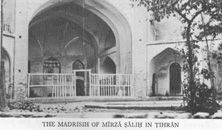
"Aqa"(1) to the Madrisiy-i-Mirza-Salih in his stead and
then return to this place. I gladly consented, and as I was
preparing to leave, I saw the Most Great Branch, a child of
exquisite beauty, wearing the
kulah(2) and cloaked in the
jubbiy-i-hizari'i,(3) emerge
from the room which His Father
occupied, and descend the steps leading to the gate of the
house. I advanced and stretched forth my arms to carry
Him. "We shall walk together," He said, as He took hold of
my hand and led me out of the house. We chatted together
as we walked hand in hand in the direction of the madrisih
known in those days by the name of Pa-Minar. As we reached
His classroom, He turned to me and said: "Come again this
afternoon and take me back to my home, for Isfandiyar is
unable to fetch me. My Father will need him to-day." I
gladly acquiesced, and returned immediately to the house
of Baha'u'llah. There again I met Mirza Yahya, who delivered
into my hands a letter which he asked me to take to the
Madrisiy-i-Sadr and hand to Baha'u'llah, whom I was
told I would find in the room occupied by Mulla Baqir-i-Bastami.
He asked me to bring back the reply immediately.
I fulfilled the commission and returned to the madrisih in
time to conduct the Most Great Branch to His home.
One day Mirza Ahmad invited me to meet
Haji Mirza
During those days I was informed that
Tahirih, who,
ever since the dispersal of the gathering at Badasht, had been
living in Nur, had arrived at Tihran and was confined in the
house of Mahmud Khan-i-Kalantar, where, although a prisoner,
she was treated with consideration and courtesy.
One day Mirza Ahmad conducted me to
the house of
Baha'u'llah, whose wife, the Varaqatu'l-'Ulya,
(1) the mother
of the Most Great Branch,(2)
had already healed my eyes with
an ointment which she herself had prepared and sent to me
On another occasion, when I visited that
same house, I
on the point of entering the room that Mirza Yahya
occupied, when Aqay-i-Kalim, whom I had previously met,
approached and requested me, since Isfandiyar, their servant,
had gone to market and had not yet returned, to conduct
"Aqa"(1) to the Madrisiy-i-Mirza-Salih in his stead and
then return to this place. I gladly consented, and as I was
preparing to leave, I saw the Most Great Branch, a child of
exquisite beauty, wearing the
kulah(2) and cloaked in the
jubbiy-i-hizari'i,(3) emerge
from the room which His Father
occupied, and descend the steps leading to the gate of the
house. I advanced and stretched forth my arms to carry
Him. "We shall walk together," He said, as He took hold of
my hand and led me out of the house. We chatted together
as we walked hand in hand in the direction of the madrisih
known in those days by the name of Pa-Minar. As we reached
His classroom, He turned to me and said: "Come again this
afternoon and take me back to my home, for Isfandiyar is
unable to fetch me. My Father will need him to-day." I
gladly acquiesced, and returned immediately to the house
of Baha'u'llah. There again I met Mirza Yahya, who delivered
into my hands a letter which he asked me to take to the
Madrisiy-i-Sadr and hand to Baha'u'llah, whom I was
told I would find in the room occupied by Mulla Baqir-i-Bastami.
He asked me to bring back the reply immediately.
I fulfilled the commission and returned to the madrisih in
time to conduct the Most Great Branch to His home.
One day Mirza Ahmad invited me to meet
Haji Mirza
 Shortly after, the stirrers-up of mischief
were able to kindle
a grave turmoil in that city. Its immediate cause was the
action of a certain siyyid from Kashan, who was living in the
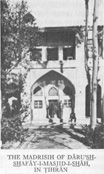
Madrisiy-i-Daru'sh-Shafa' and whom the well-known Siyyid
Muhammad had taken into his confidence and claimed to
have converted to the Bab's teachings. Mirza Muhammad-Husayn-i-Kirmani,
who lodged in that same madrisih and
who was a well-known lecturer on the metaphysical doctrines
of Islam, attempted several times to induce Siyyid Muhammad,
Shortly after, the stirrers-up of mischief
were able to kindle
a grave turmoil in that city. Its immediate cause was the
action of a certain siyyid from Kashan, who was living in the
Madrisiy-i-Daru'sh-Shafa' and whom the well-known Siyyid
Muhammad had taken into his confidence and claimed to
have converted to the Bab's teachings. Mirza Muhammad-Husayn-i-Kirmani,
who lodged in that same madrisih and
who was a well-known lecturer on the metaphysical doctrines
of Islam, attempted several times to induce Siyyid Muhammad,
 One the day they were captured, I
happened to be with
my brother and my maternal uncle, who had arrived from
Zarand and had lodged in a caravanersai outside the gate
of Naw. The next morning they departed for Zarand, and
In the meantime, Baha'u'llah had sent
from the Madrisiyi-Sadr
a message to Mirza Ahmad informing him of the
designs of the Amir-Nizam, who had, already on three different
occasions, demanded his arrest from the Imam-Jum'ih.
He was also warned that the Amir, ignoring the right of asylum
with which the masjid had been invested, intended to
arrest those who had sought refuge in that sanctuary. Mirza
Ahmad was urged to leave in disguise for Qum, and was
charged to direct me to return to my home in Zarand.
Meanwhile, my relations, who had
recognised me in the
Masjid-i-Shah, pressed me to leave for Zarand, pleading
that my father, who had been misinformed of my arrest and
impending execution, was in grave distress, and that it was
my duty to hasten and relieve him of his anxieties. Acting
on the advice of Mirza Ahmad, who counselled me to seize
this God-sent opportunity, I left for Zarand and celebrate
the Feast of Naw-Ruz with my family, a Feast that was doubly
blessed inasmuch as it coincided with the fifth day of Jamadiyu'l-Avval
in the year 1266 A.H.,(1) the
anniversary of the
day on which the Bab had declared His Mission. The Naw-Ruz
of that year has been mentioned in the "Kitab-i-Panj-Sha'n,"
In the midst of the festivities which my
relatives celebrated
in Zarand, my heart was set upon Tihran, and my
thoughts centred round the fate which might have befallen my
fellow-disciples in that agitated city. I longed to hear of
their safety. Though in the house of my father, and surrounded
with the solicitude of my parents, I felt oppressed
by the thought of being severed from that little band, whose
perils I could well imagine and whose afflictions I longed to
share. The terrible suspense under which I lived, while
confined in my home, was unexpectedly relieved by the
arrival of Sadiq-i-Tabrizi, who came from Tihran and was
received in the house of my father. Though delivering me
from the uncertainties which had been weighing so heavily
upon me, he, to my profound horror, unfolded to my ears a
tale of such terrifying cruelty that the anxieties of suspense
paled before the ghastly light which that lurid story cast
upon my heart.
The circumstances of the martyrdom of
my arrested
brethren in Tihran--for such was their fate--I now proceed
to relate. The fourteen disciples of the Bab, who had been
captured, remained incarcerated in the house of Mahmud
Khan-i-Kalantar from the first to the twenty-second day of
the month of Rabi'u'th-Thani.
(2) Tahirih was also confined
on the upper floor of that same house. Every kind of ill
treatment was inflicted upon them. Their persecutors sought,
by every device, to induce them to supply the information
they required, but failed to obtain a satisfactory answer.
Among the captives was a certain Muhammad-Husayn-i-Maraghiyi,
who obstinately refused to utter a single word
despite the severe pressure that was brought to bear upon
him. They tortured him, they resorted to every possible
measure in order to extort from him any hint that could
Convinced of their powerlessness to
bend their will, they
referred the matter to Mahmud Khan, who, in his turn, submitted
their case to the Amir-Nizam, Mirza Taqi Khan,
(1)
the Grand Vazir of Nasiri'd-Din Shah. The sovereign in
those days refrained from direct interference in matters
pertaining to the affairs of the persecuted community, and
was often ignorant of the decisions that were being made
with regard to its members. His Grand Vazir was invested
with plenary powers to deal with them as he saw fit. No
one questioned his decisions, nor dared disapprove of the
manner in which he exercised his authority. He immediately
issued a peremptory order threatening with execution whoever
among these fourteen prisoners was unwilling to recant
his faith. Seven were compelled to yield to the pressure that
was brought to bear upon them, and were immediately released.
The remaining seven constitute the Seven Martyrs
of Tihran:
1. Haji Mirza Siyyid Ali, surnamed
Khal-i-A'zam,(2) the
Bab's maternal uncle, and one of the leading merchants of
Shiraz. It was this same uncle into whose custody the Bab,
after the death of His father, was entrusted, and who, on
his Nephew's return from His pilgrimage to Hijaz and His
arrest by Husayn Khan, assumed undivided responsibility
for Him by pledging his word in writing. It was he who surrounded
Him, while under his care, with unfailing solicitude,
who served Him with such devotion, and who acted as intermediary
between Him and the hosts of His followers who
flocked to Shiraz to see Him. His only child, a Siyyid Javad,
died in infancy. Towards the middle of the year 1265 A.H.,(3)
Though his friends appealed to him to
escape the turmoil
that was fast approaching, he refused to heed their counsel
and faced, until his last hour, with complete resignation, the
persecution to which he was subjected. A considerable
number among the more affluent merchants of his acquaintance
offered to pay his ransom, an offer which he rejected.
Finally he was brought before the Amir-Nizam. "The Chief
Magistrate of this realm," the Grand Vazir informed him,
"is loth to inflict the slightest injury upon the Prophet's
descendants. Eminent merchants of Shiraz and Tihran are
willing, nay eager, to pay your ransom. The Maliku't-Tujjar
has even interceded in your behalf. A word of recantation
from you is sufficient to set you free and ensure
your return, with honours, to your native city. I pledge my
word that, should you be willing to acquiesce, the remaining
days of your life will be spent with honour and dignity under
the sheltering shadow of your sovereign." "Your Excellency,"
boldly replied Haji Mirza Siyyid Ali, "if others before me,
who quaffed joyously the cup of martyrdom, have chosen to
reject an appeal such as the one you now make to me, know
of a certainty that I am no less eager to decline such a request.
My repudiation of the truths enshrined in this Revelation
would be tantamount to a rejection of all the Revelations that
have preceded it. To refuse to acknowledge the Mission of
the Siyyid-i-Bab would be to apostatise from the Faith of my
forefathers and to deny the Divine character of the Message
which Muhammad, Jesus, Moses, and all the Prophets of the
past have revealed. God knows that whatever I have heard
and read concerning the sayings and doings of those Messengers,
I have been privileged to witness the same from
this Youth, this beloved Kinsman of mine, from His earliest
boyhood to this, the thirtieth year of His life. Everything
in Him reminds me of His illustrious Ancestor and of the
imams of His Faith whose lives our recorded traditions have
portrayed. I only request of you that you allow me to be
The Amir was stupefied by such an
answer. In a frenzy of
despair, and without uttering a word, he motioned that he
be taken out and beheaded. As the victim was being conducted
to his death, he was heard, several times, to repeat
these words of Hafiz: "Great is my gratitude to Thee, O my
God, for having granted so bountifully all I have asked of
Thee." "Hear me, O people," he cried to the multitude that
pressed around him; "I have offered myself up as a willing
sacrifice in the path of the Cause of God. The entire province
of Fars, as well as Iraq, beyond the confines of Persia, will
readily testify to my uprightness of conduct, to my sincere
piety and noble lineage. For over a thousand years, you have
prayed and prayed again that the promised Qa'im be made
manifest. At the mention of His name, how often have you
cried, from the depths of your hearts: `Hasten, O God, His
coming; remove every barrier that stands in the way of His
appearance!' And now that He is come, you have driven
Him to a hopeless exile in a remote and sequestered corner
of Adhirbayjan and have risen to exterminate His companions.
Were I to invoke the malediction of God upon you, I am
certain that His avenging wrath would grievously afflict you.
Such is not, however, my prayer. With my last breath, I
pray that the Almighty may wipe away the stain of your
guilt and enable you to awaken from the sleep of heedlessness."(1)
These words stirred his executioner to his
very depths.
Pretending that the sword he had been holding in readiness
in his hands required to be resharpened, he hastily went
away, determined never to return again. "When I was
appointed to this service," he was heard to complain, weeping
bitterly the while, "they undertook to deliver into my hands
only those who had been convicted of murder and highway
robbery. I am now ordered by them to shed the blood of
2. Mirza Qurban-'Ali,(2) a native of Barfurush in the
province
of Mazindaran, and an outstanding figure in the community
known by the name of Ni'matu'llahi. He was a man
of sincere piety and endowed with great nobleness of nature.
Such was the purity of his life that a considerable number
among the notables of Mazindaran, of Khurasan and Tihran
had pledged him their loyalty, and regarded him as the very
embodiment of virtue. Such was the esteem in which he was
held by his countrymen that, on the occasion of his pilgrimage
to Karbila, a vast concourse of devoted admirers
thronged his route in order to pay their homage to him. In
Hamadan, as well as in Kirmanshah, a great number of people
were influenced by his personality and joined the company
of his followers. Wherever he went, he was greeted with the
acclamations of the people. These demonstrations of popular
enthusiasm were, however, extremely distasteful to him. He
avoided the crowd and disdained the pomp and circumstance
of leadership. On his way to Karbila, while passing through
Mandalij, a shaykh of considerable influence became so
enamoured of him that he renounced all that he had formerly
cherished and, leaving his friends and disciples, followed him
as far as Ya'qubiyyih. Mirza Qurban-'Ali, however, succeeded
in inducing him to return to Mandalij and resume
the work which he had abandoned.
On his return from his pilgrimage, Mirza
Qurban-'Ali
met Mulla Husayn and through him embraced the truth of
the Cause. Owing to illness, he was unable to join the defenders
When Mirza Qurban-'Ali was arrested
and brought before
the Amir-Nizam, a commotion such as Tihran had rarely
experienced was raised. Large crowds of people thronged
the approaches to the headquarters of the government, eager
to learn what would befall him. "Since last night," the Amir,
as soon as he had seen him, remarked, "I have been besieged
by all classes of State officials who have vigorously interceded
in your behalf.(2) From what I
learn of the position you
occupy and the influence your words exercise, you are not
"I am loth," the Amir-Nizam remarked,
"whether your
words be of God or not, to pronounce the sentence of death
against the possessor of so exalted a station." "Why hesitate?
burst forth the impatient victim. "Are you not
aware that all names descend from Heaven? He whose
name is Ali,(1) in whose path I
am laying down my life, has
Exasperated by the reply, the Amir-Nizam arose from his
seat and, his whole frame shaking with anger, exclaimed:
"Nothing but the edge of the sword can silence the voice
of this deluded people!" "No need," he told the executioners
who were in attendance upon him, "to bring any more members
of this hateful sect before me. Words are powerless
to overcome their unswerving obstinacy. Whomever you
are able to induce to recant his faith, release him; as for the
rest, strike off their heads."
As he drew near the scene of his death,
Mirza Qurban-'Ali,
intoxicated with the prospect of an approaching reunion
with his Beloved, broke forth into expressions of joyous
exultation. "Hasten to slay me," he cried with rapturous
delight, "for through this death you will have offered me the
chalice of everlasting life. Though my withered breath you
now extinguish, with a myriad lives will my Beloved reward
me; lives such as no mortal heart can conceive!" "Hearken
to my words, you who profess to be the followers of the Apostle
of God," he pleaded, as he turned his gaze to the concourse
of spectators. "Muhammad, the Day-Star of Divine guidance,
who in a former age arose above the horizon of Hijaz,
has to-day, in the person of Ali-Muhammad, again risen from
the Day-Spring of Shiraz, shedding the same radiance and
imparting the same warmth. A rose is a rose in whichever
garden, and at whatever time, it may bloom." Seeing on
At the sight of the body of Haji Mirza
Siyyid Ali, beheaded
and bleeding at his feet, his fevered excitement rose
to its highest pitch. "Hail," he shouted as he flung himself
upon it, "hail the day of mutual rejoicing, the day of our
reunion with our Beloved!" "Approach," he cried to the
executioner, as he held the body in his arms, "and strike your
blow, for my faithful comrade is unwilling to release himself
from my embrace, and calls me to hasten together with him
to the court of the Well-Beloved." A blow from the executioner
fell immediately upon the nape of his neck. A few
moments later, and the soul of that great man had passed
away. That cruel stroke stirred in the bystanders feelings
of mingled indignation and sympathy. Cries of sorrow and
lamentation ascended from the hearts of the multitude, and
provoked a distress that was reminiscent of the outbursts of
grief with which every year the populace greets the day of
Ashura.(1)
3. Then came the turn of Haji Mulla
Isma'il-i-Qumi, who
was a native of Farahan. In his early youth, he departed
for Karbila In quest of the Truth which he was diligently
striving to discover. He had associated with all the leading
ulamas of Najaf and Karbila, had sat at the feet of Siyyid
Kazim, and had acquired from him the knowledge and understanding
which enabled him, a few years later when in Shiraz,
to acknowledge the Revelation of the Bab. He distinguished
himself by the tenacity of his faith and the fervour of his
devotion. As soon as the injunction of the Bab, bidding His
Conducted to the block and waiting for
the moment of
his execution, he turned his gaze towards those twin martyrs
who had preceded him and who still lay entwined in each
other's embrace. "Well done, beloved companions!" he
cried, as he fixed his gaze upon their gory heads. "You have
turned Tihran into a paradise! Would that I had preceded
you!" Drawing from his pocket a coin, which he handed
to his executioner, he begged him to purchase for him something
with which he could sweeten his mouth. He took
some of it and gave the rest to him, saying: "I have forgiven
you your act; approach and deal your blow. For thirty years
I have yearned to witness this blessed day, and was
fearful lest I should carry this wish with me unfulfilled to
the grave." "Accept me, O my God," he cried, as he turned
his eyes to heaven, "unworthy though I be, and deign to
inscribe my name upon the scroll of those immortals who
have laid down their lives on the altar of sacrifice." He was
4. He had hardly expired when Siyyid
Husayn-i-Turshizi,
the mujtahid, was conducted in his turn to the block.
He was a native of Turshiz, a village in Khurasan, and was
highly esteemed for his piety and rectitude of conduct. He
had studied for a number of years in Najaf, and was commissioned
by his fellow-mujtahids to proceed to Khurasan
and there propagate the principles he had been taught.
When he arrived at Kazimayn, he met Haji Muhammad-Taqiy-i-Kirmani,
an old acquaintance of his, who ranked
among the foremost merchants of Kirman, and who had
opened a branch of his business in Khurasan. As he was on
his way to Persia, he decided to accompany him. This
Haji Muhammad-Taqi had been a close friend of Haji Mirza
Siyyid Ali, the Bab's maternal uncle, through whom he had
been converted to the Cause in the year 1264 A.H.,
(2) while
preparing to leave Shiraz on a pilgrimage to Karbila. When
informed of the projected journey of Haji Mirza Siyyid Ali
to Chihriq for the purpose of visiting the Bab, he expressed
his eager desire to accompany him. Haji Mirza Siyyid Ali
advised him to carry out his original purpose and proceed
to Karbila and there await his letter, which would inform
him whether it would be advisable to join him. From Chihriq,
Haji Mirza Siyyid Ali was ordered to depart for Tihran,
in the hope that after a short stay in the capital he would be
able to renew his visit to his Nephew. Whilst in Chihriq,
he expressed his reluctance to return to Shiraz, inasmuch as
he could no longer endure .the increasing arrogance of its inhabitants.
As he faced the multitude that had
gathered round him
to witness his martyrdom, Siyyid Husayn raised his voice
and said: "Hear me, O followers of Islam! My name is
Husayn, and I am a descendant of the Siyyidu'sh-Shuhada,
who also bore that name.(1)
The mujtahids of the holy cities
of Najaf and Karbila have unanimously testified to my position
as the authorised expounder of the law and teachings of
their Faith. Not until recently had heard thee name of the
Siyyid-i-Bab. The mastery I have obtained over the intricacies
of the Islamic teachings has enabled me to appreciate
the value of the Message which the Siyyid-i-Bab has brought.
I am convinced that, were I to deny the Truth which He has
revealed, I should, by this very act, have renounced my
allegiance to every Revelation that has preceded it. I appeal
to every one of you to call upon the ulamas and mujtahids
of this city and to convene a gathering, at which I will undertake
in their presence to establish the truth of this Cause.
Let them then judge whether I am able to demonstrate the
validity of the claims advanced by the Bab. If they be
satisfied with the proofs which I shall adduce in support of
my argument, let them desist from shedding the blood of
the innocent; and if I fail, let them inflict upon me the punishment
I deserve." These words had scarcely dropped from
his lips when an officer in the service of the Amir-Nizam
haughtily interjected: "I carry with me your death-warrant
signed and sealed by seven of the recognised mujtahids of
Tihran, who have in their own handwriting pronounced you
an infidel. I will myself be answerable to God on the Day of
Judgment for your blood, and will lay the responsibility upon
those leaders in whose judgment we have been asked to put
our trust and to whose decisions we have been compelled to
submit." With these words he drew out his dagger and
stabbed him with such force that he immediately fell dead
at his feet.
5. Soon after, Haji Muhammad-Taqiy-i-Kirmani was led
One the day they were captured, I
happened to be with
my brother and my maternal uncle, who had arrived from
Zarand and had lodged in a caravanersai outside the gate
of Naw. The next morning they departed for Zarand, and
In the meantime, Baha'u'llah had sent
from the Madrisiyi-Sadr
a message to Mirza Ahmad informing him of the
designs of the Amir-Nizam, who had, already on three different
occasions, demanded his arrest from the Imam-Jum'ih.
He was also warned that the Amir, ignoring the right of asylum
with which the masjid had been invested, intended to
arrest those who had sought refuge in that sanctuary. Mirza
Ahmad was urged to leave in disguise for Qum, and was
charged to direct me to return to my home in Zarand.
Meanwhile, my relations, who had
recognised me in the
Masjid-i-Shah, pressed me to leave for Zarand, pleading
that my father, who had been misinformed of my arrest and
impending execution, was in grave distress, and that it was
my duty to hasten and relieve him of his anxieties. Acting
on the advice of Mirza Ahmad, who counselled me to seize
this God-sent opportunity, I left for Zarand and celebrate
the Feast of Naw-Ruz with my family, a Feast that was doubly
blessed inasmuch as it coincided with the fifth day of Jamadiyu'l-Avval
in the year 1266 A.H.,(1) the
anniversary of the
day on which the Bab had declared His Mission. The Naw-Ruz
of that year has been mentioned in the "Kitab-i-Panj-Sha'n,"
In the midst of the festivities which my
relatives celebrated
in Zarand, my heart was set upon Tihran, and my
thoughts centred round the fate which might have befallen my
fellow-disciples in that agitated city. I longed to hear of
their safety. Though in the house of my father, and surrounded
with the solicitude of my parents, I felt oppressed
by the thought of being severed from that little band, whose
perils I could well imagine and whose afflictions I longed to
share. The terrible suspense under which I lived, while
confined in my home, was unexpectedly relieved by the
arrival of Sadiq-i-Tabrizi, who came from Tihran and was
received in the house of my father. Though delivering me
from the uncertainties which had been weighing so heavily
upon me, he, to my profound horror, unfolded to my ears a
tale of such terrifying cruelty that the anxieties of suspense
paled before the ghastly light which that lurid story cast
upon my heart.
The circumstances of the martyrdom of
my arrested
brethren in Tihran--for such was their fate--I now proceed
to relate. The fourteen disciples of the Bab, who had been
captured, remained incarcerated in the house of Mahmud
Khan-i-Kalantar from the first to the twenty-second day of
the month of Rabi'u'th-Thani.
(2) Tahirih was also confined
on the upper floor of that same house. Every kind of ill
treatment was inflicted upon them. Their persecutors sought,
by every device, to induce them to supply the information
they required, but failed to obtain a satisfactory answer.
Among the captives was a certain Muhammad-Husayn-i-Maraghiyi,
who obstinately refused to utter a single word
despite the severe pressure that was brought to bear upon
him. They tortured him, they resorted to every possible
measure in order to extort from him any hint that could
Convinced of their powerlessness to
bend their will, they
referred the matter to Mahmud Khan, who, in his turn, submitted
their case to the Amir-Nizam, Mirza Taqi Khan,
(1)
the Grand Vazir of Nasiri'd-Din Shah. The sovereign in
those days refrained from direct interference in matters
pertaining to the affairs of the persecuted community, and
was often ignorant of the decisions that were being made
with regard to its members. His Grand Vazir was invested
with plenary powers to deal with them as he saw fit. No
one questioned his decisions, nor dared disapprove of the
manner in which he exercised his authority. He immediately
issued a peremptory order threatening with execution whoever
among these fourteen prisoners was unwilling to recant
his faith. Seven were compelled to yield to the pressure that
was brought to bear upon them, and were immediately released.
The remaining seven constitute the Seven Martyrs
of Tihran:
1. Haji Mirza Siyyid Ali, surnamed
Khal-i-A'zam,(2) the
Bab's maternal uncle, and one of the leading merchants of
Shiraz. It was this same uncle into whose custody the Bab,
after the death of His father, was entrusted, and who, on
his Nephew's return from His pilgrimage to Hijaz and His
arrest by Husayn Khan, assumed undivided responsibility
for Him by pledging his word in writing. It was he who surrounded
Him, while under his care, with unfailing solicitude,
who served Him with such devotion, and who acted as intermediary
between Him and the hosts of His followers who
flocked to Shiraz to see Him. His only child, a Siyyid Javad,
died in infancy. Towards the middle of the year 1265 A.H.,(3)
Though his friends appealed to him to
escape the turmoil
that was fast approaching, he refused to heed their counsel
and faced, until his last hour, with complete resignation, the
persecution to which he was subjected. A considerable
number among the more affluent merchants of his acquaintance
offered to pay his ransom, an offer which he rejected.
Finally he was brought before the Amir-Nizam. "The Chief
Magistrate of this realm," the Grand Vazir informed him,
"is loth to inflict the slightest injury upon the Prophet's
descendants. Eminent merchants of Shiraz and Tihran are
willing, nay eager, to pay your ransom. The Maliku't-Tujjar
has even interceded in your behalf. A word of recantation
from you is sufficient to set you free and ensure
your return, with honours, to your native city. I pledge my
word that, should you be willing to acquiesce, the remaining
days of your life will be spent with honour and dignity under
the sheltering shadow of your sovereign." "Your Excellency,"
boldly replied Haji Mirza Siyyid Ali, "if others before me,
who quaffed joyously the cup of martyrdom, have chosen to
reject an appeal such as the one you now make to me, know
of a certainty that I am no less eager to decline such a request.
My repudiation of the truths enshrined in this Revelation
would be tantamount to a rejection of all the Revelations that
have preceded it. To refuse to acknowledge the Mission of
the Siyyid-i-Bab would be to apostatise from the Faith of my
forefathers and to deny the Divine character of the Message
which Muhammad, Jesus, Moses, and all the Prophets of the
past have revealed. God knows that whatever I have heard
and read concerning the sayings and doings of those Messengers,
I have been privileged to witness the same from
this Youth, this beloved Kinsman of mine, from His earliest
boyhood to this, the thirtieth year of His life. Everything
in Him reminds me of His illustrious Ancestor and of the
imams of His Faith whose lives our recorded traditions have
portrayed. I only request of you that you allow me to be
The Amir was stupefied by such an
answer. In a frenzy of
despair, and without uttering a word, he motioned that he
be taken out and beheaded. As the victim was being conducted
to his death, he was heard, several times, to repeat
these words of Hafiz: "Great is my gratitude to Thee, O my
God, for having granted so bountifully all I have asked of
Thee." "Hear me, O people," he cried to the multitude that
pressed around him; "I have offered myself up as a willing
sacrifice in the path of the Cause of God. The entire province
of Fars, as well as Iraq, beyond the confines of Persia, will
readily testify to my uprightness of conduct, to my sincere
piety and noble lineage. For over a thousand years, you have
prayed and prayed again that the promised Qa'im be made
manifest. At the mention of His name, how often have you
cried, from the depths of your hearts: `Hasten, O God, His
coming; remove every barrier that stands in the way of His
appearance!' And now that He is come, you have driven
Him to a hopeless exile in a remote and sequestered corner
of Adhirbayjan and have risen to exterminate His companions.
Were I to invoke the malediction of God upon you, I am
certain that His avenging wrath would grievously afflict you.
Such is not, however, my prayer. With my last breath, I
pray that the Almighty may wipe away the stain of your
guilt and enable you to awaken from the sleep of heedlessness."(1)
These words stirred his executioner to his
very depths.
Pretending that the sword he had been holding in readiness
in his hands required to be resharpened, he hastily went
away, determined never to return again. "When I was
appointed to this service," he was heard to complain, weeping
bitterly the while, "they undertook to deliver into my hands
only those who had been convicted of murder and highway
robbery. I am now ordered by them to shed the blood of
2. Mirza Qurban-'Ali,(2) a native of Barfurush in the
province
of Mazindaran, and an outstanding figure in the community
known by the name of Ni'matu'llahi. He was a man
of sincere piety and endowed with great nobleness of nature.
Such was the purity of his life that a considerable number
among the notables of Mazindaran, of Khurasan and Tihran
had pledged him their loyalty, and regarded him as the very
embodiment of virtue. Such was the esteem in which he was
held by his countrymen that, on the occasion of his pilgrimage
to Karbila, a vast concourse of devoted admirers
thronged his route in order to pay their homage to him. In
Hamadan, as well as in Kirmanshah, a great number of people
were influenced by his personality and joined the company
of his followers. Wherever he went, he was greeted with the
acclamations of the people. These demonstrations of popular
enthusiasm were, however, extremely distasteful to him. He
avoided the crowd and disdained the pomp and circumstance
of leadership. On his way to Karbila, while passing through
Mandalij, a shaykh of considerable influence became so
enamoured of him that he renounced all that he had formerly
cherished and, leaving his friends and disciples, followed him
as far as Ya'qubiyyih. Mirza Qurban-'Ali, however, succeeded
in inducing him to return to Mandalij and resume
the work which he had abandoned.
On his return from his pilgrimage, Mirza
Qurban-'Ali
met Mulla Husayn and through him embraced the truth of
the Cause. Owing to illness, he was unable to join the defenders
When Mirza Qurban-'Ali was arrested
and brought before
the Amir-Nizam, a commotion such as Tihran had rarely
experienced was raised. Large crowds of people thronged
the approaches to the headquarters of the government, eager
to learn what would befall him. "Since last night," the Amir,
as soon as he had seen him, remarked, "I have been besieged
by all classes of State officials who have vigorously interceded
in your behalf.(2) From what I
learn of the position you
occupy and the influence your words exercise, you are not
"I am loth," the Amir-Nizam remarked,
"whether your
words be of God or not, to pronounce the sentence of death
against the possessor of so exalted a station." "Why hesitate?
burst forth the impatient victim. "Are you not
aware that all names descend from Heaven? He whose
name is Ali,(1) in whose path I
am laying down my life, has
Exasperated by the reply, the Amir-Nizam arose from his
seat and, his whole frame shaking with anger, exclaimed:
"Nothing but the edge of the sword can silence the voice
of this deluded people!" "No need," he told the executioners
who were in attendance upon him, "to bring any more members
of this hateful sect before me. Words are powerless
to overcome their unswerving obstinacy. Whomever you
are able to induce to recant his faith, release him; as for the
rest, strike off their heads."
As he drew near the scene of his death,
Mirza Qurban-'Ali,
intoxicated with the prospect of an approaching reunion
with his Beloved, broke forth into expressions of joyous
exultation. "Hasten to slay me," he cried with rapturous
delight, "for through this death you will have offered me the
chalice of everlasting life. Though my withered breath you
now extinguish, with a myriad lives will my Beloved reward
me; lives such as no mortal heart can conceive!" "Hearken
to my words, you who profess to be the followers of the Apostle
of God," he pleaded, as he turned his gaze to the concourse
of spectators. "Muhammad, the Day-Star of Divine guidance,
who in a former age arose above the horizon of Hijaz,
has to-day, in the person of Ali-Muhammad, again risen from
the Day-Spring of Shiraz, shedding the same radiance and
imparting the same warmth. A rose is a rose in whichever
garden, and at whatever time, it may bloom." Seeing on
At the sight of the body of Haji Mirza
Siyyid Ali, beheaded
and bleeding at his feet, his fevered excitement rose
to its highest pitch. "Hail," he shouted as he flung himself
upon it, "hail the day of mutual rejoicing, the day of our
reunion with our Beloved!" "Approach," he cried to the
executioner, as he held the body in his arms, "and strike your
blow, for my faithful comrade is unwilling to release himself
from my embrace, and calls me to hasten together with him
to the court of the Well-Beloved." A blow from the executioner
fell immediately upon the nape of his neck. A few
moments later, and the soul of that great man had passed
away. That cruel stroke stirred in the bystanders feelings
of mingled indignation and sympathy. Cries of sorrow and
lamentation ascended from the hearts of the multitude, and
provoked a distress that was reminiscent of the outbursts of
grief with which every year the populace greets the day of
Ashura.(1)
3. Then came the turn of Haji Mulla
Isma'il-i-Qumi, who
was a native of Farahan. In his early youth, he departed
for Karbila In quest of the Truth which he was diligently
striving to discover. He had associated with all the leading
ulamas of Najaf and Karbila, had sat at the feet of Siyyid
Kazim, and had acquired from him the knowledge and understanding
which enabled him, a few years later when in Shiraz,
to acknowledge the Revelation of the Bab. He distinguished
himself by the tenacity of his faith and the fervour of his
devotion. As soon as the injunction of the Bab, bidding His
Conducted to the block and waiting for
the moment of
his execution, he turned his gaze towards those twin martyrs
who had preceded him and who still lay entwined in each
other's embrace. "Well done, beloved companions!" he
cried, as he fixed his gaze upon their gory heads. "You have
turned Tihran into a paradise! Would that I had preceded
you!" Drawing from his pocket a coin, which he handed
to his executioner, he begged him to purchase for him something
with which he could sweeten his mouth. He took
some of it and gave the rest to him, saying: "I have forgiven
you your act; approach and deal your blow. For thirty years
I have yearned to witness this blessed day, and was
fearful lest I should carry this wish with me unfulfilled to
the grave." "Accept me, O my God," he cried, as he turned
his eyes to heaven, "unworthy though I be, and deign to
inscribe my name upon the scroll of those immortals who
have laid down their lives on the altar of sacrifice." He was
4. He had hardly expired when Siyyid
Husayn-i-Turshizi,
the mujtahid, was conducted in his turn to the block.
He was a native of Turshiz, a village in Khurasan, and was
highly esteemed for his piety and rectitude of conduct. He
had studied for a number of years in Najaf, and was commissioned
by his fellow-mujtahids to proceed to Khurasan
and there propagate the principles he had been taught.
When he arrived at Kazimayn, he met Haji Muhammad-Taqiy-i-Kirmani,
an old acquaintance of his, who ranked
among the foremost merchants of Kirman, and who had
opened a branch of his business in Khurasan. As he was on
his way to Persia, he decided to accompany him. This
Haji Muhammad-Taqi had been a close friend of Haji Mirza
Siyyid Ali, the Bab's maternal uncle, through whom he had
been converted to the Cause in the year 1264 A.H.,
(2) while
preparing to leave Shiraz on a pilgrimage to Karbila. When
informed of the projected journey of Haji Mirza Siyyid Ali
to Chihriq for the purpose of visiting the Bab, he expressed
his eager desire to accompany him. Haji Mirza Siyyid Ali
advised him to carry out his original purpose and proceed
to Karbila and there await his letter, which would inform
him whether it would be advisable to join him. From Chihriq,
Haji Mirza Siyyid Ali was ordered to depart for Tihran,
in the hope that after a short stay in the capital he would be
able to renew his visit to his Nephew. Whilst in Chihriq,
he expressed his reluctance to return to Shiraz, inasmuch as
he could no longer endure .the increasing arrogance of its inhabitants.
As he faced the multitude that had
gathered round him
to witness his martyrdom, Siyyid Husayn raised his voice
and said: "Hear me, O followers of Islam! My name is
Husayn, and I am a descendant of the Siyyidu'sh-Shuhada,
who also bore that name.(1)
The mujtahids of the holy cities
of Najaf and Karbila have unanimously testified to my position
as the authorised expounder of the law and teachings of
their Faith. Not until recently had heard thee name of the
Siyyid-i-Bab. The mastery I have obtained over the intricacies
of the Islamic teachings has enabled me to appreciate
the value of the Message which the Siyyid-i-Bab has brought.
I am convinced that, were I to deny the Truth which He has
revealed, I should, by this very act, have renounced my
allegiance to every Revelation that has preceded it. I appeal
to every one of you to call upon the ulamas and mujtahids
of this city and to convene a gathering, at which I will undertake
in their presence to establish the truth of this Cause.
Let them then judge whether I am able to demonstrate the
validity of the claims advanced by the Bab. If they be
satisfied with the proofs which I shall adduce in support of
my argument, let them desist from shedding the blood of
the innocent; and if I fail, let them inflict upon me the punishment
I deserve." These words had scarcely dropped from
his lips when an officer in the service of the Amir-Nizam
haughtily interjected: "I carry with me your death-warrant
signed and sealed by seven of the recognised mujtahids of
Tihran, who have in their own handwriting pronounced you
an infidel. I will myself be answerable to God on the Day of
Judgment for your blood, and will lay the responsibility upon
those leaders in whose judgment we have been asked to put
our trust and to whose decisions we have been compelled to
submit." With these words he drew out his dagger and
stabbed him with such force that he immediately fell dead
at his feet.
5. Soon after, Haji Muhammad-Taqiy-i-Kirmani was led
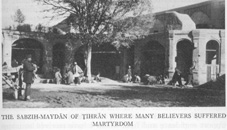 6. No sooner had Haji Muhammad-Taqi
uttered these
words than Siyyid Murtada, who was one of the noted
merchants of Zanjan, hastened to take precedence of his
companions. He flung himself over the body of Haji Muhammad-Taqi,
and pleaded that, being a siyyid, his martyrdom
would be more meritorious in the sight of God than
that of Haji Muhammad-Taqi. As the executioner un-
6. No sooner had Haji Muhammad-Taqi
uttered these
words than Siyyid Murtada, who was one of the noted
merchants of Zanjan, hastened to take precedence of his
companions. He flung himself over the body of Haji Muhammad-Taqi,
and pleaded that, being a siyyid, his martyrdom
would be more meritorious in the sight of God than
that of Haji Muhammad-Taqi. As the executioner un-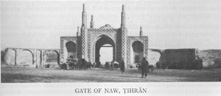 7. In the midst of the turmoil which the
stirring words
of Siyyid Murtada had raised, Muhammad-Husayn-i-Maraghiyi
rushed forward and begged that he be allowed to be
martyred immediately ere his companions were put to the
sword. As soon as his eyes fell upon the body of Haji Mulla
Isma'il-i-Qumi, for whom he entertained a deep affection, he
impulsively threw himself upon him and, holding him in his
embrace, exclaimed: "Never will I consent to separate myself
from my dearly beloved friend, in whom I have reposed the
utmost confidence and from whom I have received so many
evidences of a sincere and deep-felt affection!"
Their eagerness to precede one another in
laying down
their lives for their Faith astonished the multitude who
wondered which of the three would be preferred to his companions.
They pleaded with such fervour that eventually
they were beheaded, all three, at one and the same moment.
So great a faith, such evidences of
unbridled cruelty,
human eye has rarely beheld. Few as they were in number,
yet when we recall the circumstances of their martyrdom,
we are compelled to acknowledge the stupendous character
of that force which could evoke so rare a spirit of self-sacrifice.
When we remember the exalted rank these victims had
occupied, when we observe the degree of their renunciation
and the vitality of their faith, when we recall the pressure
which from influential quarters had been exerted to avert
the danger with which their lives were threatened, above
all when we picture to our minds the spirit that defied the
atrocities which a heartless enemy so far bemeaned themselves
as to inflict upon them, we are impelled to look upon
that episode as one of the most tragic occurrences in the
annals of this Cause.(1)
At this stage of my narrative I was
privileged to submit
to Baha'u'llah such sections of my work as I had already
revised and completed. How abundantly have my labours
been rewarded by Him whose favour alone I seek, and for
whose satisfaction I have addressed myself to this task!
He graciously summoned me to His presence and vouchsafed
me His blessings. I was in my home in the prison-city
of Akka, and lived in the neighbourhood of the house of
Aqay-i-Kalim, when the summons of my Beloved reached
me. That day, the seventh of the month of Rabi'u'th-Thani
in the year 1306 A.H.,(1) I
shall never forget. I here
reproduce the gist of His words to me on that memorable
occasion:
"In a Tablet which We yesterday
revealed, We have
explained the meaning of the words, `Turn your eyes away,'(2)
in the course of Our reference to the circumstances attending
the gathering at Badasht. We were celebrating, in the company
of a number of distinguished notables, the nuptials of
one of the princes of royal blood in Tihran, when Siyyid
Ahmad-i-Yazdi, father of Siyyid Husayn, the Bab's amanuensis,
appeared suddenly at the door. He beckoned to Us,
and seemed to be the bearer of an important message which
he wished immediately to deliver. We were, however, unable
at that moment to leave the gathering, and motioned to
him to wait. When the meeting had dispersed, he informed
"She remained in her company until the
call of the Bab,
bidding Us proceed to Khurasan, reached Our ears. We
decided that Tahirih should proceed immediately to that
province, and commissioned Mirza
(2) to conduct her to a place
outside the gate of the city, and from thence to any locality
she deemed advisable in that neighbourhood. She was taken
to an orchard in the vicinity of which was a deserted building,
where they found an old man who acted as its caretaker.
Mirza Musa returned and informed Us of the reception
which had been accorded to them, and highly praised the
beauty of the surrounding landscape. We subsequently arranged
for her departure for Khurasan, and promised that
We would follow within the space of a few days.
"We soon joined her at Badasht, where
We rented a garden
for her use, and appointed the same Muhammad-Hadi who
had achieved her deliverance, as her doorkeeper. About
seventy of Our companions were with Us and lodged in a place
in the vicinity of that garden.
"We fell ill one day, and were confined to
bed. Tahirih
sent a request to call upon Us. We were surprised at her
message, and were at a loss as to what We should reply.
Suddenly We saw her at the door, her face unveiled before
Us. How well has Mirza Aqa Jan
(3) commented upon that
incident. `The face of Fatimih,' he said, `must needs be
revealed on the Day of Judgment and appear unveiled before
the eyes of men. At that moment the voice of the Unseen
"How great was the consternation that
seized the companions
on that day! Fear and bewilderment filled their
hearts. A few, unable to tolerate that which was to them
so revolting a departure from the established customs of
Islam, fled in horror from before her face. Dismayed, they
sought refuge in a deserted castle in that neighbourhood.
Among those who were scandalised by her behaviour and
severed from her entirely were the Siyyid-i-Nahri
(1) and his
brother Mirza Hadi, to both of whom We sent word that it
was unnecessary for them to desert their companions and
seek refuge in a castle.
"Our friends eventually dispersed,
leaving Us at the
mercy of Our enemies. When, at a later time, We went to
Amul, such was the turmoil which the people had raised
that above four thousand persons had congregated in the
masjid and had crowded onto the roofs of their houses. The
leading mulla of the town denounced Us bitterly. `You have
perverted the Faith of Islam,' he cried in his mazindarani
dialect, `and sullied its fame! Last night I saw you in a
dream enter the masjid, which was thronged by an eager
multitude that had gathered to witness your arrival. As the
crowd pressed round you, I beheld, and, lo, the Qa'im was
standing in a corner with His gaze fixed upon your countenance,
His features betraying great surprise. This dream
I regard as evidence of your having deviated from the path
of Truth.' We assured him that the expression of surprise
on that countenance was a sign of the Qa'im's strong disapproval
of the treatment he and his fellow-townsmen had
accorded Us. He questioned Us regarding the Mission of the
Bab. We informed him that, although We had never met
Him face to face, yet We cherished, none the less, a great
affection for Him. We expressed Our profound conviction
that He had, under no circumstances, acted contrary to
the Faith of Islam.
The mulla and his followers, however
refused to believe
Us, and rejected Our testimony as a perversion of the truth.
They eventually placed Us in confinement, and forbade Our
"At the time We proposed to send
Muhammad-Hadiy-i-Farhadi
to Qazvin, in order to achieve the deliverance of
Tahirih and conduct her to Tihran, Shaykh Abu-Turab wrote
Us, insisting that such an attempt was fraught with grave
risks and might occasion an unprecedented tumult. We
7. In the midst of the turmoil which the
stirring words
of Siyyid Murtada had raised, Muhammad-Husayn-i-Maraghiyi
rushed forward and begged that he be allowed to be
martyred immediately ere his companions were put to the
sword. As soon as his eyes fell upon the body of Haji Mulla
Isma'il-i-Qumi, for whom he entertained a deep affection, he
impulsively threw himself upon him and, holding him in his
embrace, exclaimed: "Never will I consent to separate myself
from my dearly beloved friend, in whom I have reposed the
utmost confidence and from whom I have received so many
evidences of a sincere and deep-felt affection!"
Their eagerness to precede one another in
laying down
their lives for their Faith astonished the multitude who
wondered which of the three would be preferred to his companions.
They pleaded with such fervour that eventually
they were beheaded, all three, at one and the same moment.
So great a faith, such evidences of
unbridled cruelty,
human eye has rarely beheld. Few as they were in number,
yet when we recall the circumstances of their martyrdom,
we are compelled to acknowledge the stupendous character
of that force which could evoke so rare a spirit of self-sacrifice.
When we remember the exalted rank these victims had
occupied, when we observe the degree of their renunciation
and the vitality of their faith, when we recall the pressure
which from influential quarters had been exerted to avert
the danger with which their lives were threatened, above
all when we picture to our minds the spirit that defied the
atrocities which a heartless enemy so far bemeaned themselves
as to inflict upon them, we are impelled to look upon
that episode as one of the most tragic occurrences in the
annals of this Cause.(1)
At this stage of my narrative I was
privileged to submit
to Baha'u'llah such sections of my work as I had already
revised and completed. How abundantly have my labours
been rewarded by Him whose favour alone I seek, and for
whose satisfaction I have addressed myself to this task!
He graciously summoned me to His presence and vouchsafed
me His blessings. I was in my home in the prison-city
of Akka, and lived in the neighbourhood of the house of
Aqay-i-Kalim, when the summons of my Beloved reached
me. That day, the seventh of the month of Rabi'u'th-Thani
in the year 1306 A.H.,(1) I
shall never forget. I here
reproduce the gist of His words to me on that memorable
occasion:
"In a Tablet which We yesterday
revealed, We have
explained the meaning of the words, `Turn your eyes away,'(2)
in the course of Our reference to the circumstances attending
the gathering at Badasht. We were celebrating, in the company
of a number of distinguished notables, the nuptials of
one of the princes of royal blood in Tihran, when Siyyid
Ahmad-i-Yazdi, father of Siyyid Husayn, the Bab's amanuensis,
appeared suddenly at the door. He beckoned to Us,
and seemed to be the bearer of an important message which
he wished immediately to deliver. We were, however, unable
at that moment to leave the gathering, and motioned to
him to wait. When the meeting had dispersed, he informed
"She remained in her company until the
call of the Bab,
bidding Us proceed to Khurasan, reached Our ears. We
decided that Tahirih should proceed immediately to that
province, and commissioned Mirza
(2) to conduct her to a place
outside the gate of the city, and from thence to any locality
she deemed advisable in that neighbourhood. She was taken
to an orchard in the vicinity of which was a deserted building,
where they found an old man who acted as its caretaker.
Mirza Musa returned and informed Us of the reception
which had been accorded to them, and highly praised the
beauty of the surrounding landscape. We subsequently arranged
for her departure for Khurasan, and promised that
We would follow within the space of a few days.
"We soon joined her at Badasht, where
We rented a garden
for her use, and appointed the same Muhammad-Hadi who
had achieved her deliverance, as her doorkeeper. About
seventy of Our companions were with Us and lodged in a place
in the vicinity of that garden.
"We fell ill one day, and were confined to
bed. Tahirih
sent a request to call upon Us. We were surprised at her
message, and were at a loss as to what We should reply.
Suddenly We saw her at the door, her face unveiled before
Us. How well has Mirza Aqa Jan
(3) commented upon that
incident. `The face of Fatimih,' he said, `must needs be
revealed on the Day of Judgment and appear unveiled before
the eyes of men. At that moment the voice of the Unseen
"How great was the consternation that
seized the companions
on that day! Fear and bewilderment filled their
hearts. A few, unable to tolerate that which was to them
so revolting a departure from the established customs of
Islam, fled in horror from before her face. Dismayed, they
sought refuge in a deserted castle in that neighbourhood.
Among those who were scandalised by her behaviour and
severed from her entirely were the Siyyid-i-Nahri
(1) and his
brother Mirza Hadi, to both of whom We sent word that it
was unnecessary for them to desert their companions and
seek refuge in a castle.
"Our friends eventually dispersed,
leaving Us at the
mercy of Our enemies. When, at a later time, We went to
Amul, such was the turmoil which the people had raised
that above four thousand persons had congregated in the
masjid and had crowded onto the roofs of their houses. The
leading mulla of the town denounced Us bitterly. `You have
perverted the Faith of Islam,' he cried in his mazindarani
dialect, `and sullied its fame! Last night I saw you in a
dream enter the masjid, which was thronged by an eager
multitude that had gathered to witness your arrival. As the
crowd pressed round you, I beheld, and, lo, the Qa'im was
standing in a corner with His gaze fixed upon your countenance,
His features betraying great surprise. This dream
I regard as evidence of your having deviated from the path
of Truth.' We assured him that the expression of surprise
on that countenance was a sign of the Qa'im's strong disapproval
of the treatment he and his fellow-townsmen had
accorded Us. He questioned Us regarding the Mission of the
Bab. We informed him that, although We had never met
Him face to face, yet We cherished, none the less, a great
affection for Him. We expressed Our profound conviction
that He had, under no circumstances, acted contrary to
the Faith of Islam.
The mulla and his followers, however
refused to believe
Us, and rejected Our testimony as a perversion of the truth.
They eventually placed Us in confinement, and forbade Our
"At the time We proposed to send
Muhammad-Hadiy-i-Farhadi
to Qazvin, in order to achieve the deliverance of
Tahirih and conduct her to Tihran, Shaykh Abu-Turab wrote
Us, insisting that such an attempt was fraught with grave
risks and might occasion an unprecedented tumult. We
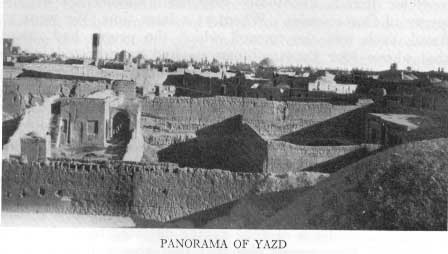 A word should now be added regarding
the closing stages
of the tragedy that witnessed to the heroism of the Seven
Martyrs of Tihran. For three days and three nights they
remained abandoned in the Sabzih-Maydan, which adjoined
the imperial palace, exposed to untold indignities which an
unrelenting foe heaped upon them. Thousands of devout
shi'ahs gathered round their corpses, kicked them with their
Having allayed the tumult of their
passion, they buried
them outside the gate of the capital, in a place which lay
beyond the limits of the public cemetery, adjoining the
moat, between the gates of Naw and of Shah Abdu'l-'Azim.
They were all laid in the same grave, thus remaining united
in body, as they had been in spirit during the days of their
earthly life.(1)
The news of their martyrdom came as an
added blow to
the Bab, who was already plunged in sorrow at the fate that
had befallen the heroes of Tabarsi. In the detailed Tablet
He revealed in their honour, every word of which testified
to the exalted position they occupied in His eyes, He referred
to them as those very "Seven Goats" spoken of in the traditions
of Islam, who on the Day of Judgment shall "walk in
front of the promised Qa'im." They shall symbolise by their
life the noblest spirit of heroism, and by their death shall
manifest true acquiescence in His will. By preceding the
Qa'im, the Bab explained, is meant that their martyrdom
will precede that of the Qa'im Himself, who is their Shepherd.
What the Bab had predicted came to be fulfilled, inasmuch
as His own martyrdom occurred four months later in Tabriz.
That memorable year witnessed, in
addition to the martyrdom
of the Bab and that of His seven companions in Tihran,
the momentous happenings of Nayriz which culminated in
the death of Vahid. Towards the end of that same year,
Zanjan likewise became the centre of a storm which raged
with exceptional violence throughout the surrounding district,
bringing in its wake the massacre of a vast number of
A word should now be added regarding
the closing stages
of the tragedy that witnessed to the heroism of the Seven
Martyrs of Tihran. For three days and three nights they
remained abandoned in the Sabzih-Maydan, which adjoined
the imperial palace, exposed to untold indignities which an
unrelenting foe heaped upon them. Thousands of devout
shi'ahs gathered round their corpses, kicked them with their
Having allayed the tumult of their
passion, they buried
them outside the gate of the capital, in a place which lay
beyond the limits of the public cemetery, adjoining the
moat, between the gates of Naw and of Shah Abdu'l-'Azim.
They were all laid in the same grave, thus remaining united
in body, as they had been in spirit during the days of their
earthly life.(1)
The news of their martyrdom came as an
added blow to
the Bab, who was already plunged in sorrow at the fate that
had befallen the heroes of Tabarsi. In the detailed Tablet
He revealed in their honour, every word of which testified
to the exalted position they occupied in His eyes, He referred
to them as those very "Seven Goats" spoken of in the traditions
of Islam, who on the Day of Judgment shall "walk in
front of the promised Qa'im." They shall symbolise by their
life the noblest spirit of heroism, and by their death shall
manifest true acquiescence in His will. By preceding the
Qa'im, the Bab explained, is meant that their martyrdom
will precede that of the Qa'im Himself, who is their Shepherd.
What the Bab had predicted came to be fulfilled, inasmuch
as His own martyrdom occurred four months later in Tabriz.
That memorable year witnessed, in
addition to the martyrdom
of the Bab and that of His seven companions in Tihran,
the momentous happenings of Nayriz which culminated in
the death of Vahid. Towards the end of that same year,
Zanjan likewise became the centre of a storm which raged
with exceptional violence throughout the surrounding district,
bringing in its wake the massacre of a vast number of



|