HE forces under the command
of Prince Mihdi-Quli Mirza meanwhile had recovered from the state of
utter demoralisation into which they had sunk, and were now diligently
preparing to renew their attack upon the occupant
s of the fort of Tabarsi. The latter found themselves again encompassed
by a numerous host, at the head of which marched Abbas-Quli Khan-i-Larijani and Sulayman Khan-i-Afshar-i-Shahriyari, who, together with
several regiments of infantry and cavalry
, had hastened to reinforce the company of the prince's soldiers.(1) Their
combined
forces encamped in the neighbourhood of the fort,(2) and proceeded
to
erect a series of seven barricades around it. With the utmost arrogance,
they sought at first to display the extent of the forces at their command,
and indulged with increasing zest in the daily exercise of their arms.
The
scarcity of water had, in the meantime,
compelled those who were besieged to dig a well within the enclosure of
the fort. On the day the work was to be completed, the eighth day of the
month
of Rabi'u'l-Avval,(1)
Mulla Husayn, who was watching his companions perform this task,
remarked: "To-day we shall have all the water we require for our bath.
Cleansed of all earthly defilements, we shall seek the court of the
Almighty, and shall hasten to our eternal abode. Whoso is willing to
partake of the cup of martyrdom, let him prepare himself and wait for
the hour when he can seal with his life-blood his faith in his Cause.
This night, ere the hour of dawn, let those who wish to join me be ready
to issue forth from behind these walls and, scattering once again the
dark forces which have beset our path, ascend untrammelled to the
heights of glory." That
same afternoon, Mulla Husayn performed his ablutions, clothed himself
in new garments, attired his head with the Bab's turban, and prepared
for the approaching encounter. An undefinable joy illumined his face.
He serenely alluded to the hour of his departure, and continued to his
last moments to animate the zeal of his companions. Alone with
Quddus, who so powerfully reminded him of his Beloved, he poured
forth, as he sat at his feet in the closing moments of his earthly life, all
that an enraptured soul could no longer restrain. Soon after midnight, as
soon as the morning-star had risen, the star that heralded to him the
dawning light of eternal reunion with his Beloved, he started to his feet
and, mounting his charger, gave the signal that the gate of the fort be
opened. As he rode out at the head of three hundred and
thirteen of his companions to meet the enemy, the cry of "Ya
Sahibu'z-Zaman!"(2) again broke forth, a cry so intense
and powerful that forest, fort, and camp vibrated to its resounding echo.
Mulla Husayn first
charged the barricade which was defended by Zakariyyay-i-Qadi-Kala'i,
one of the enemy's most valiant officers. Within a short space of time, he had broken
HE forces under the command
of Prince Mihdi-Quli Mirza meanwhile had recovered from the state of
utter demoralisation into which they had sunk, and were now diligently
preparing to renew their attack upon the occupant
s of the fort of Tabarsi. The latter found themselves again encompassed
by a numerous host, at the head of which marched Abbas-Quli Khan-i-Larijani and Sulayman Khan-i-Afshar-i-Shahriyari, who, together with
several regiments of infantry and cavalry
, had hastened to reinforce the company of the prince's soldiers.(1) Their
combined
forces encamped in the neighbourhood of the fort,(2) and proceeded
to
erect a series of seven barricades around it. With the utmost arrogance,
they sought at first to display the extent of the forces at their command,
and indulged with increasing zest in the daily exercise of their arms.
The
scarcity of water had, in the meantime,
compelled those who were besieged to dig a well within the enclosure of
the fort. On the day the work was to be completed, the eighth day of the
month
of Rabi'u'l-Avval,(1)
Mulla Husayn, who was watching his companions perform this task,
remarked: "To-day we shall have all the water we require for our bath.
Cleansed of all earthly defilements, we shall seek the court of the
Almighty, and shall hasten to our eternal abode. Whoso is willing to
partake of the cup of martyrdom, let him prepare himself and wait for
the hour when he can seal with his life-blood his faith in his Cause.
This night, ere the hour of dawn, let those who wish to join me be ready
to issue forth from behind these walls and, scattering once again the
dark forces which have beset our path, ascend untrammelled to the
heights of glory." That
same afternoon, Mulla Husayn performed his ablutions, clothed himself
in new garments, attired his head with the Bab's turban, and prepared
for the approaching encounter. An undefinable joy illumined his face.
He serenely alluded to the hour of his departure, and continued to his
last moments to animate the zeal of his companions. Alone with
Quddus, who so powerfully reminded him of his Beloved, he poured
forth, as he sat at his feet in the closing moments of his earthly life, all
that an enraptured soul could no longer restrain. Soon after midnight, as
soon as the morning-star had risen, the star that heralded to him the
dawning light of eternal reunion with his Beloved, he started to his feet
and, mounting his charger, gave the signal that the gate of the fort be
opened. As he rode out at the head of three hundred and
thirteen of his companions to meet the enemy, the cry of "Ya
Sahibu'z-Zaman!"(2) again broke forth, a cry so intense
and powerful that forest, fort, and camp vibrated to its resounding echo.
Mulla Husayn first
charged the barricade which was defended by Zakariyyay-i-Qadi-Kala'i,
one of the enemy's most valiant officers. Within a short space of time, he had broken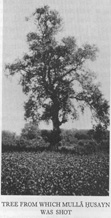 through that
barrier, disposed of its commander, and scattered his men. Dashing
forward with the same swiftness and intrepidity, he overcame the
resistance of both the second and third barric ades, diffusing, as he advanced, despair and consternation among his
foes. Undeterred by the bullets which rained continually upon him and
his companions, they pressed forward until the remaining barricades had
all been captured and overthrown.
In the midst of the tumult which ensued, Abbas-Quli Khan-i-Larijani
had climbed a tree, and, hiding himself in its branches, lay waiting in
ambush for his opponents. Protected by the darkness which surrounded
him, he was able to follow from his
hiding place the movements of Mulla Husayn and his companions, who
were exposed to the fierce glare of the conflagration which they had
raised. The steed of Mulla Husayn suddenly became entangled in the
rope of an adjoining tent, and ere he was able
to extricate himself, he was struck in the breast by a bullet from his
treacherous assailant. Though the shot was successful, Abbas-Quli
Khan was unaware of the identity of the horseman he had wounded.
Mulla Husayn, who was bleeding profusely, dismounted from his horse, staggered a few steps, and, unable to proceed
further, fell exhausted upon the ground. Two of his young companions,
of Khurasan, Quli, and Hasan, came to his rescue and bore him to the
fort.(1)
I have
heard the following account from Mulla Sadiq and Mulla Mirza
Muhammad-i-Furughi: "We were among those who had remained in
the
fort with Quddus. As soon as Mulla Husay
n, who seemed to have lost consciousness, was brought in, we were
ordered to retire. `Leave me alone with him,' were the words of Quddus
as he bade Mirza Muhammad-Baqir close the door and refuse
admittance to anyone desiring to see him. `There are certain confidential matters which I desire him alone to know.' We were
amazed a few moments later when we heard the voice of Mulla Husayn
replying to questions from Quddus. For two hours they continued to
converse with each other. We were surprised to see Mirza Muhammad-Baqir so greatly agitated. `I was watching
Quddus,' he subsequently informed us, `through a fissure in the door.
As soon as he called his name, I saw Mulla Husayn arise and seat
himself, in his customary manner, on bended knees beside him. With bowed head and downcast eyes, he listened to
every word that fell from the lips of Quddus, and answered his
questions. "You have hastened the hour of your departure," I was able
to hear Quddus remark, "and have abandoned me to the mercy of my foes. Please God, I will ere long join you and taste the
sweetness of heaven's ineffable delights." I was able to gather the
following words uttered by Mulla Husayn: "May my life be a ransom
for you. Are you well pleased with me?"' "A long time elapsed
before Quddus bade Mirza Muhammad-Baqir open the door and admit
his companions. `I have bade my last farewell to him,' he said, as we
entered the room. `Things which previously I deemed it unallowable to utter I have now shared with him.' We found on our
arrival that Mulla Husayn had expired. A faint smile still lingered upon
his face. Such was the peacefulness of his countenance that he seemed
to have fallen asleep. Quddus attended to his burial, clothed him in his own shirt, and gave instructions
to lay him to rest to the south of, and adjoining, the shrine of Shaykh
Tabarsi.(1)
`Well is it with you to have remained to your last hour faithful to the Covenant No less than ninety of the
companions were wounded that night, most of whom succumbed. From
the day of their arrival at Barfurush to the day they were first attacked,
which fell on the twelfth of Dhi'l-Qa'dih in the year 1264 A.H.,(1) to the day of the death of Mulla Husayn,
which took place at the hour of dawn on the ninth of Rabi'u'l-Avval in
the
year 1265 A.H.,(2) the number of martyrs, according to the
computation of Mirza Muhammad-Baqir, had reached a total of
seventy-two. From the
time when Mulla
Husayn was assailed by his enemies to the time of his martyrdom
was a hundred and sixteen days, a period rendered memorable by deeds
so heroic that even his bitterest foes felt bound to confess their wonder.
On four distinct occasions, he rose to such heights of courage and power
as few indeed could attain. The first encounter took place on the twelfth of Dhi'l-Qa'dih,(3) in the outskirts
of
Barfurush; the second, in the immediate neighbourhood of the fort of
Shaykh Tabarsi, on the fifth day of the month
of Muharram,(4) against
the forces of Abdu'llah Khan-i-Turkaman; the third, in Vas-Kas, on the
twenty-fifth day of Muharram,(5) directed against the army of Prince
So complete and humiliating a rout paralysed for a time the efforts of the
enemy. Five and forty days passed before they could again reassemble
their forces and renew their attack. During these intervening days,
which ended with the day of Naw-Ruz, the intense cold which prevailed induced them to defer their venture against
an opponent that had covered them with so much reproach and shame.
Though their attacks had been suspended, the officers in charge of the
remnants of the imperial army had given strict orders prohibiting the arrival of all manner of reinforcements at
the fort. When the supply of their provisions was nearly exhausted,
Quddus instructed Mirza Muhammad-Baqir to distribute among his
companions the rice which Mulla Husayn had stored for such time as might be required. When each had received his
portion, Quddus summoned them and said: "Whoever feels himself
strong enough to withstand the calamities that are soon to befall us, let
him remain with us in this fort. And whoever perceives in himself the least hesitation and fear, let him betake
himself away from this place. Let him leave immediately ere the enemy
has again assembled his forces and assailed us. The way will soon be
barred before our face; we shall very soon encounter the severest hardship and fall a victim to devastating
afflictions." The very
night Quddus had given this warning, a siyyid from Qum, Mirza
Husayn-i-Mutavalli, was moved to betray his companions. "Why is it," he wrote to Abbas-Quli Khan-i-Larijani, "that you have
left unfinished the work He had just risen from his bed when,
at the hour of sunrise, the siyyid brought him the letter. The news of the death of Mulla Husayn nerved him to a
fresh resolve. Fearing The day had just broken when he
hoisted his standard(1) and, marching at the head of two
regiments of infantry and cavalry, encompassed the fort and ordered his men to open fire
upon the sentinels who were guarding the turrets. "The betrayer,"
Quddus informed Mirza Muhammad-Baqir, who h
ad hastened to acquaint him with the gravity of the situation, "has
announced the death of Mulla Husayn to Abbas-Quli Khan.
Emboldened by his removal, he is now determined to storm our
stronghold and to secure for himself the honour of being its sole conqueror. Sally out and, with the aid of eighteen men marching at
your side, administer a befitting chastisement upon the aggressor and
his host. Let him realise that though Mulla Husayn be no more, God's
No sooner had Mirza Muhammad-Baqir selected his
companions than he ordered that the gate of the fort be flung open. Leaping upon their chargers and raising the cry of "Ya Sahibu'z-Zaman!" they plunged headlong into the camp of the enemy. The whole
army fled in confusion before so terrific a charge. All but a few were
able to escape. They reached Barfurush utterly demoralised and laden with shame. Abbas-Quli Khan was so
shaken with fear that he fell from his horse. Leaving, in his distress, one
of his boots hanging from the stirrup, he ran away, half shod and
bewildered, in the direction which the army had taken. Filled with despair, he hastened to the prince and confessed
the ignominious reverse he had sustained.(1) Mirza Muhammad-Baqir, on his part, emerging together with his eighteen companions
unscathed from that encounter, and holding in his hand the So complete a rout immediately brought relief to the hard-pressed
companions. It cemented their unity and reminded them afresh of the
efficacy of that power with which their Faith had endowed them. Their
food, alas, was by this time reduced to the flesh of horses, which they had brought away with them from the
deserted camp of the enemy. With steadfast fortitude they endured the
afflictions which beset them from every side. Their hearts were set on
the wishes of Quddus; all else mattered but little. Neither the severity of their distress nor the continual threats of
the enemy could cause them to deviate a hairbreadth from the path
which their departed companions had so heroically trodden. A few were
found who subsequently faltered in the darkest hour of adversity. The faint-heartedness which this
negligible element was compelled to betray paled, however, into
insignificance before the radiance which the mass of their stouthearted
companions shed in the hour of realised
doom. Prince Mihdi-Quli
Mirza,
who was stationed in Sari, welcomed with keen delight the news of the
defeat that had overtaken the forces under the immediate command of
his colleague Abbas-Quli Khan. Though himself desirous of
extirpating the band that had sought shelter behind the
walls of the fort, he rejoiced at the knowledge that his rival
had failed to secure the victory which
he coveted.(1)
He
wrote immediately to Tihran and demanded that reinforcements in the
form of bomb-shells and camel-artillery, with all the necessary
equipments, be despatched without delay to the neighbourhood of the
fort, he being determined, this time, to effect the complete subjugation of its obstinate occupants. Whilst their enemies were preparing
for yet another and still fiercer attack upon their stronghold, the
companions of Quddus, utterly indifferent to the gnawing distress that afflicted them, acclaimed with joy and gratitude the
approach of Naw-Ruz. In the course of that festival, they gave free vent
to their feelings of thanksgiving and praise in return for the manifold
blessings which the Almighty had bestowed upon them. Though oppressed with hunger, they indulged in
songs and merriment, utterly disdaining the danger with which they
were beset. The fort resounded with the ascriptions of glory and praise
which, both in the daytime and in the night-season, ascended from the hearts of that joyous band. The verse,
"Holy, holy, the Lord our God, the Lord of the angels and the spirit,"
issued unceasingly from their lips, heightened their enthusiasm, and
reanimated their courage. All that remained of the cattle they
had brought with them to the fort was a cow which Haji Nasiru'd-Din-i-Qazvini had set aside, and the milk of which he made into a pudding
every day for the table of Quddus. Unwilling to I have heard
Mulla Mirza Muhammad-i-Furughi testify to the following: "God knows that we had ceased to hunger for food. Our thoughts
were no longer concerned with matters pertaining to our daily bread.
We were so enraptured by the entrancing melody of those verses that,
were we to have continued for years in that state, no trace of weariness and fatigue could possibly have dimmed
our enthusiasm or marred our gladness. And whenever the lack of
nourishment would tend to sap our vitality and weaken our strength,
Mirza Muhammad-Baqir would hasten to Quddus and acquaint him with our plight. A glimpse of his face, the magic of his
words, as he walked amongst us, would transmute our despondency into
golden joy. We were reinforced with a strength of such intensity that,
had the hosts of our enemies appeared suddenly before us, we felt ourselves capable of subjugating their
forces." On the day of
Naw-Ruz, which fell on the twenty-fourth of Rabi'u'th-Thani in the year
1265 A.H.,(1) Quddus alluded, in a written message
to his companions, to the approach of
such trials as would bring in their wake the martyrdom of
a considerable number of his friends. A few days later, an innumerable
host,(2)
commanded by Prince Mihdi-Quli
So powerful an appeal
could not fail to breathe confidence into the hearts of those who heard it. A few, however, whose countenances betrayed
vacillation and fear, were seen huddled together in a sheltered corner of
the fort, viewing with envy and surprise the
zeal that animated their
companions.(1) The army of
Prince Mihdi-Quli Mirza continued for a few days to fire in the
direction
of the fort.
His men were surprised to find that the booming of their guns had
failed to silence the voice of prayer and the acclamations of joy
which the besieged raised in answer to their threats. Instead of the
unconditional surrender which they expected, the call of the
muadhdhin,(1) the chanting
of the verses of the Qur'an, and the chorus of gladsome voices
intoning hymns of thanksgiving and praise reached their ears without
ceasing.
Exasperated by these
evidences of
unquenchable fervour and impelled by a burning desire to extinguish the
enthusiasm which swelled within the breasts of his opponents, Ja'far-quli Khan erected a tower, upon which he
stationed his cannon,(2) and from that eminence directed his fire
into the heart of the fort. Quddus immediately summoned Mirza
Muhammad-Baqir and instructed him to sally again and inflict upon the
"boastful newcomer" a humiliation no less crushing than the one which
Abbas-Quli Khan had suffered. Mirza Muhammad-Baqir
again ordered eighteen of his companions to hurry to their steeds and
follow him. The gates of the fort were thrown open, and the cry of "Ya Sahibu'z-Zaman!"--fiercer and more
thrilling than ever--diffused panic and consternation in the ranks of the
enemy. Ja'far-Quli Khan, with thirty of his men, fell before the sword of
their adversary, who rushed to the tower, captured the guns, and hurled them to the ground. Thence they
threw themselves upon the barricade which had been erected,
demolished a number of them, and would, but for the approaching
darkness, have captured and destroyed the rest.
Triumphant and unhurt, they
repaired to the fort, carrying back with them a number of the stoutest
and best-fed stallions which had been left behind. A few days elapsed
during which there was no sign of a counter-attack.(1) A
sudden explosion in one of the ammunition stores of the enemy, which
had caused the death of several artillery officers and a number of their
fellow-combatants, forced them for one whole month to suspend their attacks upon the garrison.(2) This lull
enabled a number of the companions to emerge occasionally from their
stronghold and gather such grass as they could find in the field as the only means wherewith to The month of
Jamadiyu'th-Thani(2) had just begun when the artillery of the
enemy was heard again discharging its showers of balls upon the fort.
Simultaneously with the booming of the cannons, a detachment of the army, headed by a
number of officers and consisting of several regiments of infantry and
cavalry, rushed to storm it. The sound of their approach impelled
Quddus to summon promptly his valiant lieutenant, Mirza Muhammad-Baqir, and to bid him emerge with thirty-six
of his companions and repulse their attack. Mirza
Muhammad-Baqir once more leaped on horseback and, with the thirty-six companions whom he had selected, confronted and
scattered the forces which had beset him. He carried with him, as he re-entered the gate, the banner which an alarmed enemy had abandoned as
soon as the reverberating cry of "Ya Sahibu'z-Zaman!" had been raised. Five of his companions suffered martyrdom
in the course of that engagement, all of whom he bore to the fort and
interred in one tomb close to the resting place of their fallen brethren.
Prince Mihdi-Quli Mirza, astounded by this further evidence
of the inexhaustible vitality of his opponents, took counsel with the
chiefs of his staff, urging them to devise such means as would enable
him to bring that costly enterprise to a speedy end. For three days he deliberated with them, and finally came to
the conclusion that the most advisable course to take would be to
suspend all manner of hostilities for a few days in the hope that the
besieged, exhausted with hunger and goaded by despair, would decide to emerge from their retreat and submit to an
unconditional surrender. As the prince was waiting for the consummation of the
plan he had conceived, there arrived from Tihran a messenger
I have heard Aqay-i-Kalim give the following account, as related to him by that same messenger whom he met in
Tihran: "`I saw,' the messenger informed me, `Mulla Mihdi appear
above the wall of the fort, his countenance revealing an expression of
stern resolve that baffled description. He looked as fierce as a lion, his sword was girded on over a long white shirt
after the manner of the Arabs, and he had a white kerchief around his
head. "What is it that you seek?" he impatiently enquired. "Say it
quickly, for I fear that my master will summon me and find me absent." The determination that glowed in
his eyes confused me. I was dumbfounded at his looks and manner.
The thought suddenly flashed through my mind that I would awaken a
dormant sentiment in his heart. I reminded him of his infant child, Rahman, whom he had left behind in the village, in
his eagerness to enlist under the standard of Mulla Husayn. In his great
affection for the child, he had specially composed a poem which he
chanted as he rocked his cradle and lulled him to sleep. "Your beloved Rahman," I said, "longs for the
affection which you once lavished upon him. He is alone and forsaken,
and yearns to see you." "Tell him from me," was the father's instant
reply, "that the love of the true Rahman,(2) a love that
transcends all earthly affections, has so filled my heart that it has left no
place for any other it love besides His." The poignancy with which he
uttered these words brought tears to my eyes. "Accursed," I indignantly exclaimed, "be those who consider you
and your fellow-disciples as having strayed from the path of God!"
As soon as he
had joined his companions, Mulla Mihdi conveyed the prince's message
to them. On the afternoon of that same day, Siyyid Mirza Husayn-i-Mutavalli, accompanied by his servant, left the fort and
went directly to join the prince in his camp. The next day, Rasul-i-Bahnimiri and a few other of his companions, unable to resist the
ravages of famine, and encouraged by the explicit assurances During the few days that elapsed after that
incident, the enemy, still encamped in the neighbourhood of the fort,
refrained from any act of hostility towards Quddus and his companions.
On Wednesday morning, the sixteenth of Jamadiyu'th-Thani,(1) an emissary of the prince arrived at the
fort and requested that two representatives be delegated by the besieged
to conduct confidential negotiations with them in the hope of arriving at a peaceful settlement of the issues outstanding between
them.(2)
Accordingly, Quddus
instructed Mulla Yusuf-i-Ardibili and Siyyid Riday-i-Khurasani to act as his representatives, and bade them inform the prince of his
readiness to accede to his wish. Mihdi-Quli Mirza courteously received
them, and invited them to partake of the tea which he had prepared.
"We should," they said, as they declined his offer, "feel it to be an act of disloyalty on our part were we to
partake of either meat or drink whilst our beloved leader languishes
worn and famished in the fort." "The hostilities between us," the prince
remarked, "have been unduly prolonged. We, on both sides, have fought long and suffered grievously. It is
my fervent wish to achieve an amicable settlement of our differences."
He took hold of a copy of the Qur'an that lay beside him, and wrote,
with his own hand, in confirmation of his statement, the following words on the margin of the opening Surih:
"I swear by this most holy Book, by the righteousness of God who has
revealed it, and the Mission of Him who was inspired with its verses,
that I cherish no other purpose than to promote peace and friendliness between us. Come forth from your
stronghold and rest assured that no hand will be stretched forth against
you. You yourself He affixed his
seal to his statement and, delivering the Qur'an into the hands of Mulla
Yusuf, asked him to convey his greetings to his leader and to present him this formal and written assurance. "I
will," he added, "in pursuance of my declaration, despatch to the gate of
the fort, this very afternoon, a number of horses, which I trust he and his
leading companions will accept and mount, in order to ride to the neighbourhood of this camp, where
a special tent will have been pitched for their reception. I would request
them to be our guests until such time as I shall be able to arrange for
their return, at my expense, to their homes." Quddus
received the Qur'an from the hand of his messenger, kissed it reverently,
and said: "O our Lord, decide between us and between our people with
truth; for the best to decide art Thou."(1)
Immediately after, he bade the rest of his companions prepare
themselves to leave the fort. "By our response to their invitation," he
told them, "we shall enable them to demonstrate the sincerity of their intentions." As
the hour of their departure approached, Quddus attired his head with the
green turban which the Bab had sent to him at the time He sent the one
that Mulla Husayn wore on the day of his martyrdom. At the gate of the fort, they mounted the horses which
had been placed at their disposal, Quddus mounting the favourite steed
of the prince which the latter had sent for his use. His chief
companions, among whom were a number of siyyids and learned divines, rode behind him, and were followed by the rest,
who marched on foot, carrying with them all that was left of their arms
and belongings. As the company, who were two hundred and two in
number, reached the tent which the prince had ordered to be pitched for Quddus in the vicinity of the public bath
Soon after their arrival, Quddus emerged
from his tent and, gathering together his companions, addressed them in
these words: "You should show forth exemplary renunciation, for such
behaviour on your part will exalt our Cause and redound to its glory. Anything short of complete detachment will
but serve to tarnish the purity of its name and to obscure its splendour.
Pray the Almighty to grant that even to your
A few hours after sunset, they were
served with dinner brought from the camp of the prince. The food that
was offered them in separate trays, each of which was assigned to a group of thirty companions, was poor and scanty. "Nine of us,"
those who were with Quddus subsequently related, "were summoned by
our leader to partake of the dinner which had been served in his tent. As
he refused to taste it, we too, following his example, refrained from eating. The attendants who waited
upon us were delighted to partake of the dishes which we had refused to
touch, and devoured their contents with appreciation and avidity." A
few of the companions At daybreak a messenger arrived, summoning Mirza Muhammad-Baqir to the presence of the
prince. With the consent of Quddus, he responded to that invitation,
and returned an hour later, informing his chief that the prince had, in the
presence of Sulayman Khan-i-Afshar, reiterated the assurances he had given, and had treated him with great
consideration and kindness. "`My oath,' he assured me," Mirza
Muhammad-Baqir explained, "`is irrevocable and sacred.' He cited the
case of Ja'far-Quli Khan, who, notwithstanding his shameless massacre of thousands of soldiers of the imperial army, in the
course of the insurrection fomented by the Salar, was pardoned by his
sovereign and promptly invested with fresh honours by Muhammad
Shah. To-morrow the prince intends to accompany you in the morning to the public bath, from whence he will proceed to
your tent, after which he will provide the horses required to convey the
entire company to Sang-Sar, from where they will disperse, some
returning to their homes in Iraq, and others proceeding to Khurasan. At the request of Sulayman Khan, who urged
that the presence of such a large gathering at such a fortified centre as
Sang-Sar would be fraught with risk, the prince decided that the party
should disperse, instead, at Firuz-K
uh. I am of opinion that what his tongue professes, his heart does not
believe at all." Quddus, who shared his view, bade his companions
disperse that very night, and stated that he himself would soon proceed
to Barfurush. They hastened to implore him not to separate himself from them, and begged to be allowed to
continue to enjoy the blessings of his companionship. He counselled
them to be calm and patient, and assured them that, whatever afflictions
the future might yet reveal, they would meet again. "Weep not," were his parting words; "the reunion which will
follow this separation The prince
failed to redeem his promise. Instead of joining Quddus in his tent, he
called him, with several of his companions, to his headquarters, and
informed him, as soon as they reached the tent of the Farrash-Bashi,(1) that he himself
would summon him at noon to his presence. Shortly after, a number of
the prince's attendants went and told the rest of the companions that Quddus permitted them to join him at the army's headquarters. Several
of them were deceived by this report, were made captives, and were
eventually sold as slaves. These unfortunate victims constitute the
remnant of the companions of the fort of Shaykh Tabarsi, who survived that heroic struggle and were spared to
transmit to their countrymen the woeful tale of their sufferings and
trials. Soon after, the
prince's attendants brought pressure to bear upon Mulla Yusuf to inform the remainder of his companions of the
desire of Quddus that they immediately disarm. "What is it that you
will tell them exactly?" they asked him, as he was being conducted to a
place at some distance from the army's headquarters. "I will," was the bold reply, "warn them that whatever be
henceforth the nature of the message you choose to deliver to them on
behalf of their leader, that message is naught but downright falsehood."
These words had hardly escaped his lips when he was mercilessly put to death. From this savage act they turned their
attention to the fort, plundered it of its contents, and proceeded to
bombard and demolish it
completely.(2)
They then immediately encompassed the
remaining companions and opened fire upon them. Any who escaped
the
bullets were killed by the swords of the officers and the spears
of their men.(3)
In the As soon as these atrocities hath been perpetrated, the prince
ordered those who had been retained as captives to be ushered, one after another, into his presence. Those among them
who were men of recognised standing, such as the father of Badi',(1) Mulla Mirza
Muhammad-i-Furughi, and Haji
Nasir-i-Qazvini,(2)
he charged his attendants to conduct
to Tihran and obtain in return for their deliverance
a ransom from each one of them in direct proportion to
their capacity and wealth. As to the rest, he gave orders to his executioners that they be immediately put to death. A few were
cut to pieces with the sword,(3) others were torn asunder, a number were
bound to trees and riddled with bullets, and still others were blown This terrible butchery had hardly been concluded when three
of the companions of Quddus, who were residents of Sang-Sar, were ushered into the
presence of the prince. One of them was Siyyid Ahmad, whose father,
Mir Muhammad-'Ali, a devoted admirer of Shaykh Ahmad-i-Ahsa'i, had
been a man of great learning and distinguished merit. He, accompanied by this same Siyyid Ahmad and his brother,
Mir Abu'l-Qasim, who met his death the very night on which Mulla
Husayn was slain, had departed for Karbila in the year preceding the
declaration of the Bab, with the intention of introducing his two sons to Siyyid Kazim. Ere his arrival, the siyyid had
departed this life. He immediately determined to leave for Najaf. While
in that city, the Prophet Muhammad one night appeared to him in a
dream, bidding the Imam Ali, the Commander of the Faithful, announce to him that after his death both his
sons, Siyyid Ahmad and Mir Abu'l-Qasim, would attain the presence of
the promised Qa'im and would each suffer martyrdom in His path. As
soon as he awoke, he called for his son Siyyid Ahmad and acquainted him with his will and last wishes. On the
seventh day after that dream he died. In Sang-Sar two other persons,
Karbila'i Ali and Karbila'i Abu-Muhammad, both known for their piety
and spiritual insight, strove to prepare the people for the acceptance of
These two sons of Karbila'i Abu-Muhammad were the two companions who had been ushered, together
with Siyyid Ahmad, into the presence of the prince. Mulla Zaynu'l-'Abidin-i-Shahmirzadi, one of the trusted and learned counsellors of the
government, acquainted the prince with their story and related the
experiences and activities of their respective fathers. "For what reason," Siyyid Ahmad was asked, "have you chosen
to tread a path that has involved you and your kinsmen in such
circumstances of wretchedness and disgrace? Could you not have been
satisfied with the vast number of erudite and illustrious divines who are to be found in this land and in Iraq?" "My
faith in this Cause," he fearlessly retorted, "is born not of idle imitation.
I have dispassionately enquired into its precepts, and am convinced of
its truth. When in Najaf, I ventured to request the preeminent mujtahid of that city, Shaykh
Muhammad-Hasan-i-Najafi, to expound for me certain truths connected
with the secondary principles underlying the teachings of Islam. He
refused to accede to my request. I reiterated my appeal, whereupon he angrily rebuked me and persisted in his refusal.
How can I, in the light of such experience, be expected to seek
enlightenment on the abstruse articles of the Faith Meanwhile
Mirza Muhammad-Taqi, accompanied by seven of the ulamas of Sari, set out from that town to share in the meritorious act
of inflicting the punishment of death upon the companions of Quddus.
When they found that they had already been put to death, Mirza
Muhammad-Taqi urged the prince to reconsider his decision and to order the immediate execution of Siyyid Ahmad,
pleading that his arrival at Sari would be the signal for fresh
disturbances as grave as those which had already afflicted them. The
prince eventually yielded, on the express condition that he be regarded as his guest until his own arrival at Sari, at
which time he would take whatever measures were required to prevent
him from disturbing the peace of the neighbourhood. No sooner had Mirza Muhammad-Taqi taken the direction of Sari than he proceeded to
vilify Siyyid Ahmad and his father. "Why ill-treat a guest," his captive
pleaded, "whom the prince has committed to your charge? Why ignore
the Prophet's injunction, `Honour thy guest though he be an infidel'?" Roused to a burst of fury, Mirza
Muhammad-Taqi, As soon as his work was completed, the prince, accompanied
by Quddus, returned to Barfurush. They arrived on Friday afternoon,
the eighteenth of
Jamadiyu'th-Thani.(1)
The Sa'idu'l-'Ulama',
together with all the ulamas of the town, came out to welcome the
prince and to extend their congratulations on his triumphal return.
The whole town was beflagged to celebrate the victory, and the bonfires which blazed at night witnessed to the joy with which
a grateful population greeted the return of the prince. Three days of
festivities elapsed during which he gave no indication as to his intention
regarding the fate of Quddus. He vacillated in his policy, and was extremely reluctant to ill-treat his
captive. He at first refused to allow the people to gratify their feelings
of unrelenting hatred, and was able to restrain their fury. He had
originally intended to conduct him to Tihran and, by delivering him into the hands of his sovereign, to
relieve himself of the responsibility which weighed upon him.
The Sa'idu'l-'Ulama''s
unquenchable hostility, however, interfered with the execution of this plan. The hatred with which Quddus and his Cause
inspired him blazed into furious rage as he witnessed the increasing
evidences of the prince's inclination to allow so formidable an opponent
to slip from his grasp. Day and night he remonstrated with him and, with every cunning that his resourceful
brain could devise, sought to dissuade him from pursuing a policy
which he thought to be at once disastrous and cowardly. In the fury of
his despair, he appealed to the mob and sought, by inflaming their passions, to awaken the basest sentiments of
revenge in their hearts. The whole of Barfurush had been aroused by
the persistency of his call. His diabolical skill No sooner had the
ulamas assembled than the prince gave orders for Quddus to be brought into their presence. Since the day of his abandoning
the fort, Quddus, who had been delivered into the custody of the
Farrash-Bashi, had not been summoned to his presence. As soon as he
arrived, the prince arose and invited him to be seated by his side. Turning to the Sa'idu'l-'Ulama', he urged that his
conversations with him be dispassionately and conscientiously
conducted. "Your discussions," he asserted, "must revolve around, and
be based upon, the verses of the Qur'an and the traditions of Muhammad, by which means alone you can
demonstrate the truth or falsity of your contentions." "For what reason,"
the Sa'idu'l-'Ulama' impertinently enquired, "have you, by choosing to
place a green turban upon your head, arrogated to yourself a right which only he who is a true descendant of the Prophet
can claim? Do you not know that whoso defies this sacred tradition is
accursed of God?" "Was Siyyid Murtada," Quddus calmly replied,
"whom all the recognised ulamas praise and esteem, a descendant of
No one dared to contradict him. The Sa'idu'l-'Ulama' burst forth into a fit of indignation and despair.
Angrily he flung his turban to the ground and arose to leave the meeting.
"This man," he thundered, ere he departed, "has succeeded in proving to
you that he is a descendent of the Imam Hasan. He will, ere long, justify his claim to be the
mouthpiece of God and the revealer of His will!" The prince was moved
to make this declaration: "I wash my hands of all responsibility for any
harm that may befall this man. You are free to do what you like with him. You will yourselves be
answerable to God on the Day of Judgment." Immediately after he had
spoken these words, he called for his horse and, accompanied by his
attendants, departed for Sari. Intimidated by the imprecations of the ulamas and forgetful of his oath, he abjectly
surrendered Quddus to the hands of an unrelenting foe, those ravening
wolves who panted for the moment when they could pounce, with
uncontrolled violence, upon their prey, and let loose on him the fiercest passions of revenge and hate. No sooner had the prince freed them
from the restraints which he had exercised than the ulamas and the
people of Barfurush, acting under orders from the Sa'idu'l-'Ulama',(1) arose to perpetrate upon the body of their
victim acts of such atrocious cruelty as no pen can describe. By the
testimony of Baha'u'llah, that heroic youth, who was still on the threshold of his life, was subjected to such tortures and suffered
Such were its
circumstances that the Bab, who was then confined in the castle of
Chihriq, was unable for a period of six months either to write or to
dictate. The deep grief which he felt had stilled the voice of revelation and silenced His pen. How deeply He mourned His loss! What cries
of anguish He must have uttered as the tale of the siege, the untold
sufferings, the shameless betrayal, and the wholesale massacre of the
companions of Shaykh Tabarsi reached His ears and was unfolded before His eyes! What pangs of sorrow He must
have felt when He learned of the shameful treatment which His beloved
Quddus had undergone in his hour of martyrdom at the hands of the
people of Barfurush; how he was stripped of his clothes; how the turban which He had bestowed upon him had been
befouled; how, barefooted, bareheaded, and loaded with chains, he was
paraded through the streets, followed and scorned by the entire
population of the town; how he was execrated and spat upon by the howling mob; how he was assailed with the knives and
axes of the scum of its female inhabitants; how his body was pierced
and mutilated, and how eventually it was delivered to the flames!
Amidst his torments, Quddus was heard whispering forgiveness to his foes.
"Forgive, O my God," he cried, "the trespasses of this people. Deal with
them in Thy mercy, for they know not what we already have discovered
and cherish. I have striven to show them the path that leads to their salvation; behold how they have risen
to overwhelm and kill me! Show them, O God, the way of Truth, and
turn their ignorance into faith." In his hour of agony, the Siyyid-i-Qumi,
through that
barrier, disposed of its commander, and scattered his men. Dashing
forward with the same swiftness and intrepidity, he overcame the
resistance of both the second and third barric ades, diffusing, as he advanced, despair and consternation among his
foes. Undeterred by the bullets which rained continually upon him and
his companions, they pressed forward until the remaining barricades had
all been captured and overthrown.
In the midst of the tumult which ensued, Abbas-Quli Khan-i-Larijani
had climbed a tree, and, hiding himself in its branches, lay waiting in
ambush for his opponents. Protected by the darkness which surrounded
him, he was able to follow from his
hiding place the movements of Mulla Husayn and his companions, who
were exposed to the fierce glare of the conflagration which they had
raised. The steed of Mulla Husayn suddenly became entangled in the
rope of an adjoining tent, and ere he was able
to extricate himself, he was struck in the breast by a bullet from his
treacherous assailant. Though the shot was successful, Abbas-Quli
Khan was unaware of the identity of the horseman he had wounded.
Mulla Husayn, who was bleeding profusely, dismounted from his horse, staggered a few steps, and, unable to proceed
further, fell exhausted upon the ground. Two of his young companions,
of Khurasan, Quli, and Hasan, came to his rescue and bore him to the
fort.(1)
I have
heard the following account from Mulla Sadiq and Mulla Mirza
Muhammad-i-Furughi: "We were among those who had remained in
the
fort with Quddus. As soon as Mulla Husay
n, who seemed to have lost consciousness, was brought in, we were
ordered to retire. `Leave me alone with him,' were the words of Quddus
as he bade Mirza Muhammad-Baqir close the door and refuse
admittance to anyone desiring to see him. `There are certain confidential matters which I desire him alone to know.' We were
amazed a few moments later when we heard the voice of Mulla Husayn
replying to questions from Quddus. For two hours they continued to
converse with each other. We were surprised to see Mirza Muhammad-Baqir so greatly agitated. `I was watching
Quddus,' he subsequently informed us, `through a fissure in the door.
As soon as he called his name, I saw Mulla Husayn arise and seat
himself, in his customary manner, on bended knees beside him. With bowed head and downcast eyes, he listened to
every word that fell from the lips of Quddus, and answered his
questions. "You have hastened the hour of your departure," I was able
to hear Quddus remark, "and have abandoned me to the mercy of my foes. Please God, I will ere long join you and taste the
sweetness of heaven's ineffable delights." I was able to gather the
following words uttered by Mulla Husayn: "May my life be a ransom
for you. Are you well pleased with me?"' "A long time elapsed
before Quddus bade Mirza Muhammad-Baqir open the door and admit
his companions. `I have bade my last farewell to him,' he said, as we
entered the room. `Things which previously I deemed it unallowable to utter I have now shared with him.' We found on our
arrival that Mulla Husayn had expired. A faint smile still lingered upon
his face. Such was the peacefulness of his countenance that he seemed
to have fallen asleep. Quddus attended to his burial, clothed him in his own shirt, and gave instructions
to lay him to rest to the south of, and adjoining, the shrine of Shaykh
Tabarsi.(1)
`Well is it with you to have remained to your last hour faithful to the Covenant No less than ninety of the
companions were wounded that night, most of whom succumbed. From
the day of their arrival at Barfurush to the day they were first attacked,
which fell on the twelfth of Dhi'l-Qa'dih in the year 1264 A.H.,(1) to the day of the death of Mulla Husayn,
which took place at the hour of dawn on the ninth of Rabi'u'l-Avval in
the
year 1265 A.H.,(2) the number of martyrs, according to the
computation of Mirza Muhammad-Baqir, had reached a total of
seventy-two. From the
time when Mulla
Husayn was assailed by his enemies to the time of his martyrdom
was a hundred and sixteen days, a period rendered memorable by deeds
so heroic that even his bitterest foes felt bound to confess their wonder.
On four distinct occasions, he rose to such heights of courage and power
as few indeed could attain. The first encounter took place on the twelfth of Dhi'l-Qa'dih,(3) in the outskirts
of
Barfurush; the second, in the immediate neighbourhood of the fort of
Shaykh Tabarsi, on the fifth day of the month
of Muharram,(4) against
the forces of Abdu'llah Khan-i-Turkaman; the third, in Vas-Kas, on the
twenty-fifth day of Muharram,(5) directed against the army of Prince
So complete and humiliating a rout paralysed for a time the efforts of the
enemy. Five and forty days passed before they could again reassemble
their forces and renew their attack. During these intervening days,
which ended with the day of Naw-Ruz, the intense cold which prevailed induced them to defer their venture against
an opponent that had covered them with so much reproach and shame.
Though their attacks had been suspended, the officers in charge of the
remnants of the imperial army had given strict orders prohibiting the arrival of all manner of reinforcements at
the fort. When the supply of their provisions was nearly exhausted,
Quddus instructed Mirza Muhammad-Baqir to distribute among his
companions the rice which Mulla Husayn had stored for such time as might be required. When each had received his
portion, Quddus summoned them and said: "Whoever feels himself
strong enough to withstand the calamities that are soon to befall us, let
him remain with us in this fort. And whoever perceives in himself the least hesitation and fear, let him betake
himself away from this place. Let him leave immediately ere the enemy
has again assembled his forces and assailed us. The way will soon be
barred before our face; we shall very soon encounter the severest hardship and fall a victim to devastating
afflictions." The very
night Quddus had given this warning, a siyyid from Qum, Mirza
Husayn-i-Mutavalli, was moved to betray his companions. "Why is it," he wrote to Abbas-Quli Khan-i-Larijani, "that you have
left unfinished the work He had just risen from his bed when,
at the hour of sunrise, the siyyid brought him the letter. The news of the death of Mulla Husayn nerved him to a
fresh resolve. Fearing The day had just broken when he
hoisted his standard(1) and, marching at the head of two
regiments of infantry and cavalry, encompassed the fort and ordered his men to open fire
upon the sentinels who were guarding the turrets. "The betrayer,"
Quddus informed Mirza Muhammad-Baqir, who h
ad hastened to acquaint him with the gravity of the situation, "has
announced the death of Mulla Husayn to Abbas-Quli Khan.
Emboldened by his removal, he is now determined to storm our
stronghold and to secure for himself the honour of being its sole conqueror. Sally out and, with the aid of eighteen men marching at
your side, administer a befitting chastisement upon the aggressor and
his host. Let him realise that though Mulla Husayn be no more, God's
No sooner had Mirza Muhammad-Baqir selected his
companions than he ordered that the gate of the fort be flung open. Leaping upon their chargers and raising the cry of "Ya Sahibu'z-Zaman!" they plunged headlong into the camp of the enemy. The whole
army fled in confusion before so terrific a charge. All but a few were
able to escape. They reached Barfurush utterly demoralised and laden with shame. Abbas-Quli Khan was so
shaken with fear that he fell from his horse. Leaving, in his distress, one
of his boots hanging from the stirrup, he ran away, half shod and
bewildered, in the direction which the army had taken. Filled with despair, he hastened to the prince and confessed
the ignominious reverse he had sustained.(1) Mirza Muhammad-Baqir, on his part, emerging together with his eighteen companions
unscathed from that encounter, and holding in his hand the So complete a rout immediately brought relief to the hard-pressed
companions. It cemented their unity and reminded them afresh of the
efficacy of that power with which their Faith had endowed them. Their
food, alas, was by this time reduced to the flesh of horses, which they had brought away with them from the
deserted camp of the enemy. With steadfast fortitude they endured the
afflictions which beset them from every side. Their hearts were set on
the wishes of Quddus; all else mattered but little. Neither the severity of their distress nor the continual threats of
the enemy could cause them to deviate a hairbreadth from the path
which their departed companions had so heroically trodden. A few were
found who subsequently faltered in the darkest hour of adversity. The faint-heartedness which this
negligible element was compelled to betray paled, however, into
insignificance before the radiance which the mass of their stouthearted
companions shed in the hour of realised
doom. Prince Mihdi-Quli
Mirza,
who was stationed in Sari, welcomed with keen delight the news of the
defeat that had overtaken the forces under the immediate command of
his colleague Abbas-Quli Khan. Though himself desirous of
extirpating the band that had sought shelter behind the
walls of the fort, he rejoiced at the knowledge that his rival
had failed to secure the victory which
he coveted.(1)
He
wrote immediately to Tihran and demanded that reinforcements in the
form of bomb-shells and camel-artillery, with all the necessary
equipments, be despatched without delay to the neighbourhood of the
fort, he being determined, this time, to effect the complete subjugation of its obstinate occupants. Whilst their enemies were preparing
for yet another and still fiercer attack upon their stronghold, the
companions of Quddus, utterly indifferent to the gnawing distress that afflicted them, acclaimed with joy and gratitude the
approach of Naw-Ruz. In the course of that festival, they gave free vent
to their feelings of thanksgiving and praise in return for the manifold
blessings which the Almighty had bestowed upon them. Though oppressed with hunger, they indulged in
songs and merriment, utterly disdaining the danger with which they
were beset. The fort resounded with the ascriptions of glory and praise
which, both in the daytime and in the night-season, ascended from the hearts of that joyous band. The verse,
"Holy, holy, the Lord our God, the Lord of the angels and the spirit,"
issued unceasingly from their lips, heightened their enthusiasm, and
reanimated their courage. All that remained of the cattle they
had brought with them to the fort was a cow which Haji Nasiru'd-Din-i-Qazvini had set aside, and the milk of which he made into a pudding
every day for the table of Quddus. Unwilling to I have heard
Mulla Mirza Muhammad-i-Furughi testify to the following: "God knows that we had ceased to hunger for food. Our thoughts
were no longer concerned with matters pertaining to our daily bread.
We were so enraptured by the entrancing melody of those verses that,
were we to have continued for years in that state, no trace of weariness and fatigue could possibly have dimmed
our enthusiasm or marred our gladness. And whenever the lack of
nourishment would tend to sap our vitality and weaken our strength,
Mirza Muhammad-Baqir would hasten to Quddus and acquaint him with our plight. A glimpse of his face, the magic of his
words, as he walked amongst us, would transmute our despondency into
golden joy. We were reinforced with a strength of such intensity that,
had the hosts of our enemies appeared suddenly before us, we felt ourselves capable of subjugating their
forces." On the day of
Naw-Ruz, which fell on the twenty-fourth of Rabi'u'th-Thani in the year
1265 A.H.,(1) Quddus alluded, in a written message
to his companions, to the approach of
such trials as would bring in their wake the martyrdom of
a considerable number of his friends. A few days later, an innumerable
host,(2)
commanded by Prince Mihdi-Quli
So powerful an appeal
could not fail to breathe confidence into the hearts of those who heard it. A few, however, whose countenances betrayed
vacillation and fear, were seen huddled together in a sheltered corner of
the fort, viewing with envy and surprise the
zeal that animated their
companions.(1) The army of
Prince Mihdi-Quli Mirza continued for a few days to fire in the
direction
of the fort.
His men were surprised to find that the booming of their guns had
failed to silence the voice of prayer and the acclamations of joy
which the besieged raised in answer to their threats. Instead of the
unconditional surrender which they expected, the call of the
muadhdhin,(1) the chanting
of the verses of the Qur'an, and the chorus of gladsome voices
intoning hymns of thanksgiving and praise reached their ears without
ceasing.
Exasperated by these
evidences of
unquenchable fervour and impelled by a burning desire to extinguish the
enthusiasm which swelled within the breasts of his opponents, Ja'far-quli Khan erected a tower, upon which he
stationed his cannon,(2) and from that eminence directed his fire
into the heart of the fort. Quddus immediately summoned Mirza
Muhammad-Baqir and instructed him to sally again and inflict upon the
"boastful newcomer" a humiliation no less crushing than the one which
Abbas-Quli Khan had suffered. Mirza Muhammad-Baqir
again ordered eighteen of his companions to hurry to their steeds and
follow him. The gates of the fort were thrown open, and the cry of "Ya Sahibu'z-Zaman!"--fiercer and more
thrilling than ever--diffused panic and consternation in the ranks of the
enemy. Ja'far-Quli Khan, with thirty of his men, fell before the sword of
their adversary, who rushed to the tower, captured the guns, and hurled them to the ground. Thence they
threw themselves upon the barricade which had been erected,
demolished a number of them, and would, but for the approaching
darkness, have captured and destroyed the rest.
Triumphant and unhurt, they
repaired to the fort, carrying back with them a number of the stoutest
and best-fed stallions which had been left behind. A few days elapsed
during which there was no sign of a counter-attack.(1) A
sudden explosion in one of the ammunition stores of the enemy, which
had caused the death of several artillery officers and a number of their
fellow-combatants, forced them for one whole month to suspend their attacks upon the garrison.(2) This lull
enabled a number of the companions to emerge occasionally from their
stronghold and gather such grass as they could find in the field as the only means wherewith to The month of
Jamadiyu'th-Thani(2) had just begun when the artillery of the
enemy was heard again discharging its showers of balls upon the fort.
Simultaneously with the booming of the cannons, a detachment of the army, headed by a
number of officers and consisting of several regiments of infantry and
cavalry, rushed to storm it. The sound of their approach impelled
Quddus to summon promptly his valiant lieutenant, Mirza Muhammad-Baqir, and to bid him emerge with thirty-six
of his companions and repulse their attack. Mirza
Muhammad-Baqir once more leaped on horseback and, with the thirty-six companions whom he had selected, confronted and
scattered the forces which had beset him. He carried with him, as he re-entered the gate, the banner which an alarmed enemy had abandoned as
soon as the reverberating cry of "Ya Sahibu'z-Zaman!" had been raised. Five of his companions suffered martyrdom
in the course of that engagement, all of whom he bore to the fort and
interred in one tomb close to the resting place of their fallen brethren.
Prince Mihdi-Quli Mirza, astounded by this further evidence
of the inexhaustible vitality of his opponents, took counsel with the
chiefs of his staff, urging them to devise such means as would enable
him to bring that costly enterprise to a speedy end. For three days he deliberated with them, and finally came to
the conclusion that the most advisable course to take would be to
suspend all manner of hostilities for a few days in the hope that the
besieged, exhausted with hunger and goaded by despair, would decide to emerge from their retreat and submit to an
unconditional surrender. As the prince was waiting for the consummation of the
plan he had conceived, there arrived from Tihran a messenger
I have heard Aqay-i-Kalim give the following account, as related to him by that same messenger whom he met in
Tihran: "`I saw,' the messenger informed me, `Mulla Mihdi appear
above the wall of the fort, his countenance revealing an expression of
stern resolve that baffled description. He looked as fierce as a lion, his sword was girded on over a long white shirt
after the manner of the Arabs, and he had a white kerchief around his
head. "What is it that you seek?" he impatiently enquired. "Say it
quickly, for I fear that my master will summon me and find me absent." The determination that glowed in
his eyes confused me. I was dumbfounded at his looks and manner.
The thought suddenly flashed through my mind that I would awaken a
dormant sentiment in his heart. I reminded him of his infant child, Rahman, whom he had left behind in the village, in
his eagerness to enlist under the standard of Mulla Husayn. In his great
affection for the child, he had specially composed a poem which he
chanted as he rocked his cradle and lulled him to sleep. "Your beloved Rahman," I said, "longs for the
affection which you once lavished upon him. He is alone and forsaken,
and yearns to see you." "Tell him from me," was the father's instant
reply, "that the love of the true Rahman,(2) a love that
transcends all earthly affections, has so filled my heart that it has left no
place for any other it love besides His." The poignancy with which he
uttered these words brought tears to my eyes. "Accursed," I indignantly exclaimed, "be those who consider you
and your fellow-disciples as having strayed from the path of God!"
As soon as he
had joined his companions, Mulla Mihdi conveyed the prince's message
to them. On the afternoon of that same day, Siyyid Mirza Husayn-i-Mutavalli, accompanied by his servant, left the fort and
went directly to join the prince in his camp. The next day, Rasul-i-Bahnimiri and a few other of his companions, unable to resist the
ravages of famine, and encouraged by the explicit assurances During the few days that elapsed after that
incident, the enemy, still encamped in the neighbourhood of the fort,
refrained from any act of hostility towards Quddus and his companions.
On Wednesday morning, the sixteenth of Jamadiyu'th-Thani,(1) an emissary of the prince arrived at the
fort and requested that two representatives be delegated by the besieged
to conduct confidential negotiations with them in the hope of arriving at a peaceful settlement of the issues outstanding between
them.(2)
Accordingly, Quddus
instructed Mulla Yusuf-i-Ardibili and Siyyid Riday-i-Khurasani to act as his representatives, and bade them inform the prince of his
readiness to accede to his wish. Mihdi-Quli Mirza courteously received
them, and invited them to partake of the tea which he had prepared.
"We should," they said, as they declined his offer, "feel it to be an act of disloyalty on our part were we to
partake of either meat or drink whilst our beloved leader languishes
worn and famished in the fort." "The hostilities between us," the prince
remarked, "have been unduly prolonged. We, on both sides, have fought long and suffered grievously. It is
my fervent wish to achieve an amicable settlement of our differences."
He took hold of a copy of the Qur'an that lay beside him, and wrote,
with his own hand, in confirmation of his statement, the following words on the margin of the opening Surih:
"I swear by this most holy Book, by the righteousness of God who has
revealed it, and the Mission of Him who was inspired with its verses,
that I cherish no other purpose than to promote peace and friendliness between us. Come forth from your
stronghold and rest assured that no hand will be stretched forth against
you. You yourself He affixed his
seal to his statement and, delivering the Qur'an into the hands of Mulla
Yusuf, asked him to convey his greetings to his leader and to present him this formal and written assurance. "I
will," he added, "in pursuance of my declaration, despatch to the gate of
the fort, this very afternoon, a number of horses, which I trust he and his
leading companions will accept and mount, in order to ride to the neighbourhood of this camp, where
a special tent will have been pitched for their reception. I would request
them to be our guests until such time as I shall be able to arrange for
their return, at my expense, to their homes." Quddus
received the Qur'an from the hand of his messenger, kissed it reverently,
and said: "O our Lord, decide between us and between our people with
truth; for the best to decide art Thou."(1)
Immediately after, he bade the rest of his companions prepare
themselves to leave the fort. "By our response to their invitation," he
told them, "we shall enable them to demonstrate the sincerity of their intentions." As
the hour of their departure approached, Quddus attired his head with the
green turban which the Bab had sent to him at the time He sent the one
that Mulla Husayn wore on the day of his martyrdom. At the gate of the fort, they mounted the horses which
had been placed at their disposal, Quddus mounting the favourite steed
of the prince which the latter had sent for his use. His chief
companions, among whom were a number of siyyids and learned divines, rode behind him, and were followed by the rest,
who marched on foot, carrying with them all that was left of their arms
and belongings. As the company, who were two hundred and two in
number, reached the tent which the prince had ordered to be pitched for Quddus in the vicinity of the public bath
Soon after their arrival, Quddus emerged
from his tent and, gathering together his companions, addressed them in
these words: "You should show forth exemplary renunciation, for such
behaviour on your part will exalt our Cause and redound to its glory. Anything short of complete detachment will
but serve to tarnish the purity of its name and to obscure its splendour.
Pray the Almighty to grant that even to your
A few hours after sunset, they were
served with dinner brought from the camp of the prince. The food that
was offered them in separate trays, each of which was assigned to a group of thirty companions, was poor and scanty. "Nine of us,"
those who were with Quddus subsequently related, "were summoned by
our leader to partake of the dinner which had been served in his tent. As
he refused to taste it, we too, following his example, refrained from eating. The attendants who waited
upon us were delighted to partake of the dishes which we had refused to
touch, and devoured their contents with appreciation and avidity." A
few of the companions At daybreak a messenger arrived, summoning Mirza Muhammad-Baqir to the presence of the
prince. With the consent of Quddus, he responded to that invitation,
and returned an hour later, informing his chief that the prince had, in the
presence of Sulayman Khan-i-Afshar, reiterated the assurances he had given, and had treated him with great
consideration and kindness. "`My oath,' he assured me," Mirza
Muhammad-Baqir explained, "`is irrevocable and sacred.' He cited the
case of Ja'far-Quli Khan, who, notwithstanding his shameless massacre of thousands of soldiers of the imperial army, in the
course of the insurrection fomented by the Salar, was pardoned by his
sovereign and promptly invested with fresh honours by Muhammad
Shah. To-morrow the prince intends to accompany you in the morning to the public bath, from whence he will proceed to
your tent, after which he will provide the horses required to convey the
entire company to Sang-Sar, from where they will disperse, some
returning to their homes in Iraq, and others proceeding to Khurasan. At the request of Sulayman Khan, who urged
that the presence of such a large gathering at such a fortified centre as
Sang-Sar would be fraught with risk, the prince decided that the party
should disperse, instead, at Firuz-K
uh. I am of opinion that what his tongue professes, his heart does not
believe at all." Quddus, who shared his view, bade his companions
disperse that very night, and stated that he himself would soon proceed
to Barfurush. They hastened to implore him not to separate himself from them, and begged to be allowed to
continue to enjoy the blessings of his companionship. He counselled
them to be calm and patient, and assured them that, whatever afflictions
the future might yet reveal, they would meet again. "Weep not," were his parting words; "the reunion which will
follow this separation The prince
failed to redeem his promise. Instead of joining Quddus in his tent, he
called him, with several of his companions, to his headquarters, and
informed him, as soon as they reached the tent of the Farrash-Bashi,(1) that he himself
would summon him at noon to his presence. Shortly after, a number of
the prince's attendants went and told the rest of the companions that Quddus permitted them to join him at the army's headquarters. Several
of them were deceived by this report, were made captives, and were
eventually sold as slaves. These unfortunate victims constitute the
remnant of the companions of the fort of Shaykh Tabarsi, who survived that heroic struggle and were spared to
transmit to their countrymen the woeful tale of their sufferings and
trials. Soon after, the
prince's attendants brought pressure to bear upon Mulla Yusuf to inform the remainder of his companions of the
desire of Quddus that they immediately disarm. "What is it that you
will tell them exactly?" they asked him, as he was being conducted to a
place at some distance from the army's headquarters. "I will," was the bold reply, "warn them that whatever be
henceforth the nature of the message you choose to deliver to them on
behalf of their leader, that message is naught but downright falsehood."
These words had hardly escaped his lips when he was mercilessly put to death. From this savage act they turned their
attention to the fort, plundered it of its contents, and proceeded to
bombard and demolish it
completely.(2)
They then immediately encompassed the
remaining companions and opened fire upon them. Any who escaped
the
bullets were killed by the swords of the officers and the spears
of their men.(3)
In the As soon as these atrocities hath been perpetrated, the prince
ordered those who had been retained as captives to be ushered, one after another, into his presence. Those among them
who were men of recognised standing, such as the father of Badi',(1) Mulla Mirza
Muhammad-i-Furughi, and Haji
Nasir-i-Qazvini,(2)
he charged his attendants to conduct
to Tihran and obtain in return for their deliverance
a ransom from each one of them in direct proportion to
their capacity and wealth. As to the rest, he gave orders to his executioners that they be immediately put to death. A few were
cut to pieces with the sword,(3) others were torn asunder, a number were
bound to trees and riddled with bullets, and still others were blown This terrible butchery had hardly been concluded when three
of the companions of Quddus, who were residents of Sang-Sar, were ushered into the
presence of the prince. One of them was Siyyid Ahmad, whose father,
Mir Muhammad-'Ali, a devoted admirer of Shaykh Ahmad-i-Ahsa'i, had
been a man of great learning and distinguished merit. He, accompanied by this same Siyyid Ahmad and his brother,
Mir Abu'l-Qasim, who met his death the very night on which Mulla
Husayn was slain, had departed for Karbila in the year preceding the
declaration of the Bab, with the intention of introducing his two sons to Siyyid Kazim. Ere his arrival, the siyyid had
departed this life. He immediately determined to leave for Najaf. While
in that city, the Prophet Muhammad one night appeared to him in a
dream, bidding the Imam Ali, the Commander of the Faithful, announce to him that after his death both his
sons, Siyyid Ahmad and Mir Abu'l-Qasim, would attain the presence of
the promised Qa'im and would each suffer martyrdom in His path. As
soon as he awoke, he called for his son Siyyid Ahmad and acquainted him with his will and last wishes. On the
seventh day after that dream he died. In Sang-Sar two other persons,
Karbila'i Ali and Karbila'i Abu-Muhammad, both known for their piety
and spiritual insight, strove to prepare the people for the acceptance of
These two sons of Karbila'i Abu-Muhammad were the two companions who had been ushered, together
with Siyyid Ahmad, into the presence of the prince. Mulla Zaynu'l-'Abidin-i-Shahmirzadi, one of the trusted and learned counsellors of the
government, acquainted the prince with their story and related the
experiences and activities of their respective fathers. "For what reason," Siyyid Ahmad was asked, "have you chosen
to tread a path that has involved you and your kinsmen in such
circumstances of wretchedness and disgrace? Could you not have been
satisfied with the vast number of erudite and illustrious divines who are to be found in this land and in Iraq?" "My
faith in this Cause," he fearlessly retorted, "is born not of idle imitation.
I have dispassionately enquired into its precepts, and am convinced of
its truth. When in Najaf, I ventured to request the preeminent mujtahid of that city, Shaykh
Muhammad-Hasan-i-Najafi, to expound for me certain truths connected
with the secondary principles underlying the teachings of Islam. He
refused to accede to my request. I reiterated my appeal, whereupon he angrily rebuked me and persisted in his refusal.
How can I, in the light of such experience, be expected to seek
enlightenment on the abstruse articles of the Faith Meanwhile
Mirza Muhammad-Taqi, accompanied by seven of the ulamas of Sari, set out from that town to share in the meritorious act
of inflicting the punishment of death upon the companions of Quddus.
When they found that they had already been put to death, Mirza
Muhammad-Taqi urged the prince to reconsider his decision and to order the immediate execution of Siyyid Ahmad,
pleading that his arrival at Sari would be the signal for fresh
disturbances as grave as those which had already afflicted them. The
prince eventually yielded, on the express condition that he be regarded as his guest until his own arrival at Sari, at
which time he would take whatever measures were required to prevent
him from disturbing the peace of the neighbourhood. No sooner had Mirza Muhammad-Taqi taken the direction of Sari than he proceeded to
vilify Siyyid Ahmad and his father. "Why ill-treat a guest," his captive
pleaded, "whom the prince has committed to your charge? Why ignore
the Prophet's injunction, `Honour thy guest though he be an infidel'?" Roused to a burst of fury, Mirza
Muhammad-Taqi, As soon as his work was completed, the prince, accompanied
by Quddus, returned to Barfurush. They arrived on Friday afternoon,
the eighteenth of
Jamadiyu'th-Thani.(1)
The Sa'idu'l-'Ulama',
together with all the ulamas of the town, came out to welcome the
prince and to extend their congratulations on his triumphal return.
The whole town was beflagged to celebrate the victory, and the bonfires which blazed at night witnessed to the joy with which
a grateful population greeted the return of the prince. Three days of
festivities elapsed during which he gave no indication as to his intention
regarding the fate of Quddus. He vacillated in his policy, and was extremely reluctant to ill-treat his
captive. He at first refused to allow the people to gratify their feelings
of unrelenting hatred, and was able to restrain their fury. He had
originally intended to conduct him to Tihran and, by delivering him into the hands of his sovereign, to
relieve himself of the responsibility which weighed upon him.
The Sa'idu'l-'Ulama''s
unquenchable hostility, however, interfered with the execution of this plan. The hatred with which Quddus and his Cause
inspired him blazed into furious rage as he witnessed the increasing
evidences of the prince's inclination to allow so formidable an opponent
to slip from his grasp. Day and night he remonstrated with him and, with every cunning that his resourceful
brain could devise, sought to dissuade him from pursuing a policy
which he thought to be at once disastrous and cowardly. In the fury of
his despair, he appealed to the mob and sought, by inflaming their passions, to awaken the basest sentiments of
revenge in their hearts. The whole of Barfurush had been aroused by
the persistency of his call. His diabolical skill No sooner had the
ulamas assembled than the prince gave orders for Quddus to be brought into their presence. Since the day of his abandoning
the fort, Quddus, who had been delivered into the custody of the
Farrash-Bashi, had not been summoned to his presence. As soon as he
arrived, the prince arose and invited him to be seated by his side. Turning to the Sa'idu'l-'Ulama', he urged that his
conversations with him be dispassionately and conscientiously
conducted. "Your discussions," he asserted, "must revolve around, and
be based upon, the verses of the Qur'an and the traditions of Muhammad, by which means alone you can
demonstrate the truth or falsity of your contentions." "For what reason,"
the Sa'idu'l-'Ulama' impertinently enquired, "have you, by choosing to
place a green turban upon your head, arrogated to yourself a right which only he who is a true descendant of the Prophet
can claim? Do you not know that whoso defies this sacred tradition is
accursed of God?" "Was Siyyid Murtada," Quddus calmly replied,
"whom all the recognised ulamas praise and esteem, a descendant of
No one dared to contradict him. The Sa'idu'l-'Ulama' burst forth into a fit of indignation and despair.
Angrily he flung his turban to the ground and arose to leave the meeting.
"This man," he thundered, ere he departed, "has succeeded in proving to
you that he is a descendent of the Imam Hasan. He will, ere long, justify his claim to be the
mouthpiece of God and the revealer of His will!" The prince was moved
to make this declaration: "I wash my hands of all responsibility for any
harm that may befall this man. You are free to do what you like with him. You will yourselves be
answerable to God on the Day of Judgment." Immediately after he had
spoken these words, he called for his horse and, accompanied by his
attendants, departed for Sari. Intimidated by the imprecations of the ulamas and forgetful of his oath, he abjectly
surrendered Quddus to the hands of an unrelenting foe, those ravening
wolves who panted for the moment when they could pounce, with
uncontrolled violence, upon their prey, and let loose on him the fiercest passions of revenge and hate. No sooner had the prince freed them
from the restraints which he had exercised than the ulamas and the
people of Barfurush, acting under orders from the Sa'idu'l-'Ulama',(1) arose to perpetrate upon the body of their
victim acts of such atrocious cruelty as no pen can describe. By the
testimony of Baha'u'llah, that heroic youth, who was still on the threshold of his life, was subjected to such tortures and suffered
Such were its
circumstances that the Bab, who was then confined in the castle of
Chihriq, was unable for a period of six months either to write or to
dictate. The deep grief which he felt had stilled the voice of revelation and silenced His pen. How deeply He mourned His loss! What cries
of anguish He must have uttered as the tale of the siege, the untold
sufferings, the shameless betrayal, and the wholesale massacre of the
companions of Shaykh Tabarsi reached His ears and was unfolded before His eyes! What pangs of sorrow He must
have felt when He learned of the shameful treatment which His beloved
Quddus had undergone in his hour of martyrdom at the hands of the
people of Barfurush; how he was stripped of his clothes; how the turban which He had bestowed upon him had been
befouled; how, barefooted, bareheaded, and loaded with chains, he was
paraded through the streets, followed and scorned by the entire
population of the town; how he was execrated and spat upon by the howling mob; how he was assailed with the knives and
axes of the scum of its female inhabitants; how his body was pierced
and mutilated, and how eventually it was delivered to the flames!
Amidst his torments, Quddus was heard whispering forgiveness to his foes.
"Forgive, O my God," he cried, "the trespasses of this people. Deal with
them in Thy mercy, for they know not what we already have discovered
and cherish. I have striven to show them the path that leads to their salvation; behold how they have risen
to overwhelm and kill me! Show them, O God, the way of Truth, and
turn their ignorance into faith." In his hour of agony, the Siyyid-i-Qumi, 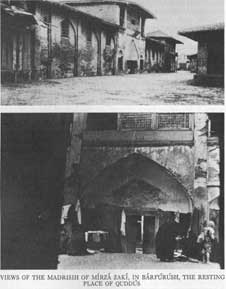 It would be appropriate at this juncture to place on record the names of those martyrs who participated in the defence of
the fort of Shaykh Tabarsi, in the hope that generations yet to come may
recall with pride and gratitude the names, no less than the deeds, of
those pioneers who, by their life and death, have so greatly enriched the annals of God's immortal Faith.
Such names as I have been able to collect from various sources, and for
which I am particularly indebted
It would be appropriate at this juncture to place on record the names of those martyrs who participated in the defence of
the fort of Shaykh Tabarsi, in the hope that generations yet to come may
recall with pride and gratitude the names, no less than the deeds, of
those pioneers who, by their life and death, have so greatly enriched the annals of God's immortal Faith.
Such names as I have been able to collect from various sources, and for
which I am particularly indebted
on His pilgrimage to Mecca and Medina, was, together with Mulla Sadiq and Mulla Ali-Akbar-i-Ardistani, the first to suffer persecution on Persian soil for the sake of the Cause of God. He was only eighteen years of age when he left his native town of Barfurush for Karbila. For about four years he sat at the feet of Siyyid Kazim, and at the age of twenty-two met and recognised his Beloved in Shiraz. Five years later, on the twenty-third day of Jamadiyu'th-Thani in the year 1265 A.H.,(1) he was destined to fall, in the Sabzih-Maydan of Barfurush, a victim of the most refined and wanton barbarity at the hands of the enemy. The Bab and, at a later time, Baha'u'llah have mourned in unnumbered Tablets and prayers his loss, and have lavished on him their eulogies. Such was the honour accorded to him by Baha'u'llah that in His commentary on the verse of Kullu't-Ta'am,(2) which He revealed while in Baghdad, He conferred upon him the unrivalled station of the Nuqtiy-i-Ukhra,(3) a station second to none except that of the Bab Himself.(4)
remained closely associated with Siyyid Kazim. Four years prior to the Declaration of the B ab, acting according to the instructions of Siyyid Kazim, he met in Isfahan the learned mujtahid Siyyid Baqir-i-Rashti and in Mashhad Mirza Askari, to both of whom he delivered with dignity and eloquence the messages with which he had been entrusted by his leader. The circumstances attending his martyrdom evoked the Bab's inexpressible sorrow, a sorrow that found vent in eulogies and prayers of such great number as would be equivalent to thrice the volume of the Qur'an. In one of His visiting Tablets, the Bab asserts that the very dust of the ground where the remains of Mulla Husayn lie buried is endowed with such potency as to bring joy to the disconsolate and healing to the sick. In the Kitab-i-Iqan, Baha'u'llah extols with still greater force the virtues of Mulla Husayn. "But for him," He writes, "God would not have been established upon the seat of His mercy, nor have ascended the throne of eternal glory!"(1)
by his unwavering constancy, and had been one of the servants of the shrine of the Imam Rida.
cause the same tumult in Kirman as he has already done in Shiraz. The injury he will inflict will be irreparable. The magic of his eloquence and the force of his personality, if they do not already excel those of Mulla Husayn, are certainly not inferior to them." By this means he was able to force him to curtail his stay in Kirman and to prevent him from addressing the people from the pulpit. The Bab gave him the following instructions: "You must visit the towns and cities of Persia and summon their inhabitants to the Cause of God. On the first day of the month of Muharram in the year 1265 A.H.,(1) you must be in Mazindaran and must arise to lend every assistance in your power to Quddus." Mulla Yusuf, faithful to the instructions of his Master, refused to prolong his stay beyond a week in any of the towns and cities which he visited. On his arrival in Mazindaran, he was made captive by the forces of Prince Mihdi-Quli Mirza, who immediately recognised him and gave orders that he be imprisoned. He was eventually released, as we have already observed, by the companions of Mulla Husayn on the day of the battle of Vas-Kas.
truth.'"(1) The prince, infuriated by his answer, gave orders that his body be cut to pieces and that no effort be spared to inflict upon him a most humiliating punishment.
The circumstances of the martyrdom of these last two
companions were related by Siyyid Abu-Talib-i-Sang-Sari, one of those
who survived that memorable siege, in a communication he addressed to
Baha'u'llah. In it he relates, in addition, his own story, as well as that of his two brothers, Siyyid Ahmad and Mir
Abu'l-Qasim, both of whom were martyred while defending the fort.
"On the day on which Khusraw was slain," he wrote, "I happened to be
the guest of a certain Karbila'i Ali-Jan,
the kad-khuda(20) of
one of the villages in the neighbourhood of the fort. He had gone to
assist in the protection of Khusraw, and had returned and was relating to
me the circumstances attendi
ng his death. On that very day, a messenger informed me that two
Arabs had arrived at that village and were anxious to join the occupants
of the fort. They expressed their fear of the people of the village of
Qadi-Kala, and promised that they would amply reward whoever would be willing to conduct them to their
destination. I recalled the counsels of my f
ather, Mir Muhammad-'Ali, who exhorted me to arise and 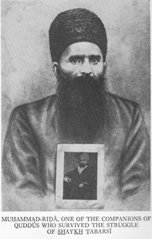 The names of some of the officers who distinguished themselves
among the opponents of the
companions of Quddus are as follows:
The names of some of the officers who distinguished themselves
among the opponents of the
companions of Quddus are as follows: 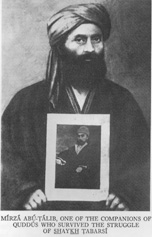 As to those believers
who
participated in that memorable siege and survived its tragic end, I have
been thus far unable to ascertain in full either their names or their
number. I have contented myself with a representative, though
incomplete, list of the names of its martyrs, trusting that in the days
to come the valiant promoters of the Faith will arise to fill this gap, and
will, by their research and industry, be able to remedy the imperfections
of this altogether inadequate description of
what must ever remain as one of the most moving episodes of modern
times.
As to those believers
who
participated in that memorable siege and survived its tragic end, I have
been thus far unable to ascertain in full either their names or their
number. I have contented myself with a representative, though
incomplete, list of the names of its martyrs, trusting that in the days
to come the valiant promoters of the Faith will arise to fill this gap, and
will, by their research and industry, be able to remedy the imperfections
of this altogether inadequate description of
what must ever remain as one of the most moving episodes of modern
times.