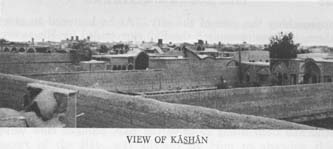

 N THE eve of the Bab's arrival at Kashan, Haji
Mirza Jani, surnamed Parpa, a noted resident of
that city, dreamed that he was standing at a late
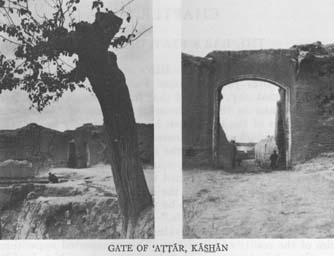
hour in the afternoon at the gate of Attar, one
of the gates of the city, when his eyes suddenly beheld the
Bab on horseback wearing, instead of His customary turban,
the kulah(1) usually worn by the merchants of Persia. Before
Him, as well as behind Him, marched a number of horsemen
into whose custody He seemed to have been delivered. As
they approached the gate, the Bab saluted him and said:
" Haji Mirza Jani, We are to be your Guest for three nights.
Prepare yourself to receive Us."
When he awoke, the vividness of his dream convinced
him of the reality of his vision. This unexpected apparition
constituted in his eyes a providential warning which he felt
it his duty to heed and observe. He accordingly set out
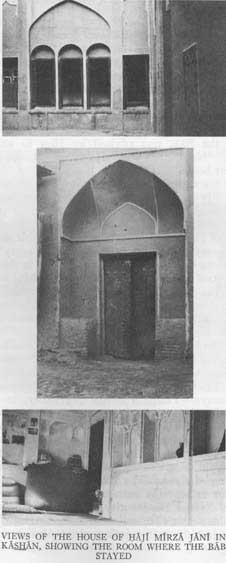
to prepare his house for the reception of the Visitor, and to
provide whatever seemed necessary for His comfort. As soon
as he had completed the preliminary arrangements for the
banquet which he had decided to offer the Bab that night,
Haji Mirza Jani proceeded to the gate of Attar, and there
waited for the signs of the Bab's expected arrival. At the
appointed hour, as he was scanning the horizon, he descried
in the distance what seemed to him a company of horsemen
N THE eve of the Bab's arrival at Kashan, Haji
Mirza Jani, surnamed Parpa, a noted resident of
that city, dreamed that he was standing at a late
hour in the afternoon at the gate of Attar, one
of the gates of the city, when his eyes suddenly beheld the
Bab on horseback wearing, instead of His customary turban,
the kulah(1) usually worn by the merchants of Persia. Before
Him, as well as behind Him, marched a number of horsemen
into whose custody He seemed to have been delivered. As
they approached the gate, the Bab saluted him and said:
" Haji Mirza Jani, We are to be your Guest for three nights.
Prepare yourself to receive Us."
When he awoke, the vividness of his dream convinced
him of the reality of his vision. This unexpected apparition
constituted in his eyes a providential warning which he felt
it his duty to heed and observe. He accordingly set out
to prepare his house for the reception of the Visitor, and to
provide whatever seemed necessary for His comfort. As soon
as he had completed the preliminary arrangements for the
banquet which he had decided to offer the Bab that night,
Haji Mirza Jani proceeded to the gate of Attar, and there
waited for the signs of the Bab's expected arrival. At the
appointed hour, as he was scanning the horizon, he descried
in the distance what seemed to him a company of horsemen
 The night the Bab arrived at Kashan coincided with the
eve preceding the third Naw-Ruz, after the declaration of
His Mission, which fell on the second day of the month of
Rabi'u'th-Thani, in the year 1263 A.H.(1) On that same night,
Siyyid Husayn-i-Yazdi, who had previously, in accordance
with the directions of the Bab, come to Kashan, was invited
to the house of Haji Mirza Jani and introduced into the
presence of his Master. The Bab was dictating to him a
Tablet in honour of His host, when a friend of the latter, a
certain Siyyid Abdu'l-Baqi, who was noted in Kashan for
his learning, arrived. The Bab invited him to enter, permitted
him to hear the verses which He was revealing, but
refused to disclose His identity. In the concluding passages
of the Tablet which He was addressing to Haji Mirza Jani,
He prayed in his behalf, supplicated the Almighty to illumine
The night the Bab arrived at Kashan coincided with the
eve preceding the third Naw-Ruz, after the declaration of
His Mission, which fell on the second day of the month of
Rabi'u'th-Thani, in the year 1263 A.H.(1) On that same night,
Siyyid Husayn-i-Yazdi, who had previously, in accordance
with the directions of the Bab, come to Kashan, was invited
to the house of Haji Mirza Jani and introduced into the
presence of his Master. The Bab was dictating to him a
Tablet in honour of His host, when a friend of the latter, a
certain Siyyid Abdu'l-Baqi, who was noted in Kashan for
his learning, arrived. The Bab invited him to enter, permitted
him to hear the verses which He was revealing, but
refused to disclose His identity. In the concluding passages
of the Tablet which He was addressing to Haji Mirza Jani,
He prayed in his behalf, supplicated the Almighty to illumine
 Siyyid Abdu'l-Baqi sat and listened to the Bab. He
heard His voice, watched His movements, looked upon the
expression of His face, and noted the words which streamed
unceasingly from His lips, and yet failed to be moved by
their majesty and power. Wrapt in the veils of his own idle
fancy and learning, he was powerless to appreciate the meaning
of the utterances of the Bab. He did not even trouble
to enquire the name or the character of the Guest into whose
presence he had been introduced. Unmoved by the things
he had heard and seen, he retired from that presence, unaware
of the unique opportunity which, through his apathy, he had
irretrievably lost. A few days later, when informed of the
name of the Youth whom he had treated with such careless
indifference, he was filled with chagrin and remorse. It was
too late, however, for him to seek His presence and atone
for his conduct, for the Bab had already departed from
Kashan. In his grief, he renounced the society of his fellowmen,
and led, to the end of his days, a life of unrelieved
seclusion.
Among those who were privileged to meet the Bab in the
home of Haji Mirza Jani was a man named Mihdi, who was
destined at a later time, in the year 1268 A.H.,(1) to suffer
martyrdom in Tihran. He and a few others were, during
those three days, affectionately entertained by Haji Mirza
Jani, whose lavish hospitality earned him the praise and
commendation of his Master. To even the members of the
Bab's escort he extended the same loving-kindness, and, by
Siyyid Abdu'l-Baqi sat and listened to the Bab. He
heard His voice, watched His movements, looked upon the
expression of His face, and noted the words which streamed
unceasingly from His lips, and yet failed to be moved by
their majesty and power. Wrapt in the veils of his own idle
fancy and learning, he was powerless to appreciate the meaning
of the utterances of the Bab. He did not even trouble
to enquire the name or the character of the Guest into whose
presence he had been introduced. Unmoved by the things
he had heard and seen, he retired from that presence, unaware
of the unique opportunity which, through his apathy, he had
irretrievably lost. A few days later, when informed of the
name of the Youth whom he had treated with such careless
indifference, he was filled with chagrin and remorse. It was
too late, however, for him to seek His presence and atone
for his conduct, for the Bab had already departed from
Kashan. In his grief, he renounced the society of his fellowmen,
and led, to the end of his days, a life of unrelieved
seclusion.
Among those who were privileged to meet the Bab in the
home of Haji Mirza Jani was a man named Mihdi, who was
destined at a later time, in the year 1268 A.H.,(1) to suffer
martyrdom in Tihran. He and a few others were, during
those three days, affectionately entertained by Haji Mirza
Jani, whose lavish hospitality earned him the praise and
commendation of his Master. To even the members of the
Bab's escort he extended the same loving-kindness, and, by



|