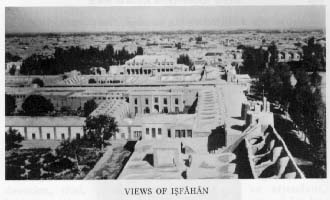

 HE summer of the year 1262 A.H.(1) was drawing to
a close when the Bab bade His last farewell to
His native city of Shiraz, and proceeded to Isfahan.
Siyyid Kazim-i-Zanjani accompanied Him on that
journey. As He approached the outskirts of the city, He
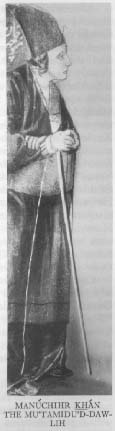
wrote a letter to the governor of the province, Manuchihr
Khan, the Mu'tamidu'd-Dawlih,(2) in which He requested
him to signify his wish as to the place where He could dwell.
The letter, which He entrusted to Siyyid Kazim, was expressive
of such courtesy and revealed such exquisite penmanship
that the Mu'tamid was moved to instruct the
Sultanu'l-'Ulama, the Imam-Jum'ih of Isfahan,'(3) the foremost
ecclesiastical authority of that province, to receive the Bab
in his own home and to accord Him a kindly and generous
HE summer of the year 1262 A.H.(1) was drawing to
a close when the Bab bade His last farewell to
His native city of Shiraz, and proceeded to Isfahan.
Siyyid Kazim-i-Zanjani accompanied Him on that
journey. As He approached the outskirts of the city, He
wrote a letter to the governor of the province, Manuchihr
Khan, the Mu'tamidu'd-Dawlih,(2) in which He requested
him to signify his wish as to the place where He could dwell.
The letter, which He entrusted to Siyyid Kazim, was expressive
of such courtesy and revealed such exquisite penmanship
that the Mu'tamid was moved to instruct the
Sultanu'l-'Ulama, the Imam-Jum'ih of Isfahan,'(3) the foremost
ecclesiastical authority of that province, to receive the Bab
in his own home and to accord Him a kindly and generous
 Such were the honours accorded to the Bab in those days
that when, on a certain Friday, He was returning from the
public bath to the house, a multitude of people were seen
eagerly clamouring for the water which He had used for His
ablutions. His fervent admirers firmly believed in its unfailng
virtue and power to heal their sicknesses and ailments.
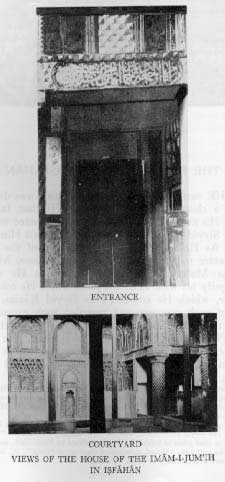
The Imam-Jum'ih himself had, from the very first night,
become so enamoured with Him who was the object of such
devotion, that, assuming the functions of an attendant,
he undertook to minister to the needs and wants of his beloved
Guest. Seizing the ewer from the hand of the chief
steward and utterly ignoring the customary dignity of his
rank, he proceeded to pour out the water over the hands of
the Bab.
One night, after supper, the Imam-Jum'ih, whose curiosity
had been excited by the extraordinary traits of character
which his youthful Guest had revealed, ventured to request
Him to reveal a commentary on the Surih of Va'l-'Asr.(2)
His request was readily granted. Calling for pen and paper,
the Bab, with astonishing rapidity and without the least
premeditation, began to reveal, in the presence of His host,
a most illuminating interpretation of the aforementioned
Surih. It was nearing midnight when the Bab found Himself
engaged in the exposition of the manifold implications involved
in the first letter of that Surih. That letter, the letter
` vav' upon which Shaykh Ahmad-i-Ahsa'i had already laid such
emphasis in his writings, symbolised for the Bab the advent
of a new cycle of Divine Revelation, and has since been
alluded to by Baha'u'llah in the "Kitab-i-Aqdas" in such
passages as "the mastery of the Great Reversal" and "the
Sign of the Sovereign." The Bab soon after began to chant,
in the presence of His host and his companions, the homily
with which He had prefaced His commentary on the Surih.
Those words of power confounded His hearers with wonder.
As the Bab's fame was being gradually diffused over the
entire city of Isfahan, an unceasing stream of visitors flowed
from every quarter to the house of the Imam-Jum'ih: a few
to satisfy their curiosity, others to obtain a deeper understanding
of the fundamental verities of His Faith, and still
others to seek the remedy for their ills and sufferings. The
Mu'tamid himself came one day to visit the Bab and, while
seated in the midst of an assemblage of the most brilliant
and accomplished divines of Isfahan, requested Him to expound
the nature and demonstrate the validity of the Nubuvvat-i-Khassih.(1) He had previously, in that same gathering, called upon those who were present to adduce such
proofs and evidences in support of this fundamental article
of their Faith as would constitute an unanswerable testimony
for those who were inclined to repudiate its truth. No one,
however, seemed capable of responding to his invitation.
"Which do you prefer," asked the Bab, "a verbal or a written
answer to your question?" "A written reply," he answered,
"not only would please those who are present at this meeting,
but would edify and instruct both the present and future
generations."
The Bab instantly took up His pen and began to write.
In less than two hours, He had filled about fifty pages with
a most refreshing and circumstantial enquiry into the origin,
the character, and the pervasive influence of Islam. The
originality of His dissertation, the vigour and vividness of
Such were the honours accorded to the Bab in those days
that when, on a certain Friday, He was returning from the
public bath to the house, a multitude of people were seen
eagerly clamouring for the water which He had used for His
ablutions. His fervent admirers firmly believed in its unfailng
virtue and power to heal their sicknesses and ailments.
The Imam-Jum'ih himself had, from the very first night,
become so enamoured with Him who was the object of such
devotion, that, assuming the functions of an attendant,
he undertook to minister to the needs and wants of his beloved
Guest. Seizing the ewer from the hand of the chief
steward and utterly ignoring the customary dignity of his
rank, he proceeded to pour out the water over the hands of
the Bab.
One night, after supper, the Imam-Jum'ih, whose curiosity
had been excited by the extraordinary traits of character
which his youthful Guest had revealed, ventured to request
Him to reveal a commentary on the Surih of Va'l-'Asr.(2)
His request was readily granted. Calling for pen and paper,
the Bab, with astonishing rapidity and without the least
premeditation, began to reveal, in the presence of His host,
a most illuminating interpretation of the aforementioned
Surih. It was nearing midnight when the Bab found Himself
engaged in the exposition of the manifold implications involved
in the first letter of that Surih. That letter, the letter
` vav' upon which Shaykh Ahmad-i-Ahsa'i had already laid such
emphasis in his writings, symbolised for the Bab the advent
of a new cycle of Divine Revelation, and has since been
alluded to by Baha'u'llah in the "Kitab-i-Aqdas" in such
passages as "the mastery of the Great Reversal" and "the
Sign of the Sovereign." The Bab soon after began to chant,
in the presence of His host and his companions, the homily
with which He had prefaced His commentary on the Surih.
Those words of power confounded His hearers with wonder.
As the Bab's fame was being gradually diffused over the
entire city of Isfahan, an unceasing stream of visitors flowed
from every quarter to the house of the Imam-Jum'ih: a few
to satisfy their curiosity, others to obtain a deeper understanding
of the fundamental verities of His Faith, and still
others to seek the remedy for their ills and sufferings. The
Mu'tamid himself came one day to visit the Bab and, while
seated in the midst of an assemblage of the most brilliant
and accomplished divines of Isfahan, requested Him to expound
the nature and demonstrate the validity of the Nubuvvat-i-Khassih.(1) He had previously, in that same gathering, called upon those who were present to adduce such
proofs and evidences in support of this fundamental article
of their Faith as would constitute an unanswerable testimony
for those who were inclined to repudiate its truth. No one,
however, seemed capable of responding to his invitation.
"Which do you prefer," asked the Bab, "a verbal or a written
answer to your question?" "A written reply," he answered,
"not only would please those who are present at this meeting,
but would edify and instruct both the present and future
generations."
The Bab instantly took up His pen and began to write.
In less than two hours, He had filled about fifty pages with
a most refreshing and circumstantial enquiry into the origin,
the character, and the pervasive influence of Islam. The
originality of His dissertation, the vigour and vividness of
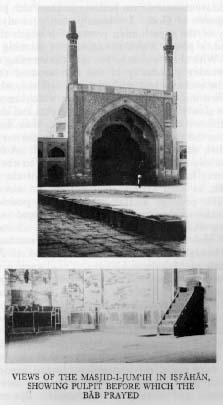 The growing popularity of the Bab aroused the resentment
of the ecclesiastical authorities of Isfahan, who viewed
with concern and envy the ascendancy which an unlearned
Youth was slowly acquiring over the thoughts and consciences
of their followers. They firmly believed that unless they
rose to stem the tide of popular enthusiasm, the very foundations
of their existence would be undermined. A few of the
more sagacious among them thought it wise to abstain from
acts of direct hostility to either the person or the teachings
of the Bab, as such action, they felt, would serve only to
enhance His prestige and consolidate His position. The
mischief-makers, however, were busily engaged in disseminating
the wildest reports concerning the character and
claims of the Bab. These reports soon reached Tihran
and were brought to the attention of Haji Mirza Aqasi, the
Grand Vazir of Muhammad Shah. This haughty and overbearing
minister viewed with apprehension the possibility
that his sovereign might one day feel inclined to befriend
the Bab, an inclination which he felt sure would precipitate
his own downfall. The Haji was, moreover, apprehensive
lest the Mu'tamid, who enjoyed the confidence of the Shah,
should succeed in arranging an interview between the sovereign
and the Bab. He was well aware that should such an
interview take place, the impressionable and tender-hearted
Muhammad Shah would be completely won over by the
attractiveness and novelty of that creed. Spurred on by
As soon as the Mu'tamid was informed of these developments,
he sent a message to the Imam-Jum'ih in which he
reminded him of the visit he as governor had paid to the
Bab, and extended to him as well as to his Guest an invitation
to his home. The Mu'tamid invited Haji Siyyid Asadu'llah,
son of the late Haji Siyyid Muhammad Baqir-i-Rashti,
Haji Muhammad-Ja'far-i-Abadiyi, Muhammad-Mihdi, Mirza
Hasan-i-Nuri, and a few others to be present at that meeting.
Haji Siyyid Asadu'llah refused the invitation and endeavoured
to dissuade those who had been invited, from participating
in that gathering. "I have sought to excuse myself," he
informed them, "and I would most certainly urge you to do
the same. I regard it as most unwise of you to meet the
Siyyid-i-Bab face to face. He will, no doubt, reassert his
claim and will, in support of his argument, adduce whatever
proof you may desire him to give, and, without the least
hesitation, will reveal as a testimony to the truth he bears,
verses of such a number as would equal half the Qur'an. In
the end he will challenge you in these words: `Produce likewise,
The growing popularity of the Bab aroused the resentment
of the ecclesiastical authorities of Isfahan, who viewed
with concern and envy the ascendancy which an unlearned
Youth was slowly acquiring over the thoughts and consciences
of their followers. They firmly believed that unless they
rose to stem the tide of popular enthusiasm, the very foundations
of their existence would be undermined. A few of the
more sagacious among them thought it wise to abstain from
acts of direct hostility to either the person or the teachings
of the Bab, as such action, they felt, would serve only to
enhance His prestige and consolidate His position. The
mischief-makers, however, were busily engaged in disseminating
the wildest reports concerning the character and
claims of the Bab. These reports soon reached Tihran
and were brought to the attention of Haji Mirza Aqasi, the
Grand Vazir of Muhammad Shah. This haughty and overbearing
minister viewed with apprehension the possibility
that his sovereign might one day feel inclined to befriend
the Bab, an inclination which he felt sure would precipitate
his own downfall. The Haji was, moreover, apprehensive
lest the Mu'tamid, who enjoyed the confidence of the Shah,
should succeed in arranging an interview between the sovereign
and the Bab. He was well aware that should such an
interview take place, the impressionable and tender-hearted
Muhammad Shah would be completely won over by the
attractiveness and novelty of that creed. Spurred on by
As soon as the Mu'tamid was informed of these developments,
he sent a message to the Imam-Jum'ih in which he
reminded him of the visit he as governor had paid to the
Bab, and extended to him as well as to his Guest an invitation
to his home. The Mu'tamid invited Haji Siyyid Asadu'llah,
son of the late Haji Siyyid Muhammad Baqir-i-Rashti,
Haji Muhammad-Ja'far-i-Abadiyi, Muhammad-Mihdi, Mirza
Hasan-i-Nuri, and a few others to be present at that meeting.
Haji Siyyid Asadu'llah refused the invitation and endeavoured
to dissuade those who had been invited, from participating
in that gathering. "I have sought to excuse myself," he
informed them, "and I would most certainly urge you to do
the same. I regard it as most unwise of you to meet the
Siyyid-i-Bab face to face. He will, no doubt, reassert his
claim and will, in support of his argument, adduce whatever
proof you may desire him to give, and, without the least
hesitation, will reveal as a testimony to the truth he bears,
verses of such a number as would equal half the Qur'an. In
the end he will challenge you in these words: `Produce likewise,
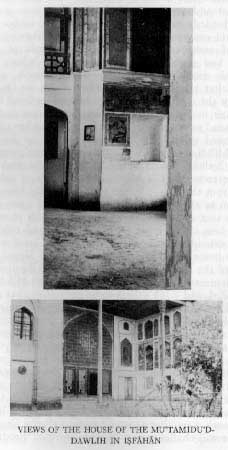 Haji Muhammad-Ja'far heeded this counsel and refused
to accept the invitation of the governor. Muhammad Mihdi,
Mirza Hasan-i-Nuri, and a few others who disdained such
advice, presented themselves at the appointed hour at the
home of the Mu'tamid. At the invitation of the host, Mirza
Hasan, a noted Platonist, requested the Bab to elucidate
certain abstruse philosophical doctrines connected with the
Arshiyyih of Mulla Sadra,(1) the meaning of which only a
few had been able to unravel.(2) In simple and unconventional
language, the Bab replied to each of his questions.
Mirza Hasan, though unable to apprehend the meaning of
the answers which he had received, realised how inferior
was the learning of the so-called exponents of the Platonic
and the Aristotelian schools of thought of his day to the
knowledge displayed by that Youth. Muhammad Mihdi
ventured in his turn to question the Bab regarding certain
aspects of the Islamic law. Dissatisfied with the explanation
he received, he began to contend idly with the Bab. He was
soon silenced by the Mu'tamid, who, cutting short his conversation,
turned to an attendant and, bidding him light the
lantern, gave the order that Muhammad Mihdi be immediately
conducted to his home. The Mu'tamid subsequently
The Bab had tarried forty days at the residence of the
Imam-Jum'ih. While He was still there, a certain Mulla
Muhammad-Taqiy-i-Harati, who was privileged to meet the
Bab every day, undertook, with His consent, to translate
one of His works, entitled Risaliy-i-Furu'-i-'Adliyyih, from
the original Arabic into Persian. The service he thereby
rendered to the Persian believers was marred, however, by
his subsequent behaviour. Fear suddenly seized him, and
he was induced eventually to sever his connection with his
fellow-believers.
Ere the Bab had transferred His residence to the house
of the Mu'tamid, Mirza Ibrahim, father of the Sultanu'sh-Shuhada'
and elder brother of Mirza Muhammad-'Aliy-i-Nahri,
to whom we have already referred, invited the Bab
to his home one night. Mirza Ibrahim was a friend of the
Imam-Jum'ih, was intimately associated with him, and controlled
the management of all his affairs. The banquet which
was spread for the Bab that night was one of unsurpassed
magnificence. It was commonly observed that neither the
officials nor the notables of the city had offered a feast of
such magnitude and splendour. The Sultanu'sh-Shuhada'
and his brother, the Mahbubu'sh-Shuhada', who were lads
of nine and eleven, respectively, served at that banquet and
received special attention from the Bab. That night, during
dinner, Mirza Ibrahim turned to his Guest and said: "My
brother, Mirza Muhammad-'Ali, has no child. I beg You
to intercede in his behalf and to grant his heart's desire."
The Bab took a portion of the food with which He had been
served, placed it with His own hands on a platter, and handed
it to His host, asking him to take it to Mirza Muhammad-'Ali
and his wife. "Let them both partake of this," He said;
"their wish will be fulfilled." By virtue of that portion which
the Bab had chosen to bestow upon her, the wife of Mirza
The high honours accorded to the Bab served further to
inflame the hostility of the ulamas of Isfahan. With feelings
of dismay, they beheld on every side evidences of His all-pervasive
influence invading the stronghold of orthodoxy and
subverting their foundations. They summoned a gathering,
at which they issued a written document, signed and sealed
by all the ecclesiastical leaders of the city, condemning the
Bab to death.(2) They all concurred in this condemnation
with the exception of Haji Siyyid Asadu'llah and Haji
Muhammad-Ja'far-i-Abadiyi, both of whom refused to associate
themselves with the contents of so glaringly abusive a document.
The Imam-Jum'ih, though declining to endorse the
death-warrant of the Bab, was induced, by reason of his
extreme cowardice and ambition, to add to that document,
in his own handwriting, the following testimony: "I testify
that in the course of my association with this youth I have
been unable to discover any act that would in any way
betray his repudiation of the doctrines of Islam. On the
contrary, I have known him as a pious and loyal observer
of its precepts. The extravagance of his claims, however,
and his disdainful contempt for the things of the world,
incline me to believe that he is devoid of reason and judgment."
No sooner had the Mu'tamid been informed of the condemnation
pronounced by the ulamas of Isfahan than he
determined, by a plan which he himself conceived, to nullify
the effects of that cruel verdict. He issued immediate instructions
that towards the hour of sunset the Bab, escorted
by five hundred horsemen of the governor's own mounted
body-guard, should leave the gate of the city and proceed
in the direction of Tihran. Imperative orders had been
given that at the completion of each farsang(3) one hundred
of this mounted escort should return directly to Isfahan.
Haji Muhammad-Ja'far heeded this counsel and refused
to accept the invitation of the governor. Muhammad Mihdi,
Mirza Hasan-i-Nuri, and a few others who disdained such
advice, presented themselves at the appointed hour at the
home of the Mu'tamid. At the invitation of the host, Mirza
Hasan, a noted Platonist, requested the Bab to elucidate
certain abstruse philosophical doctrines connected with the
Arshiyyih of Mulla Sadra,(1) the meaning of which only a
few had been able to unravel.(2) In simple and unconventional
language, the Bab replied to each of his questions.
Mirza Hasan, though unable to apprehend the meaning of
the answers which he had received, realised how inferior
was the learning of the so-called exponents of the Platonic
and the Aristotelian schools of thought of his day to the
knowledge displayed by that Youth. Muhammad Mihdi
ventured in his turn to question the Bab regarding certain
aspects of the Islamic law. Dissatisfied with the explanation
he received, he began to contend idly with the Bab. He was
soon silenced by the Mu'tamid, who, cutting short his conversation,
turned to an attendant and, bidding him light the
lantern, gave the order that Muhammad Mihdi be immediately
conducted to his home. The Mu'tamid subsequently
The Bab had tarried forty days at the residence of the
Imam-Jum'ih. While He was still there, a certain Mulla
Muhammad-Taqiy-i-Harati, who was privileged to meet the
Bab every day, undertook, with His consent, to translate
one of His works, entitled Risaliy-i-Furu'-i-'Adliyyih, from
the original Arabic into Persian. The service he thereby
rendered to the Persian believers was marred, however, by
his subsequent behaviour. Fear suddenly seized him, and
he was induced eventually to sever his connection with his
fellow-believers.
Ere the Bab had transferred His residence to the house
of the Mu'tamid, Mirza Ibrahim, father of the Sultanu'sh-Shuhada'
and elder brother of Mirza Muhammad-'Aliy-i-Nahri,
to whom we have already referred, invited the Bab
to his home one night. Mirza Ibrahim was a friend of the
Imam-Jum'ih, was intimately associated with him, and controlled
the management of all his affairs. The banquet which
was spread for the Bab that night was one of unsurpassed
magnificence. It was commonly observed that neither the
officials nor the notables of the city had offered a feast of
such magnitude and splendour. The Sultanu'sh-Shuhada'
and his brother, the Mahbubu'sh-Shuhada', who were lads
of nine and eleven, respectively, served at that banquet and
received special attention from the Bab. That night, during
dinner, Mirza Ibrahim turned to his Guest and said: "My
brother, Mirza Muhammad-'Ali, has no child. I beg You
to intercede in his behalf and to grant his heart's desire."
The Bab took a portion of the food with which He had been
served, placed it with His own hands on a platter, and handed
it to His host, asking him to take it to Mirza Muhammad-'Ali
and his wife. "Let them both partake of this," He said;
"their wish will be fulfilled." By virtue of that portion which
the Bab had chosen to bestow upon her, the wife of Mirza
The high honours accorded to the Bab served further to
inflame the hostility of the ulamas of Isfahan. With feelings
of dismay, they beheld on every side evidences of His all-pervasive
influence invading the stronghold of orthodoxy and
subverting their foundations. They summoned a gathering,
at which they issued a written document, signed and sealed
by all the ecclesiastical leaders of the city, condemning the
Bab to death.(2) They all concurred in this condemnation
with the exception of Haji Siyyid Asadu'llah and Haji
Muhammad-Ja'far-i-Abadiyi, both of whom refused to associate
themselves with the contents of so glaringly abusive a document.
The Imam-Jum'ih, though declining to endorse the
death-warrant of the Bab, was induced, by reason of his
extreme cowardice and ambition, to add to that document,
in his own handwriting, the following testimony: "I testify
that in the course of my association with this youth I have
been unable to discover any act that would in any way
betray his repudiation of the doctrines of Islam. On the
contrary, I have known him as a pious and loyal observer
of its precepts. The extravagance of his claims, however,
and his disdainful contempt for the things of the world,
incline me to believe that he is devoid of reason and judgment."
No sooner had the Mu'tamid been informed of the condemnation
pronounced by the ulamas of Isfahan than he
determined, by a plan which he himself conceived, to nullify
the effects of that cruel verdict. He issued immediate instructions
that towards the hour of sunset the Bab, escorted
by five hundred horsemen of the governor's own mounted
body-guard, should leave the gate of the city and proceed
in the direction of Tihran. Imperative orders had been
given that at the completion of each farsang(3) one hundred
of this mounted escort should return directly to Isfahan.
 remaining hundred should likewise be
ordered by him to return to the city.
Of the twenty remaining horsemen, the
Mu'tamid directed that ten should be
despatched to Ardistan for the purpose
of collecting the taxes levied by the
government, and that the rest, all of
whom should be of his tried and most
reliable men, should, by an unfrequented
route, bring the Bab back in
disguise to Isfahan.(1) They were, moreover,
instructed so to regulate their
march that before dawn of the ensuing
day the Bab should have arrived at
Isfahan and should have been delivered
into his custody. This plan was
immediately taken in hand and duly
executed. At an unsuspected hour the
Bab re-entered the city, was directly
conducted to the private residence of
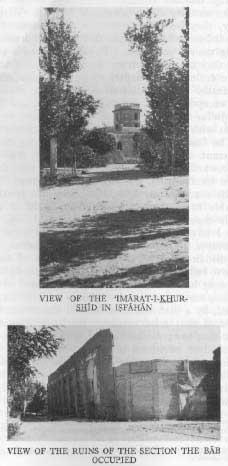
the Mu'tamid, known by the name of
Imarat-i-Khurshid,(2) and was introduced,
through a side entrance reserved
for the Mu'tamid himself, into his private
apartments. The governor waited
in person on the Bab, served His meals,
and provided whatever was required
for His comfort and safety.(3)
Meanwhile the wildest conjectures obtained currency in
the city regarding the journey of the Bab to Tihran, the sufferings
which He was made to endure on His way to the
capital, the verdict which had been pronounced against Him,
and the penalty which He had suffered. These rumours
greatly distressed the believers who were residing in Isfahan.
The Mu'tamid, who was well aware of their grief and anxiety,
interceded with the Bab in their behalf and begged to be
allowed to introduce them into His presence. The Bab addressed
a few words in His own handwriting to Mulla Abdu'l-Karim-i-Qazvini,
who had taken up his quarters in the
madrisih of Nim-Avard, and instructed the Mu'tamid to
send it to him by a trusted messenger. An hour later, Mulla
Abdu'l-Karim was ushered into the presence of the Bab.
Of his arrival no one except the Mu'tamid was informed.
He received from his Master some of His writings, and was
instructed to transcribe them in collaboration with Siyyid
Husayn-i-Yazdi and Shaykh Hasan-i-Zunuzi. To these he
soon returned, bearing the welcome news of the Bab's well-being
and safety. Of all the believers residing in Isfahan,
these three alone were allowed to see Him.
One day, while seated with the Bab in his private garden
within the courtyard of his house, the Mu'tamid, taking his
Guest into his confidence, addressed Him in these words:
"The almighty Giver has endowed me with great riches.(1) I
know not how best to use them. Now that I have, by the
aid of God, been led to recognise this Revelation, it is my
ardent desire to consecrate all my possessions to the furtherance
of its interests and the spread of its fame. It is my
intention to proceed, by Your leave, to Tihran, and to do
my best to win to this Cause Muhammad Shah, whose confidence
in me is firm and unshaken. I am certain that he
will eagerly embrace it, and will arise to promote it far and
wide. I will also endeavour to induce the Shah to dismiss
the profligate Haji Mirza Aqasi, the folly of whose administration
has well-nigh brought this land to the verge of ruin.
Next, I will strive to obtain for You the hand of one of the
As the days of his earthly life were drawing to a close,
the Mu'tamid increasingly sought the presence of the Bab,
and, in his hours of intimate fellowship with Him, obtained
a deeper realisation of the spirit which animated His Faith.
"As the hour of my departure approaches," he one day told
the Bab, "I feel an undefinable joy pervading my soul. But
I am apprehensive for You, I tremble at the thought of
being compelled to leave You to the mercy of so ruthless a
successor as Gurgin Khan. He will, no doubt, discover
Your presence in this home, and will, I fear, grievously ill-treat
You." "Fear not," remonstrated the Bab; "I have
As the life of the Mu'tamid was approaching its end, the
Bab summoned to His presence Siyyid Husayn-i-Yazdi and
Mulla Abdu'l-Karim, acquainted them with the nature of
His prediction to His host, and bade them tell the believers
who had gathered in the city, to scatter throughout Kashan,
Qum, and Tihran, and await whatever Providence, in His
wisdom, might choose to decree.
A few days after the death of the Mu'tamid, a certain
person who was aware of the design which he had conceived
and carried out for the protection of the Bab, informed his
successor, Gurgin Khan,(3) of the actual residence of the Bab
in the Imarat-i-Khurshid, and described to him the honours
which his predecessor had lavished upon his Guest in the
privacy of his own home. On the receipt of this unexpected
intelligence, Gurgin Khan despatched his messenger to
Tihran and instructed him to deliver in person the following
The Shah, who was firmly convinced of the loyalty of
the Mu'tamid, realised, when he received this message, that
the late governor's sincere intention had been to await a
favourable occasion when he could arrange a meeting between
him and the Bab, and that his sudden death had interfered
with the execution of that plan. He issued an imperial mandate
summoning the Bab to the capital. In his written
message to Gurgin Khan, the Shah commanded him to send
the Bab in disguise, in the company of a mounted escort(1) headed by Muhammad Big-i-Chaparchi,(2) of the sect of the Aliyu'llahi, to Tihran; to exe
rcise the utmost consideration
towards Him in the course of His journey, and strictly to
maintain the secrecy of His departure.(3)
Gurgin Khan went immediately to the Bab and delivered
into His hands the written mandate of the sovereign. He
then summoned Muhammad Big, conveyed to him the behests
of Muhammad Shah, and ordered him to undertake
immediate preparations for the journey. "Beware," he
warned him, "lest anyone discover his identity or suspect
the nature of your mission. No one but you, not even the
members of his escort, should be allowed to recognise him.
Should anyone question you concerning him, say that he is
remaining hundred should likewise be
ordered by him to return to the city.
Of the twenty remaining horsemen, the
Mu'tamid directed that ten should be
despatched to Ardistan for the purpose
of collecting the taxes levied by the
government, and that the rest, all of
whom should be of his tried and most
reliable men, should, by an unfrequented
route, bring the Bab back in
disguise to Isfahan.(1) They were, moreover,
instructed so to regulate their
march that before dawn of the ensuing
day the Bab should have arrived at
Isfahan and should have been delivered
into his custody. This plan was
immediately taken in hand and duly
executed. At an unsuspected hour the
Bab re-entered the city, was directly
conducted to the private residence of
the Mu'tamid, known by the name of
Imarat-i-Khurshid,(2) and was introduced,
through a side entrance reserved
for the Mu'tamid himself, into his private
apartments. The governor waited
in person on the Bab, served His meals,
and provided whatever was required
for His comfort and safety.(3)
Meanwhile the wildest conjectures obtained currency in
the city regarding the journey of the Bab to Tihran, the sufferings
which He was made to endure on His way to the
capital, the verdict which had been pronounced against Him,
and the penalty which He had suffered. These rumours
greatly distressed the believers who were residing in Isfahan.
The Mu'tamid, who was well aware of their grief and anxiety,
interceded with the Bab in their behalf and begged to be
allowed to introduce them into His presence. The Bab addressed
a few words in His own handwriting to Mulla Abdu'l-Karim-i-Qazvini,
who had taken up his quarters in the
madrisih of Nim-Avard, and instructed the Mu'tamid to
send it to him by a trusted messenger. An hour later, Mulla
Abdu'l-Karim was ushered into the presence of the Bab.
Of his arrival no one except the Mu'tamid was informed.
He received from his Master some of His writings, and was
instructed to transcribe them in collaboration with Siyyid
Husayn-i-Yazdi and Shaykh Hasan-i-Zunuzi. To these he
soon returned, bearing the welcome news of the Bab's well-being
and safety. Of all the believers residing in Isfahan,
these three alone were allowed to see Him.
One day, while seated with the Bab in his private garden
within the courtyard of his house, the Mu'tamid, taking his
Guest into his confidence, addressed Him in these words:
"The almighty Giver has endowed me with great riches.(1) I
know not how best to use them. Now that I have, by the
aid of God, been led to recognise this Revelation, it is my
ardent desire to consecrate all my possessions to the furtherance
of its interests and the spread of its fame. It is my
intention to proceed, by Your leave, to Tihran, and to do
my best to win to this Cause Muhammad Shah, whose confidence
in me is firm and unshaken. I am certain that he
will eagerly embrace it, and will arise to promote it far and
wide. I will also endeavour to induce the Shah to dismiss
the profligate Haji Mirza Aqasi, the folly of whose administration
has well-nigh brought this land to the verge of ruin.
Next, I will strive to obtain for You the hand of one of the
As the days of his earthly life were drawing to a close,
the Mu'tamid increasingly sought the presence of the Bab,
and, in his hours of intimate fellowship with Him, obtained
a deeper realisation of the spirit which animated His Faith.
"As the hour of my departure approaches," he one day told
the Bab, "I feel an undefinable joy pervading my soul. But
I am apprehensive for You, I tremble at the thought of
being compelled to leave You to the mercy of so ruthless a
successor as Gurgin Khan. He will, no doubt, discover
Your presence in this home, and will, I fear, grievously ill-treat
You." "Fear not," remonstrated the Bab; "I have
As the life of the Mu'tamid was approaching its end, the
Bab summoned to His presence Siyyid Husayn-i-Yazdi and
Mulla Abdu'l-Karim, acquainted them with the nature of
His prediction to His host, and bade them tell the believers
who had gathered in the city, to scatter throughout Kashan,
Qum, and Tihran, and await whatever Providence, in His
wisdom, might choose to decree.
A few days after the death of the Mu'tamid, a certain
person who was aware of the design which he had conceived
and carried out for the protection of the Bab, informed his
successor, Gurgin Khan,(3) of the actual residence of the Bab
in the Imarat-i-Khurshid, and described to him the honours
which his predecessor had lavished upon his Guest in the
privacy of his own home. On the receipt of this unexpected
intelligence, Gurgin Khan despatched his messenger to
Tihran and instructed him to deliver in person the following
The Shah, who was firmly convinced of the loyalty of
the Mu'tamid, realised, when he received this message, that
the late governor's sincere intention had been to await a
favourable occasion when he could arrange a meeting between
him and the Bab, and that his sudden death had interfered
with the execution of that plan. He issued an imperial mandate
summoning the Bab to the capital. In his written
message to Gurgin Khan, the Shah commanded him to send
the Bab in disguise, in the company of a mounted escort(1) headed by Muhammad Big-i-Chaparchi,(2) of the sect of the Aliyu'llahi, to Tihran; to exe
rcise the utmost consideration
towards Him in the course of His journey, and strictly to
maintain the secrecy of His departure.(3)
Gurgin Khan went immediately to the Bab and delivered
into His hands the written mandate of the sovereign. He
then summoned Muhammad Big, conveyed to him the behests
of Muhammad Shah, and ordered him to undertake
immediate preparations for the journey. "Beware," he
warned him, "lest anyone discover his identity or suspect
the nature of your mission. No one but you, not even the
members of his escort, should be allowed to recognise him.
Should anyone question you concerning him, say that he is



|