
 HE tale of the tragedy
that marked the closing stages of the Nayriz upheaval spread over the
length and breadth of Persia and kindled a startling
enthusiasm in the hearts of those who heard it. It
plunged the authorities of the capital into consternation and
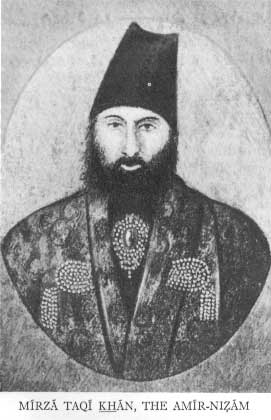
nerved them to a resolve of despair. The Amir-Nizam, the Grand
Vazir of Nasiri'd-Din Shah, was particularly overawed by these
recurrent manifestations of an indomitable will, of a fierce and
inflexible tenacity of faith. Though the forces of the imperial
army had everywhere triumphed, though the companions of
Mulla Husayn and Vahid had successively been mowed down in
a ruthless carnage at the hands of its officers, yet to the shrewd
minds of the rulers of Tihran it was clear and evident that
Bestirred to action, he summoned his counsellors, shared
with them his fears and his hopes, and acquainted them with
the nature of his plans. "Behold," he exclaimed, "the storm
which the Faith of the Siyyid-i-Bab has provoked in the hearts
of my fellow-countrymen! Nothing short of his public execution
can, to my mind, enable this distracted country to recover
its tranquillity and peace. Who dare compute the forces
that have perished in the course of the engagements at Shaykh
Tabarsi? Who can estimate the efforts exerted to secure
that victory? No sooner had the mischief that convulsed
Mazindaran been suppressed, than the flames of another
sedition blazed forth in the province of Fars, bringing in its
wake so much suffering to my people. We had no sooner succeeded
in quelling the revolt that had ravaged the south,
than another insurrection breaks out in the north, sweeping
in its vortex Zanjan and its surroundings. If you are able
to advise a remedy, acquaint me with it, for my sole purpose
is to ensure the peace and honour of my countrymen."
Not a single voice dared venture a reply, except that of
Mirza Aqa Khani-i-Nuri, the Minister of War, who pleaded
HE tale of the tragedy
that marked the closing stages of the Nayriz upheaval spread over the
length and breadth of Persia and kindled a startling
enthusiasm in the hearts of those who heard it. It
plunged the authorities of the capital into consternation and
nerved them to a resolve of despair. The Amir-Nizam, the Grand
Vazir of Nasiri'd-Din Shah, was particularly overawed by these
recurrent manifestations of an indomitable will, of a fierce and
inflexible tenacity of faith. Though the forces of the imperial
army had everywhere triumphed, though the companions of
Mulla Husayn and Vahid had successively been mowed down in
a ruthless carnage at the hands of its officers, yet to the shrewd
minds of the rulers of Tihran it was clear and evident that
Bestirred to action, he summoned his counsellors, shared
with them his fears and his hopes, and acquainted them with
the nature of his plans. "Behold," he exclaimed, "the storm
which the Faith of the Siyyid-i-Bab has provoked in the hearts
of my fellow-countrymen! Nothing short of his public execution
can, to my mind, enable this distracted country to recover
its tranquillity and peace. Who dare compute the forces
that have perished in the course of the engagements at Shaykh
Tabarsi? Who can estimate the efforts exerted to secure
that victory? No sooner had the mischief that convulsed
Mazindaran been suppressed, than the flames of another
sedition blazed forth in the province of Fars, bringing in its
wake so much suffering to my people. We had no sooner succeeded
in quelling the revolt that had ravaged the south,
than another insurrection breaks out in the north, sweeping
in its vortex Zanjan and its surroundings. If you are able
to advise a remedy, acquaint me with it, for my sole purpose
is to ensure the peace and honour of my countrymen."
Not a single voice dared venture a reply, except that of
Mirza Aqa Khani-i-Nuri, the Minister of War, who pleaded
 Disregarding the advice of his counsellor, the Amir-Nizam
despatched his orders to Navvab Hamzih Mirza, the governor
of Adhirbayjan, who was distinguished among the princes of
royal blood for his kind-heartedness and rectitude of conduct,
to summon the Bab to Tabriz.(1) He was careful not to divulge
to the prince his real purpose. The Navvab, assuming that
the intention of the minister was to enable his Captive to
return to His home, immediately directed one of his trusted
officers, together with a mounted escort, to proceed to Chihriq,
where the Bab still lay confined, and to bring Him back
to Tabriz. He recommended Him to their care, urging them
to exercise towards Him the utmost consideration.
Forty days before the arrival of that officer at Chihriq,
the Bab collected all the documents and Tablets in His
possession and, placing them, with His pen-case, His seals,
and agate rings, in a coffer, entrusted them to the care of
Mulla Baqir, one of the Letters of the Living. To him He
also delivered a letter addressed to Mirza Ahmad, His amanuensis,
Mulla Baqir departed forthwith for Qazvin. Within
eighteen days he reached that town and was informed that
Mirza Ahmad had departed for Qum. He left immediately
for that destination and arrived towards the middle of the
month of Sha'ban.(1) I was then in Qum, together with a
certain Sadiq-i-Tabrizi, whom Mirza Ahmad had sent to
fetch me from Zarand. I was living in the same house with
Mirza Ahmad, a house which he had hired in the Bagh-Panbih
quarter. In those days Shaykh Azim, Siyyid Isma'il,
and a number of other companions likewise were dwelling
with us. Mulla Baqir delivered the trust into the hands of
Mirza Ahmad, who, at the insistence of Shaykh Azim,
opened it before us. We marvelled when we beheld, among
the things which that coffer contained, a scroll of blue paper,
of the most delicate texture, on which the Bab, in His own
exquisite handwriting, which was a fine shikastih script, had
penned, in the form of a pentacle, what numbered about
five hundred verses, all consisting of derivatives from the
word "Baha."(2) That scroll was in a state of perfect preservation,
was spotlessly clean, and gave the impression, at first
sight, of being a printed rather than a written page. So fine
and intricate was the penmanship that, viewed at a distance,
the writing appeared as a single wash of ink on the paper.
We were overcome with admiration as we gazed upon a
masterpiece which no calligraphist, we believed, could rival.
That scroll was replaced in the coffer and handed back to
Mirza Ahmad, who, on the very day he received it, proceeded
to Tihran. Ere he departed, he informed us that all he could
divulge of that letter was the injunction that the trust was
to be delivered into the hands of Jinab-i-Baha(3) in Tihran.(4)
Faithful to the instructions he had received from Navvab
Hamzih Mirza, that officer conducted the Bab to Tabriz and
showed Him the utmost respect and consideration. The
prince had instructed one of his friends to accommodate Him
in his home and to treat Him with extreme deference. Three
days after the Bab's arrival, a fresh order was received from
the Grand Vazir, commanding the prince to carry out the
execution of his Prisoner on the very day the farman(1) would
reach him. Whoever would profess himself His follower
was likewise to be condemned to death. The Armenian
regiment of Urumiyyih, whose colonel was Sam Khan, was
ordered to shoot Him, in the courtyard of the barracks of
Tabriz, which were situated in the centre of the city.
The prince expressed his consternation to the bearer of
the farman, Mirza Hasan Khan, the Vazir-Nizam and brother
of the Grand Vazir. "The Amir," he told him, "would do
better to entrust me with services of greater merit than the
one with which he has now commissioned me. The task
I am called upon to perform is a task that only ignoble people
would accept. I am neither Ibn-i-Ziyad nor Ibn-i-Sa'd(2)
that he should call upon me to slay an innocent descendant
of the Prophet of God." Mirza Hasan Khan reported these
sayings of the prince to his brother, who thereupon ordered
him to follow, himself, without delay and in their entirety,
the instructions he had already given. "Relieve us," the
Vazir urged his brother, "from this anxiety that weighs upon
our hearts, and let this affair be brought to an end ere the
month of Ramadan breaks upon us, that we may enter the
period of fasting with undisturbed tranquillity." Mirza
Hasan Khan attempted to acquaint the prince with these
fresh instructions, but failed in his efforts, as the prince,
pretending to be ill, refused to meet him. Undeterred by
this refusal, he issued his instructions for the immediate
transfer of the Bab and those in His company from the house
Deprived of His turban and sash, the twin emblems of
His noble lineage, the Bab, together with Siyyid Husayn,
His amanuensis, was driven to yet another confinement which
He well knew was but a step further on the way leading Him
to the goal He had set Himself to attain. That day witnessed
a tremendous commotion in the city of Tabriz. The great
convulsion associated in the ideas of its inhabitants with the
Day of Judgment seemed at last to have come upon them.
Never had that city experienced a turmoil so fierce and so
mysterious as the one which seized its inhabitants on the day
the Bab was led to that place which was to be the scene of
His martyrdom. As He approached the courtyard of the
barracks, a youth suddenly leaped forward who, in his eagerness
to overtake Him, had forced his way through the crowd,
utterly ignoring the risks and perils which such an attempt
might involve. His face was haggard, his feet were bare, and
his hair dishevelled. Breathless with excitement and exhausted
with fatigue, he flung himself at the feet of the
Bab and, seizing the hem of His garment, passionately implored
Him: "Send me not from Thee, O Master. Wherever
Thou goest, suffer me to follow Thee." "Muhammad-'Ali,"
answered the Bab, "arise, and rest assured that you
will be with Me.(1) To-morrow you shall witness what God
has decreed." Two other companions, unable to contain
themselves, rushed forward and assured Him of their unalterable
loyalty. These, together with Mirza Muhammad-'Aliy-i-Zunuzi,
were seized and placed in the same cell in
which the Bab and Siyyid Husayn were confined.
I have heard Siyyid Husayn bear witness to the following:
"That night the face of the Bab was aglow with joy, a joy
such as had never shone from His countenance. Indifferent
to the storm that raged about Him, He conversed with us
with gaiety and cheerfulness. The sorrows that had weighed
Early in the morning, Mirza Hasan Khan ordered his
farrash-bashi(1) to conduct the Bab into the presence of the
leading mujtahids of the city and to obtain from them the
authorisation required for His execution.(2) As the Bab was
leaving the barracks, Siyyid Husayn asked Him what he
should do. "Confess not your faith," He advised him.
"Thereby you will be enabled, when the hour comes, to
convey to those who are destined to hear you, the things of
which you alone are aware." He was engaged in a confidential
conversation with him when the farrash-bashi suddenly
When Mirza Muhammad-'Ali was ushered into the
presence of the mujtahids, he was repeatedly urged, in view
Disregarding the advice of his counsellor, the Amir-Nizam
despatched his orders to Navvab Hamzih Mirza, the governor
of Adhirbayjan, who was distinguished among the princes of
royal blood for his kind-heartedness and rectitude of conduct,
to summon the Bab to Tabriz.(1) He was careful not to divulge
to the prince his real purpose. The Navvab, assuming that
the intention of the minister was to enable his Captive to
return to His home, immediately directed one of his trusted
officers, together with a mounted escort, to proceed to Chihriq,
where the Bab still lay confined, and to bring Him back
to Tabriz. He recommended Him to their care, urging them
to exercise towards Him the utmost consideration.
Forty days before the arrival of that officer at Chihriq,
the Bab collected all the documents and Tablets in His
possession and, placing them, with His pen-case, His seals,
and agate rings, in a coffer, entrusted them to the care of
Mulla Baqir, one of the Letters of the Living. To him He
also delivered a letter addressed to Mirza Ahmad, His amanuensis,
Mulla Baqir departed forthwith for Qazvin. Within
eighteen days he reached that town and was informed that
Mirza Ahmad had departed for Qum. He left immediately
for that destination and arrived towards the middle of the
month of Sha'ban.(1) I was then in Qum, together with a
certain Sadiq-i-Tabrizi, whom Mirza Ahmad had sent to
fetch me from Zarand. I was living in the same house with
Mirza Ahmad, a house which he had hired in the Bagh-Panbih
quarter. In those days Shaykh Azim, Siyyid Isma'il,
and a number of other companions likewise were dwelling
with us. Mulla Baqir delivered the trust into the hands of
Mirza Ahmad, who, at the insistence of Shaykh Azim,
opened it before us. We marvelled when we beheld, among
the things which that coffer contained, a scroll of blue paper,
of the most delicate texture, on which the Bab, in His own
exquisite handwriting, which was a fine shikastih script, had
penned, in the form of a pentacle, what numbered about
five hundred verses, all consisting of derivatives from the
word "Baha."(2) That scroll was in a state of perfect preservation,
was spotlessly clean, and gave the impression, at first
sight, of being a printed rather than a written page. So fine
and intricate was the penmanship that, viewed at a distance,
the writing appeared as a single wash of ink on the paper.
We were overcome with admiration as we gazed upon a
masterpiece which no calligraphist, we believed, could rival.
That scroll was replaced in the coffer and handed back to
Mirza Ahmad, who, on the very day he received it, proceeded
to Tihran. Ere he departed, he informed us that all he could
divulge of that letter was the injunction that the trust was
to be delivered into the hands of Jinab-i-Baha(3) in Tihran.(4)
Faithful to the instructions he had received from Navvab
Hamzih Mirza, that officer conducted the Bab to Tabriz and
showed Him the utmost respect and consideration. The
prince had instructed one of his friends to accommodate Him
in his home and to treat Him with extreme deference. Three
days after the Bab's arrival, a fresh order was received from
the Grand Vazir, commanding the prince to carry out the
execution of his Prisoner on the very day the farman(1) would
reach him. Whoever would profess himself His follower
was likewise to be condemned to death. The Armenian
regiment of Urumiyyih, whose colonel was Sam Khan, was
ordered to shoot Him, in the courtyard of the barracks of
Tabriz, which were situated in the centre of the city.
The prince expressed his consternation to the bearer of
the farman, Mirza Hasan Khan, the Vazir-Nizam and brother
of the Grand Vazir. "The Amir," he told him, "would do
better to entrust me with services of greater merit than the
one with which he has now commissioned me. The task
I am called upon to perform is a task that only ignoble people
would accept. I am neither Ibn-i-Ziyad nor Ibn-i-Sa'd(2)
that he should call upon me to slay an innocent descendant
of the Prophet of God." Mirza Hasan Khan reported these
sayings of the prince to his brother, who thereupon ordered
him to follow, himself, without delay and in their entirety,
the instructions he had already given. "Relieve us," the
Vazir urged his brother, "from this anxiety that weighs upon
our hearts, and let this affair be brought to an end ere the
month of Ramadan breaks upon us, that we may enter the
period of fasting with undisturbed tranquillity." Mirza
Hasan Khan attempted to acquaint the prince with these
fresh instructions, but failed in his efforts, as the prince,
pretending to be ill, refused to meet him. Undeterred by
this refusal, he issued his instructions for the immediate
transfer of the Bab and those in His company from the house
Deprived of His turban and sash, the twin emblems of
His noble lineage, the Bab, together with Siyyid Husayn,
His amanuensis, was driven to yet another confinement which
He well knew was but a step further on the way leading Him
to the goal He had set Himself to attain. That day witnessed
a tremendous commotion in the city of Tabriz. The great
convulsion associated in the ideas of its inhabitants with the
Day of Judgment seemed at last to have come upon them.
Never had that city experienced a turmoil so fierce and so
mysterious as the one which seized its inhabitants on the day
the Bab was led to that place which was to be the scene of
His martyrdom. As He approached the courtyard of the
barracks, a youth suddenly leaped forward who, in his eagerness
to overtake Him, had forced his way through the crowd,
utterly ignoring the risks and perils which such an attempt
might involve. His face was haggard, his feet were bare, and
his hair dishevelled. Breathless with excitement and exhausted
with fatigue, he flung himself at the feet of the
Bab and, seizing the hem of His garment, passionately implored
Him: "Send me not from Thee, O Master. Wherever
Thou goest, suffer me to follow Thee." "Muhammad-'Ali,"
answered the Bab, "arise, and rest assured that you
will be with Me.(1) To-morrow you shall witness what God
has decreed." Two other companions, unable to contain
themselves, rushed forward and assured Him of their unalterable
loyalty. These, together with Mirza Muhammad-'Aliy-i-Zunuzi,
were seized and placed in the same cell in
which the Bab and Siyyid Husayn were confined.
I have heard Siyyid Husayn bear witness to the following:
"That night the face of the Bab was aglow with joy, a joy
such as had never shone from His countenance. Indifferent
to the storm that raged about Him, He conversed with us
with gaiety and cheerfulness. The sorrows that had weighed
Early in the morning, Mirza Hasan Khan ordered his
farrash-bashi(1) to conduct the Bab into the presence of the
leading mujtahids of the city and to obtain from them the
authorisation required for His execution.(2) As the Bab was
leaving the barracks, Siyyid Husayn asked Him what he
should do. "Confess not your faith," He advised him.
"Thereby you will be enabled, when the hour comes, to
convey to those who are destined to hear you, the things of
which you alone are aware." He was engaged in a confidential
conversation with him when the farrash-bashi suddenly
When Mirza Muhammad-'Ali was ushered into the
presence of the mujtahids, he was repeatedly urged, in view
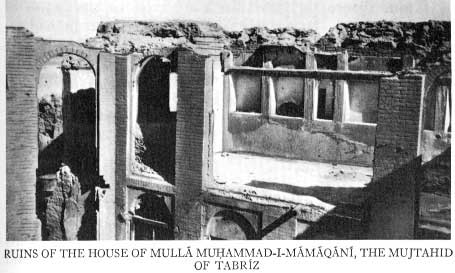 The Bab was, in His turn, brought before Mulla Muhammad-i-Mamaqani.
No sooner had he recognised Him
than he seized the death-warrant he himself had previously
written and, handing it to his attendant, bade him deliver
it to the farrash-bashi. "No need," he cried, "to bring the
Siyyid-i-Bab into my presence. This death-warrant I penned
the very day I met him at the gathering presided over by the
Vali-'Ahd. He surely is the same man whom I saw on that
occasion, and has not, in the meantime, surrendered any of
his claims."
From thence the Bab was conducted to the house of
Mirza Baqir, the son of Mirza Ahmad, to whom he had recently
succeeded. When they arrived, they found his attendant
standing at the gate and holding in his hand the
Bab's death-warrant. "No need to enter," he told them.
"My master is already satisfied that his father was right in
pronouncing the sentence of death. He can do no better
than follow his example."
Mulla Murtada-Quli, following in the footsteps of the
other two mujtahids, had previously issued his own written
testimony and refused to meet face to face his dreaded opponent.
No sooner had the farrash-bashi secured the necessary
documents than he delivered his Captive into the hands
of Sam Khan, assuring him that he could proceed with his
task now that he had obtained the sanction of the civil and
ecclesiastical authorities of the realm.
Siyyid Husayn had remained confined in the same room
in which he had spent the previous night with the Bab.
They were proceeding to place Mirza Muhammad-'Ali in
that same room, when he burst forth into tears and entreated
them to allow him to remain with his Master. He was delivered
into the hands of Sam Khan, who was ordered to
execute him also, if he persisted in his refusal to deny his
Faith.
Sam Khan was, in the meantime, finding himself increasingly
affected by the behaviour of his Captive and the
treatment that had been meted out to Him. He was seized
with great fear lest his action should bring upon him the
The Bab was, in His turn, brought before Mulla Muhammad-i-Mamaqani.
No sooner had he recognised Him
than he seized the death-warrant he himself had previously
written and, handing it to his attendant, bade him deliver
it to the farrash-bashi. "No need," he cried, "to bring the
Siyyid-i-Bab into my presence. This death-warrant I penned
the very day I met him at the gathering presided over by the
Vali-'Ahd. He surely is the same man whom I saw on that
occasion, and has not, in the meantime, surrendered any of
his claims."
From thence the Bab was conducted to the house of
Mirza Baqir, the son of Mirza Ahmad, to whom he had recently
succeeded. When they arrived, they found his attendant
standing at the gate and holding in his hand the
Bab's death-warrant. "No need to enter," he told them.
"My master is already satisfied that his father was right in
pronouncing the sentence of death. He can do no better
than follow his example."
Mulla Murtada-Quli, following in the footsteps of the
other two mujtahids, had previously issued his own written
testimony and refused to meet face to face his dreaded opponent.
No sooner had the farrash-bashi secured the necessary
documents than he delivered his Captive into the hands
of Sam Khan, assuring him that he could proceed with his
task now that he had obtained the sanction of the civil and
ecclesiastical authorities of the realm.
Siyyid Husayn had remained confined in the same room
in which he had spent the previous night with the Bab.
They were proceeding to place Mirza Muhammad-'Ali in
that same room, when he burst forth into tears and entreated
them to allow him to remain with his Master. He was delivered
into the hands of Sam Khan, who was ordered to
execute him also, if he persisted in his refusal to deny his
Faith.
Sam Khan was, in the meantime, finding himself increasingly
affected by the behaviour of his Captive and the
treatment that had been meted out to Him. He was seized
with great fear lest his action should bring upon him the
 Sam Khan ordered his men to drive a nail into the pillar
that lay between the door of the room that Siyyid Husayn
occupied and the entrance to the adjoining one, and to make
fast two ropes to that nail, from which the Bab and His companion
were to be separately suspended.(1) Mirza Muhammad-'Ali
begged Sam Khan to be placed in such a manner that
his own body would shield that of the Bab.(2) He was eventually
suspended in such a position that his head reposed on
the breast of his Master. As soon as they were fastened, a
regiment of soldiers ranged itself in three files, each of two
hundred and fifty men, each of which was ordered to open
fire in its turn until the whole detachment had discharged
the volleys of its bullets.(3) The smoke of the firing of the
seven hundred and fifty rifles was such as to turn the light
of the noonday sun into darkness. There had crowded onto
As soon as the cloud of smoke had cleared away, an astounded
multitude were looking upon a scene which their
eyes could scarcely believe. There, standing before them alive
and unhurt, was the companion of the Bab, whilst He Himself
had vanished uninjured from their sight. Though the cords
with which they were suspended had been rent in pieces by
the bullets, yet their bodies had miraculously escaped the
volleys.(1) Even the tunic which Mirza Muhammad-'Ali was
wearing had, despite the thickness of the smoke, remained
unsullied. "The Siyyid-i-Bab has gone from our sight!"
rang out the voices of the bewildered multitude. They set
out in a frenzied search for Him, and found Him, eventually,
seated in the same room which He had occupied the night
before, engaged in completing His interrupted conversation,
with Siyyid Husayn. An expression of unruffled calm was
upon His face. His body had emerged unscathed from
the shower of bullets which the regiment had directed against
Him. "I have finished My conversation with Siyyid Husayn,"
the Bab told the farrash-bashi. "Now you may proceed to
fulfil your intention." The man was too much shaken to
resume what he had already attempted. Refusing to accomplish
his duty, he, that same moment, left that scene
and resigned his post. He related all that he had seen to
I was privileged to meet, subsequently, this same Mirza
Siyyid Muhsin, who conducted me to the scene of the Bab's
martyrdom and showed me the wall where He had been
suspended. I was taken to the room in which He had been
found conversing with Siyyid Husayn, and was shown the
very spot where He had been seated. I saw the very nail
which His enemies had hammered into the wall and to which
the rope which had supported His body had been attached.
Sam Khan was likewise stunned by the force of this
tremendous revelation. He ordered his men to leave the
barracks immediately, and refused ever again to associate
himself and his regiment with any act that involved the least
injury to the Bab. He swore, as he left that courtyard, never
again to resume that task even though his refusal should
entail the loss of his own life.
No sooner had Sam Khan departed than Aqa Jan Khan-i-Khamsih,
colonel of the body-guard, known also by the
names of Khamsih and Nasiri, volunteered to carry out the
order for execution. On the same wall and in the same manner,
the Bab and His companion were again suspended, while
the regiment formed in line to open fire upon them. Contrariwise
to the previous occasion, when only the cord with
which they were suspended had been shot into pieces, this
time their bodies were shattered and were blended into one
mass of mingled flesh and bone.(1) "Had you believed in Me,
O wayward generation," were the last words of the Bab to
the gazing multitude as the regiment was preparing to fire
the final volley, "every one of you would have followed the
example of this youth, who stood in rank above most of you,
and willingly would have sacrificed himself in My path. The
day will come when you will have recognised Me; that day
I shall have ceased to be with you."(2)
The very moment the shots were fired, a gale of exceptional
severity arose and swept over the whole city. A
whirlwind of dust of incredible density obscured the light
of the sun and blinded the eyes of the people. The entire
city remained enveloped in that darkness from noon till
night. Even so strange a phenomenon, following immediately
in the wake of that still more astounding failure of
Sam Khan's regiment to injure the Bab, was unable to move
The martyrdom of the Bab took place at noon on Sunday,
the twenty-eighth of Sha'ban, in the year 1266 A.H.,(1) thirty-one
lunar years, seven months, and twenty-seven days from
the day of His birth in Shiraz.
Sam Khan ordered his men to drive a nail into the pillar
that lay between the door of the room that Siyyid Husayn
occupied and the entrance to the adjoining one, and to make
fast two ropes to that nail, from which the Bab and His companion
were to be separately suspended.(1) Mirza Muhammad-'Ali
begged Sam Khan to be placed in such a manner that
his own body would shield that of the Bab.(2) He was eventually
suspended in such a position that his head reposed on
the breast of his Master. As soon as they were fastened, a
regiment of soldiers ranged itself in three files, each of two
hundred and fifty men, each of which was ordered to open
fire in its turn until the whole detachment had discharged
the volleys of its bullets.(3) The smoke of the firing of the
seven hundred and fifty rifles was such as to turn the light
of the noonday sun into darkness. There had crowded onto
As soon as the cloud of smoke had cleared away, an astounded
multitude were looking upon a scene which their
eyes could scarcely believe. There, standing before them alive
and unhurt, was the companion of the Bab, whilst He Himself
had vanished uninjured from their sight. Though the cords
with which they were suspended had been rent in pieces by
the bullets, yet their bodies had miraculously escaped the
volleys.(1) Even the tunic which Mirza Muhammad-'Ali was
wearing had, despite the thickness of the smoke, remained
unsullied. "The Siyyid-i-Bab has gone from our sight!"
rang out the voices of the bewildered multitude. They set
out in a frenzied search for Him, and found Him, eventually,
seated in the same room which He had occupied the night
before, engaged in completing His interrupted conversation,
with Siyyid Husayn. An expression of unruffled calm was
upon His face. His body had emerged unscathed from
the shower of bullets which the regiment had directed against
Him. "I have finished My conversation with Siyyid Husayn,"
the Bab told the farrash-bashi. "Now you may proceed to
fulfil your intention." The man was too much shaken to
resume what he had already attempted. Refusing to accomplish
his duty, he, that same moment, left that scene
and resigned his post. He related all that he had seen to
I was privileged to meet, subsequently, this same Mirza
Siyyid Muhsin, who conducted me to the scene of the Bab's
martyrdom and showed me the wall where He had been
suspended. I was taken to the room in which He had been
found conversing with Siyyid Husayn, and was shown the
very spot where He had been seated. I saw the very nail
which His enemies had hammered into the wall and to which
the rope which had supported His body had been attached.
Sam Khan was likewise stunned by the force of this
tremendous revelation. He ordered his men to leave the
barracks immediately, and refused ever again to associate
himself and his regiment with any act that involved the least
injury to the Bab. He swore, as he left that courtyard, never
again to resume that task even though his refusal should
entail the loss of his own life.
No sooner had Sam Khan departed than Aqa Jan Khan-i-Khamsih,
colonel of the body-guard, known also by the
names of Khamsih and Nasiri, volunteered to carry out the
order for execution. On the same wall and in the same manner,
the Bab and His companion were again suspended, while
the regiment formed in line to open fire upon them. Contrariwise
to the previous occasion, when only the cord with
which they were suspended had been shot into pieces, this
time their bodies were shattered and were blended into one
mass of mingled flesh and bone.(1) "Had you believed in Me,
O wayward generation," were the last words of the Bab to
the gazing multitude as the regiment was preparing to fire
the final volley, "every one of you would have followed the
example of this youth, who stood in rank above most of you,
and willingly would have sacrificed himself in My path. The
day will come when you will have recognised Me; that day
I shall have ceased to be with you."(2)
The very moment the shots were fired, a gale of exceptional
severity arose and swept over the whole city. A
whirlwind of dust of incredible density obscured the light
of the sun and blinded the eyes of the people. The entire
city remained enveloped in that darkness from noon till
night. Even so strange a phenomenon, following immediately
in the wake of that still more astounding failure of
Sam Khan's regiment to injure the Bab, was unable to move
The martyrdom of the Bab took place at noon on Sunday,
the twenty-eighth of Sha'ban, in the year 1266 A.H.,(1) thirty-one
lunar years, seven months, and twenty-seven days from
the day of His birth in Shiraz.
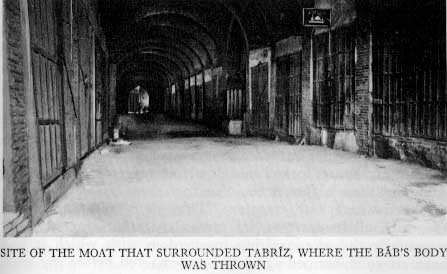 On the evening of that same day, the mangled bodies
of the Bab and His companion were removed from the courtyard
I have heard Haji Ali-'Askar relate the following: "An
official of the Russian consulate, to whom I was related,
showed me that same sketch on the very day it was drawn.
It was such a faithful portrait of the Bab that I looked upon!
No bullet had struck His forehead, His cheeks, or His lips.
I gazed upon a smile which seemed to be still lingering upon
His countenance. His body, however, had been severely
mutilated. I could recognise the arms and head of His
companion, who seemed to be holding Him in his embrace.
As I gazed horror-struck upon that haunting picture, and
saw how those noble traits had been disfigured, my heart
sank within me. I turned away my face in anguish and, regaining
my house, locked myself with my room. For three
days and three nights, I could neither sleep nor eat, so overwhelmed
was I with emotion. That short and tumultuous
life, with all its sorrows, its turmoils, its banishments, and
eventually the awe-inspiring martyrdom with which it had
been crowned, seemed again to be re-enacted before my eyes.
I tossed upon my bed, writhing in agony and pain."
On the afternoon of the second day after the Bab's martyrdom,
Haji Sulayman Khan, son of Yahya Khan, arrived at
Bagh-Mishih, a suburb of Tabriz, and was received at the
house of the Kalantar,(2) one of his friends and confidants,
Haji Sulayman Khan immediately reported the matter
On the evening of that same day, the mangled bodies
of the Bab and His companion were removed from the courtyard
I have heard Haji Ali-'Askar relate the following: "An
official of the Russian consulate, to whom I was related,
showed me that same sketch on the very day it was drawn.
It was such a faithful portrait of the Bab that I looked upon!
No bullet had struck His forehead, His cheeks, or His lips.
I gazed upon a smile which seemed to be still lingering upon
His countenance. His body, however, had been severely
mutilated. I could recognise the arms and head of His
companion, who seemed to be holding Him in his embrace.
As I gazed horror-struck upon that haunting picture, and
saw how those noble traits had been disfigured, my heart
sank within me. I turned away my face in anguish and, regaining
my house, locked myself with my room. For three
days and three nights, I could neither sleep nor eat, so overwhelmed
was I with emotion. That short and tumultuous
life, with all its sorrows, its turmoils, its banishments, and
eventually the awe-inspiring martyrdom with which it had
been crowned, seemed again to be re-enacted before my eyes.
I tossed upon my bed, writhing in agony and pain."
On the afternoon of the second day after the Bab's martyrdom,
Haji Sulayman Khan, son of Yahya Khan, arrived at
Bagh-Mishih, a suburb of Tabriz, and was received at the
house of the Kalantar,(2) one of his friends and confidants,
Haji Sulayman Khan immediately reported the matter
 I was myself in Tihran, in the company of Mirza Ahmad,
when the bodies of the Bab and His companion arrived.
Baha'u'llah had in the meantime departed for Karbila, in
pursuance of the instructions of the Amir-Nizam. Aqay-i-Kalim,
together with Mirza Ahmad, transferred those remains
from the Imam-Zadih-Hasan,(2) where they were first
taken, to a place the site of which remained unknown to
anyone excepting themselves. That place remained secret
until the departure of Baha'u'llah for Adrianople, at which
time Aqay-i-Kalim was charged to inform Munir, one of his
fellow-disciples, of the actual site where the bodies had been
laid. In spite of his search, he was unable to find it. It was
subsequently discovered by Jamal, an old adherent of the
Faith, to whom that secret was confided while Baha'u'llah
The first in Tihran to hear of the circumstances attending
that cruel martyrdom, after the Grand Vazir, was Mirza
Aqa Khan-i-Nuri, who had been banished to Kashan by Muhammad
Shah when the Bab was passing through that city.
He had assured Haji Mirza Jani, who had acquainted him
with the precepts of the Faith, that if the love he bore for
the new Revelation would cause him to regain his lost position,
he would exert his utmost endeavour to secure the well-being
and safety of the persecuted community. Haji Mirza
Jani reported the matter to his Master, who charged him to
assure the disgraced minister that ere long he would be summoned
to Tihran and would be invested, by his sovereign,
with a position that would be second to none except that of
the Shah himself. He was warned not to forget his promise,
and to strive to carry out his intention. He was delighted
with that message, and renewed the assurance he had given.
When the news of the Bab's martyrdom reached him,
he had already been promoted, had received the title of
I'timadu'd-Dawlih, and was hoping to be raised to the position
of Grand Vazir. He hastened to inform Baha'u'llah,
with whom he was intimately acquainted, of the news he had
received, expressing the hope that the fire he feared would
one day bring untold calamity upon Him, was at last extinguished.
"Not so," Baha'u'llah replied. "If this be true,
you can be certain that the flame that has been kindled will,
by this very act, blaze forth more fiercely than ever, and will
set up a conflagration such as the combined forces of the
statesmen of this realm will be powerless to quench." The
significance of these words Mirza Aqa Khan was destined to
appreciate at a later time. Scarcely did he imagine, when
that prediction was uttered, that the Faith which had received
so staggering a blow could survive its Author. He
himself had, on one occasion, been cured by Baha'u'llah of
an illness from which he had given up all hope of recovery.
His son, the Nizamu'l-Mulk, one day asked him whether
he did not think that Baha'u'llah, who, of all the sons of the
late Vazir, had shown Himself the most capable, had failed
The malicious persistence with which a savage enemy
sought to ill-treat and eventually to destroy the life of the
Bab brought in its wake untold calamities upon Persia and
its inhabitants. The men who perpetrated these atrocities
fell victims to gnawing remorse, and in an incredibly short
period were made to suffer ignominious deaths. As to the
great mass of its people, who watched with sullen indifference
the tragedy that was being enacted before their eyes, and
who failed to raise a finger in protest against the hideousness
of those cruelties, they fell, in their turn, victims to a misery
which all the resources of the land and the energy of its statesmen
were powerless to alleviate. The wind of adversity blew
fiercely upon them, and shook to its foundations their material
prosperity. From the very day the hand of the assailant
was stretched forth against the Bab, and sought to
The first who arose to ill-treat the Bab was none other
than Husayn Khan, the governor of Shiraz. His disgraceful
treatment of his Captive cost him the lives of thousands
who had been committed to his protection and who connived
at his acts. His province was ravaged by a plague which
brought it to the verge of destruction. Impoverished and
exhausted, Fars languished helpless beneath its weight, calling
for the charity of its neighbours and the assistance of its
friends. Husayn Khan himself witnessed with bitterness
the undoing of all his labours, was condemned to lead in
obscurity the remaining days of his life, and tottered to his
grave, abandoned and forgotten, alike by his friends and
his enemies.
The next who sought to challenge the Faith of the Bab
As to the regiment which, despite the unaccountable
failure of Sam Khan and his men to destroy the life of the
Bab, had volunteered to renew that attempt, and which
eventually riddled His body with its bullets, two hundred
and fifty of its members met their death in that same year,
together with their officers, in a terrible earthquake. While
they were resting on a hot summer day under the shadow of a
wall on their way between Ardibil and Tabriz, absorbed in
their games and pleasures, the whole structure suddenly
collapsed and fell upon them, leaving not one survivor. The
remaining five hundred suffered the same fate as that which
their own hands had inflicted upon the Bab. Three years
after His martyrdom, that regiment mutinied, and its members
were thereupon mercilessly shot by command of Mirza
Sadiq Khan-i-Nuri. Not content with a first volley, he ordered
that a second one be fired in order to ensure that none
of the mutineers had survived. Their bodies were afterwards
pierced with spears and lances, and left exposed to the gaze
of the people of Tabriz. That day many of the inhabitants
of the city, recalling the circumstances of the Bab's martyrdom,
wondered at that same fate which had overtaken those
who had slain Him. "Could it be, by any chance, the vengeance
The prime mover of the forces that precipitated the
Bab's martyrdom, the Amir-Nizam, and also his brother,
the Vazir-Nizam, his chief accomplice, were, within two years
of that savage act, subjected to a dreadful punishment, which
ended miserably in their death. The blood of the Amir-Nizam
stains, to this very day, the wall of the bath of Fin,(1)
a witness to the atrocities his own hand had wrought.(2)
I was myself in Tihran, in the company of Mirza Ahmad,
when the bodies of the Bab and His companion arrived.
Baha'u'llah had in the meantime departed for Karbila, in
pursuance of the instructions of the Amir-Nizam. Aqay-i-Kalim,
together with Mirza Ahmad, transferred those remains
from the Imam-Zadih-Hasan,(2) where they were first
taken, to a place the site of which remained unknown to
anyone excepting themselves. That place remained secret
until the departure of Baha'u'llah for Adrianople, at which
time Aqay-i-Kalim was charged to inform Munir, one of his
fellow-disciples, of the actual site where the bodies had been
laid. In spite of his search, he was unable to find it. It was
subsequently discovered by Jamal, an old adherent of the
Faith, to whom that secret was confided while Baha'u'llah
The first in Tihran to hear of the circumstances attending
that cruel martyrdom, after the Grand Vazir, was Mirza
Aqa Khan-i-Nuri, who had been banished to Kashan by Muhammad
Shah when the Bab was passing through that city.
He had assured Haji Mirza Jani, who had acquainted him
with the precepts of the Faith, that if the love he bore for
the new Revelation would cause him to regain his lost position,
he would exert his utmost endeavour to secure the well-being
and safety of the persecuted community. Haji Mirza
Jani reported the matter to his Master, who charged him to
assure the disgraced minister that ere long he would be summoned
to Tihran and would be invested, by his sovereign,
with a position that would be second to none except that of
the Shah himself. He was warned not to forget his promise,
and to strive to carry out his intention. He was delighted
with that message, and renewed the assurance he had given.
When the news of the Bab's martyrdom reached him,
he had already been promoted, had received the title of
I'timadu'd-Dawlih, and was hoping to be raised to the position
of Grand Vazir. He hastened to inform Baha'u'llah,
with whom he was intimately acquainted, of the news he had
received, expressing the hope that the fire he feared would
one day bring untold calamity upon Him, was at last extinguished.
"Not so," Baha'u'llah replied. "If this be true,
you can be certain that the flame that has been kindled will,
by this very act, blaze forth more fiercely than ever, and will
set up a conflagration such as the combined forces of the
statesmen of this realm will be powerless to quench." The
significance of these words Mirza Aqa Khan was destined to
appreciate at a later time. Scarcely did he imagine, when
that prediction was uttered, that the Faith which had received
so staggering a blow could survive its Author. He
himself had, on one occasion, been cured by Baha'u'llah of
an illness from which he had given up all hope of recovery.
His son, the Nizamu'l-Mulk, one day asked him whether
he did not think that Baha'u'llah, who, of all the sons of the
late Vazir, had shown Himself the most capable, had failed
The malicious persistence with which a savage enemy
sought to ill-treat and eventually to destroy the life of the
Bab brought in its wake untold calamities upon Persia and
its inhabitants. The men who perpetrated these atrocities
fell victims to gnawing remorse, and in an incredibly short
period were made to suffer ignominious deaths. As to the
great mass of its people, who watched with sullen indifference
the tragedy that was being enacted before their eyes, and
who failed to raise a finger in protest against the hideousness
of those cruelties, they fell, in their turn, victims to a misery
which all the resources of the land and the energy of its statesmen
were powerless to alleviate. The wind of adversity blew
fiercely upon them, and shook to its foundations their material
prosperity. From the very day the hand of the assailant
was stretched forth against the Bab, and sought to
The first who arose to ill-treat the Bab was none other
than Husayn Khan, the governor of Shiraz. His disgraceful
treatment of his Captive cost him the lives of thousands
who had been committed to his protection and who connived
at his acts. His province was ravaged by a plague which
brought it to the verge of destruction. Impoverished and
exhausted, Fars languished helpless beneath its weight, calling
for the charity of its neighbours and the assistance of its
friends. Husayn Khan himself witnessed with bitterness
the undoing of all his labours, was condemned to lead in
obscurity the remaining days of his life, and tottered to his
grave, abandoned and forgotten, alike by his friends and
his enemies.
The next who sought to challenge the Faith of the Bab
As to the regiment which, despite the unaccountable
failure of Sam Khan and his men to destroy the life of the
Bab, had volunteered to renew that attempt, and which
eventually riddled His body with its bullets, two hundred
and fifty of its members met their death in that same year,
together with their officers, in a terrible earthquake. While
they were resting on a hot summer day under the shadow of a
wall on their way between Ardibil and Tabriz, absorbed in
their games and pleasures, the whole structure suddenly
collapsed and fell upon them, leaving not one survivor. The
remaining five hundred suffered the same fate as that which
their own hands had inflicted upon the Bab. Three years
after His martyrdom, that regiment mutinied, and its members
were thereupon mercilessly shot by command of Mirza
Sadiq Khan-i-Nuri. Not content with a first volley, he ordered
that a second one be fired in order to ensure that none
of the mutineers had survived. Their bodies were afterwards
pierced with spears and lances, and left exposed to the gaze
of the people of Tabriz. That day many of the inhabitants
of the city, recalling the circumstances of the Bab's martyrdom,
wondered at that same fate which had overtaken those
who had slain Him. "Could it be, by any chance, the vengeance
The prime mover of the forces that precipitated the
Bab's martyrdom, the Amir-Nizam, and also his brother,
the Vazir-Nizam, his chief accomplice, were, within two years
of that savage act, subjected to a dreadful punishment, which
ended miserably in their death. The blood of the Amir-Nizam
stains, to this very day, the wall of the bath of Fin,(1)
a witness to the atrocities his own hand had wrought.(2)



|