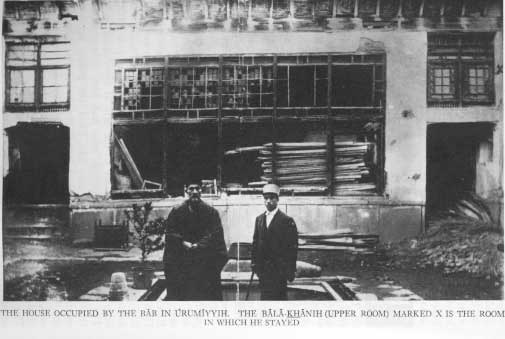

 HE Bab, in anticipation of
the approaching hour of His affliction, had dispersed His disciples who
had gathered in Chihriq and awaited with calm
resignation the order which was to summon Him
to Tabriz. Those into whose custody He was delivered
thought it inadvisable to pass through the town of Khuy,
which lay on their route to the capital of Adhirbayjan.
They decided to go by way of Urumiyyih and thus avoid
the demonstrations which the excited populace in Khuy were
likely to make as a protest against the tyranny of the government.
When the Bab arrived at Urumiyyih, Malik Qasim
Mirza ceremoniously received Him and accorded Him the
warmest hospitality. In His presence, the prince acted with
extraordinary deference and refused to allow the least disrespect
on the part of those who were allowed to meet Him.
On a certain Friday when the Bab was going to the
public bath, the prince, who was curious to test the courage
and power of his Guest, ordered his groom to offer Him
one of his wildest horses to ride. Apprehensive lest the
Bab might suffer any harm, the attendant secretly approached
Him and tried to induce Him to refuse to mount a horse that
had already overthrown the bravest and most skilful of
horsemen. "Fear not," was His reply. "Do as you have
been bidden, and commit Us to the care of the Almighty."
The inhabitants of Urumiyyih, who had been informed of
the intention of the prince, had filled the public square,
eager to witness what might befall the Bab. As soon as
the horse was brought to Him, He quietly approached it
and, taking hold of the bridle which the groom had offered
Him, gently caressed it and placed His foot in the stirrup.
The horse stood still and motionless beside Him as if conscious
of the power which was dominating it. The multitude
that watched this most unusual spectacle marvelled at the
No sooner had the Bab left the bath than the people of
Urumiyyih rushed to take away, to the last drop, the water
which had served for His ablutions. Great excitement prevailed
on that day. The Bab, as He observed these evidences
of unrestrained enthusiasm, was reminded of the well-known
tradition, commonly ascribed to the Imam Ali, the Commander
of the Faithful, which specifically referred to Adhirbayjan.
The lake of Urumiyyih, that same tradition asserts
in its concluding passages, will boil up, will overrun its banks,
and inundate the town. When He was subsequently informed
how the overwhelming majority of the people had spontaneously
arisen to proclaim their undivided allegiance to His
Cause, He calmly observed: "Think men that when they
say, `We believe,' they shall be let alone and not be put to
the proof?"(1) This comment was fully justified by the attitude
which that same people assumed towards Him when
the news of the dreadful treatment meted out to Him in
Tabriz reached them. Hardly a handful among those who
had so ostentatiously professed their faith in Him persevered,
in the hour of trial, in their allegiance to His Cause. Foremost
among these was Mulla Imam-Vardi, the tenacity of
whose faith no one except Mulla Jalil-i-Urumi, a native of
The tales of the signs and wonders which the Bab's
unnumbered admirers had witnessed were soon transmitted
from mouth to mouth, and gave rise to a wave of unprecedented
enthusiasm which spread with bewildering rapidity
over the entire country. It swept over Tihran and roused
the ecclesiastical dignitaries of the realm to fresh exertions
against Him. They trembled at the progress of a Movement
which, if allowed to run its course, they felt certain would
soon engulf the institutions upon which their authority, nay
their very existence, depended. They saw on every side
increasing evidences of a faith and devotion such as they
themselves had been powerless to evoke, of a loyalty which
struck at the very root of the fabric which their own hands
had reared and which all the resources at their command
had as yet failed to undermine.
Tabriz, in particular, was in the throes of the wildcat
excitement. The news of the impending arrival of the Bab
had inflamed the imagination of its inhabitants and had
kindled the fiercest animosity in the hearts of the ecclesiastical
leaders of Adhirbayjan. These alone, of all the people
of Tabriz, abstained from sharing in the demonstrations with
which a grateful population hailed the return of the Bab to
their city. Such was the fervour of popular enthusiasm which
that news had evoked that the authorities decided to house
the Bab in a place outside the gates of the city. Only those
On the second night after His arrival, the Bab summoned
Azim to His presence and, in the course of His conversation
with him, asserted emphatically His claim to be none other
than the promised Qa'im. He found him, however, reluctant
to acknowledge this claim unreservedly. Perceiving his inner
agitation, He said: "To-morrow I shall, in the presence of
the Vali-'Ahd,(1) and in the midst of the assembled ulamas
and notables of the city, proclaim My Mission. Whoso may
feel inclined to require from Me any other testimony besides
the verses which I have revealed, let him seek satisfaction
from the Qa'im of his idle fancy."
I have heard Azim testify to the following: "That night
I was in a state of great perturbation. I remained awake
and restless until the hour of sunrise. As soon as I had
offered my morning prayer, however, I realised that a great
change had come over me. A new door seemed to have been
unlocked and set open before my face. The conviction soon
dawned upon me that if I were loyal to my faith in
Muhammad, the Apostle of God, I must needs also unreservedly
acknowledge the claims advanced by the Bab, and
must submit without fear or hesitation to whatever He
might choose to decree. This conclusion allayed the agitation
of my heart. I hastened to the Bab and begged His
forgiveness. `It is a further evidence of the greatness of
this Cause,' He remarked, `that even Azim(2) should have felt
so exceedingly troubled and shaken by its power and the
immensity of its claim.' `Rest assured,' He added, `the grace
of the Almighty shall enable you to fortify the faint in heart
and to make firm the step of the waverer. So great shall be
your faith that should the enemy mutilate and tear your
body to pieces, in the hope of lessening by one jot or tittle
the ardour of your love, he would fail to attain his object.
You will, no doubt, in the days to come, meet face to face
Him who is the Lord of all the worlds, and will partake of
the joy of His presence.' These words dispelled the gloom
of my apprehensions. From that day onward, no trace of
either fear or agitation ever again cast its shadow upon me."
HE Bab, in anticipation of
the approaching hour of His affliction, had dispersed His disciples who
had gathered in Chihriq and awaited with calm
resignation the order which was to summon Him
to Tabriz. Those into whose custody He was delivered
thought it inadvisable to pass through the town of Khuy,
which lay on their route to the capital of Adhirbayjan.
They decided to go by way of Urumiyyih and thus avoid
the demonstrations which the excited populace in Khuy were
likely to make as a protest against the tyranny of the government.
When the Bab arrived at Urumiyyih, Malik Qasim
Mirza ceremoniously received Him and accorded Him the
warmest hospitality. In His presence, the prince acted with
extraordinary deference and refused to allow the least disrespect
on the part of those who were allowed to meet Him.
On a certain Friday when the Bab was going to the
public bath, the prince, who was curious to test the courage
and power of his Guest, ordered his groom to offer Him
one of his wildest horses to ride. Apprehensive lest the
Bab might suffer any harm, the attendant secretly approached
Him and tried to induce Him to refuse to mount a horse that
had already overthrown the bravest and most skilful of
horsemen. "Fear not," was His reply. "Do as you have
been bidden, and commit Us to the care of the Almighty."
The inhabitants of Urumiyyih, who had been informed of
the intention of the prince, had filled the public square,
eager to witness what might befall the Bab. As soon as
the horse was brought to Him, He quietly approached it
and, taking hold of the bridle which the groom had offered
Him, gently caressed it and placed His foot in the stirrup.
The horse stood still and motionless beside Him as if conscious
of the power which was dominating it. The multitude
that watched this most unusual spectacle marvelled at the
No sooner had the Bab left the bath than the people of
Urumiyyih rushed to take away, to the last drop, the water
which had served for His ablutions. Great excitement prevailed
on that day. The Bab, as He observed these evidences
of unrestrained enthusiasm, was reminded of the well-known
tradition, commonly ascribed to the Imam Ali, the Commander
of the Faithful, which specifically referred to Adhirbayjan.
The lake of Urumiyyih, that same tradition asserts
in its concluding passages, will boil up, will overrun its banks,
and inundate the town. When He was subsequently informed
how the overwhelming majority of the people had spontaneously
arisen to proclaim their undivided allegiance to His
Cause, He calmly observed: "Think men that when they
say, `We believe,' they shall be let alone and not be put to
the proof?"(1) This comment was fully justified by the attitude
which that same people assumed towards Him when
the news of the dreadful treatment meted out to Him in
Tabriz reached them. Hardly a handful among those who
had so ostentatiously professed their faith in Him persevered,
in the hour of trial, in their allegiance to His Cause. Foremost
among these was Mulla Imam-Vardi, the tenacity of
whose faith no one except Mulla Jalil-i-Urumi, a native of
The tales of the signs and wonders which the Bab's
unnumbered admirers had witnessed were soon transmitted
from mouth to mouth, and gave rise to a wave of unprecedented
enthusiasm which spread with bewildering rapidity
over the entire country. It swept over Tihran and roused
the ecclesiastical dignitaries of the realm to fresh exertions
against Him. They trembled at the progress of a Movement
which, if allowed to run its course, they felt certain would
soon engulf the institutions upon which their authority, nay
their very existence, depended. They saw on every side
increasing evidences of a faith and devotion such as they
themselves had been powerless to evoke, of a loyalty which
struck at the very root of the fabric which their own hands
had reared and which all the resources at their command
had as yet failed to undermine.
Tabriz, in particular, was in the throes of the wildcat
excitement. The news of the impending arrival of the Bab
had inflamed the imagination of its inhabitants and had
kindled the fiercest animosity in the hearts of the ecclesiastical
leaders of Adhirbayjan. These alone, of all the people
of Tabriz, abstained from sharing in the demonstrations with
which a grateful population hailed the return of the Bab to
their city. Such was the fervour of popular enthusiasm which
that news had evoked that the authorities decided to house
the Bab in a place outside the gates of the city. Only those
On the second night after His arrival, the Bab summoned
Azim to His presence and, in the course of His conversation
with him, asserted emphatically His claim to be none other
than the promised Qa'im. He found him, however, reluctant
to acknowledge this claim unreservedly. Perceiving his inner
agitation, He said: "To-morrow I shall, in the presence of
the Vali-'Ahd,(1) and in the midst of the assembled ulamas
and notables of the city, proclaim My Mission. Whoso may
feel inclined to require from Me any other testimony besides
the verses which I have revealed, let him seek satisfaction
from the Qa'im of his idle fancy."
I have heard Azim testify to the following: "That night
I was in a state of great perturbation. I remained awake
and restless until the hour of sunrise. As soon as I had
offered my morning prayer, however, I realised that a great
change had come over me. A new door seemed to have been
unlocked and set open before my face. The conviction soon
dawned upon me that if I were loyal to my faith in
Muhammad, the Apostle of God, I must needs also unreservedly
acknowledge the claims advanced by the Bab, and
must submit without fear or hesitation to whatever He
might choose to decree. This conclusion allayed the agitation
of my heart. I hastened to the Bab and begged His
forgiveness. `It is a further evidence of the greatness of
this Cause,' He remarked, `that even Azim(2) should have felt
so exceedingly troubled and shaken by its power and the
immensity of its claim.' `Rest assured,' He added, `the grace
of the Almighty shall enable you to fortify the faint in heart
and to make firm the step of the waverer. So great shall be
your faith that should the enemy mutilate and tear your
body to pieces, in the hope of lessening by one jot or tittle
the ardour of your love, he would fail to attain his object.
You will, no doubt, in the days to come, meet face to face
Him who is the Lord of all the worlds, and will partake of
the joy of His presence.' These words dispelled the gloom
of my apprehensions. From that day onward, no trace of
either fear or agitation ever again cast its shadow upon me."
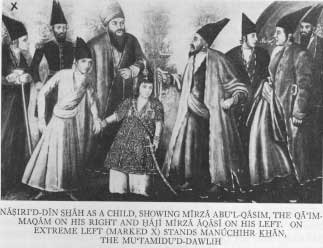 The detention of the Bab outside the gate of Tabriz
failed to allay the excitement which reigned in the city.
Every measure of precaution, every restriction, which the
authorities had imposed, served only to aggravate a situation
which had already become ominous and menacing.
Haji Mirza Aqasi issued his orders for the immediate convocation
of the ecclesiastical dignitaries of Tabriz in the
official residence of the governor of Adhirbayjan for the
express purpose of arraigning the Bab and of seeking the
most effective means for the extinction of His influence.
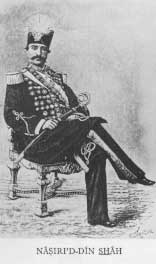
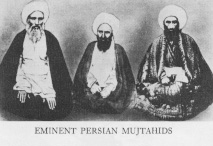
Haji Mulla Mahmud, entitled the Nizamu'l-'Ulama', who
was the tutor of Nasiri'd-Din Mirza the Vali-'Ahd,(1) Mulla
Muhammad-i-Mamaqani, Mirza Ali-Asghar the Shaykhu'l-Islam,
and a number of the most distinguished shaykhis and
doctors of divinity were among those who had convened for
that purpose.(2) Nasiri'd-Din Mirza himself attended that
Upon His arrival, the Bab observed that every seat in
that hall was occupied except one which had been reserved
for the Vali-'Ahd. He greeted the assembly and, without
the slightest hesitation, proceeded to occupy that vacant
seat. The majesty of His
The detention of the Bab outside the gate of Tabriz
failed to allay the excitement which reigned in the city.
Every measure of precaution, every restriction, which the
authorities had imposed, served only to aggravate a situation
which had already become ominous and menacing.
Haji Mirza Aqasi issued his orders for the immediate convocation
of the ecclesiastical dignitaries of Tabriz in the
official residence of the governor of Adhirbayjan for the
express purpose of arraigning the Bab and of seeking the
most effective means for the extinction of His influence.
Haji Mulla Mahmud, entitled the Nizamu'l-'Ulama', who
was the tutor of Nasiri'd-Din Mirza the Vali-'Ahd,(1) Mulla
Muhammad-i-Mamaqani, Mirza Ali-Asghar the Shaykhu'l-Islam,
and a number of the most distinguished shaykhis and
doctors of divinity were among those who had convened for
that purpose.(2) Nasiri'd-Din Mirza himself attended that
Upon His arrival, the Bab observed that every seat in
that hall was occupied except one which had been reserved
for the Vali-'Ahd. He greeted the assembly and, without
the slightest hesitation, proceeded to occupy that vacant
seat. The majesty of His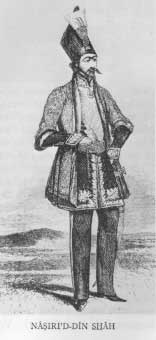 gait, the expression of overpowering
confidence which
sat upon His brow--above
all, the spirit of power which
shone from His whole being,
appeared to have for a moment
crushed the soul out
of the body of those whom
He had greeted. A deep, a
mysterious silence, suddenly
fell upon them. Not one
soul in that distinguished
assembly dared breathe a
single word. At last the
stillness which brooded over
them was broken by the
Nizamu'l-'Ulama'. "Whom
do you claim to be," he
asked the Bab, "and what
is the message which you
have brought?" "I am,"
thrice exclaimed the Bab,
"I am, I am, the promised
One! I am the One whose
name you have for a thousand
years invoked, at whose
gait, the expression of overpowering
confidence which
sat upon His brow--above
all, the spirit of power which
shone from His whole being,
appeared to have for a moment
crushed the soul out
of the body of those whom
He had greeted. A deep, a
mysterious silence, suddenly
fell upon them. Not one
soul in that distinguished
assembly dared breathe a
single word. At last the
stillness which brooded over
them was broken by the
Nizamu'l-'Ulama'. "Whom
do you claim to be," he
asked the Bab, "and what
is the message which you
have brought?" "I am,"
thrice exclaimed the Bab,
"I am, I am, the promised
One! I am the One whose
name you have for a thousand
years invoked, at whose
 mention you have risen,
whose advent you have
longed to witness, and the
hour of whose Revelation
you have prayed God to
hasten. Verily I say, it is
incumbent upon the peoples
of both the East and the
West to obey My word and
to pledge allegiance to My
person." No one ventured
to reply except Mulla
Muhammad-i-Mamaqani, a
leader of the Shaykhi community
who had been himself
a disciple of Siyyid Kazim.
It was he on whose unfaithfulness
and insincerity the
siyyid had tearfully remarked,
and the perversity
of whose nature he had deplored.
Shaykh Hasan-i-Zunuzi, who had heard Siyyid
Kazim make these criticisms, recounted to me the following:
"I was greatly surprised at the tone of his reference to
Mulla Muhammad, and was curious to know what his
future behaviour would be so as to merit such expressions
of pity and condemnation from his master. Not until I
discovered his attitude that day towards the Bab did I
realise the extent of his arrogance and blindness. I was
standing together with other people outside the hall, and
was able to follow the conversation of those who were within.
Mulla Muhammad was seated on the left hand of the Vali-'Ahd.
The Bab was occupying a seat between them. Immediately
after He had declared Himself to be the promised
One, a feeling of awe seized those who were present. They
had dropped their heads in silent confusion. The pallor
of their faces betrayed the agitation of their hearts. Mulla
Muhammad, that one-eyed and white-bearded renegade, insolently
reprimanded Him, saying: `You wretched and
immature lad of Shiraz! You have already convulsed and
"The Nizamu'l-'Ulama' uthought it best to challenge His
Mission openly. `The claim which you have advanced,' he
told the Bab, `is a stupendous one; it must needs be sup
mention you have risen,
whose advent you have
longed to witness, and the
hour of whose Revelation
you have prayed God to
hasten. Verily I say, it is
incumbent upon the peoples
of both the East and the
West to obey My word and
to pledge allegiance to My
person." No one ventured
to reply except Mulla
Muhammad-i-Mamaqani, a
leader of the Shaykhi community
who had been himself
a disciple of Siyyid Kazim.
It was he on whose unfaithfulness
and insincerity the
siyyid had tearfully remarked,
and the perversity
of whose nature he had deplored.
Shaykh Hasan-i-Zunuzi, who had heard Siyyid
Kazim make these criticisms, recounted to me the following:
"I was greatly surprised at the tone of his reference to
Mulla Muhammad, and was curious to know what his
future behaviour would be so as to merit such expressions
of pity and condemnation from his master. Not until I
discovered his attitude that day towards the Bab did I
realise the extent of his arrogance and blindness. I was
standing together with other people outside the hall, and
was able to follow the conversation of those who were within.
Mulla Muhammad was seated on the left hand of the Vali-'Ahd.
The Bab was occupying a seat between them. Immediately
after He had declared Himself to be the promised
One, a feeling of awe seized those who were present. They
had dropped their heads in silent confusion. The pallor
of their faces betrayed the agitation of their hearts. Mulla
Muhammad, that one-eyed and white-bearded renegade, insolently
reprimanded Him, saying: `You wretched and
immature lad of Shiraz! You have already convulsed and
"The Nizamu'l-'Ulama' uthought it best to challenge His
Mission openly. `The claim which you have advanced,' he
told the Bab, `is a stupendous one; it must needs be sup
 "He then repeated the same-words He had uttered, to
which Mulla Muhammad raised again the same objection.
Shortly after, another person ventured to put this question
to the Bab: `To which tense does the word Ishtartanna
belong?' In answer to him, the Bab quoted this verse of
the Qur'an: `Far be the glory of thy Lord, the Lord of all
greatness, from what they impute to Him, and peace be
upon His Apostles! And praise be to God, the Lord of the
worlds.' Immediately after, He arose and left the gathering."(2)
The Nizamu'l-'Ulama' was sorely displeased at the manner
in which the meeting had been conducted. "How shameful,"
he was heard to exclaim later, "is the discourtesy of
the people of Tabriz! What could possibly be the connection
between these idle remarks and the consideration of such
weighty, such momentous issues?" A few others were likewise
The persistent denunciations of that evil plotter excited
the apprehensions of the authorities of Tabriz. Those who
held the reins of power in their grasp took counsel together
as to the most effective measures to be taken to resist the
progress of His Faith. Some urged that in view of the marked
disrespect which the Bab had shown to the Vali-'Ahd in
occupying his seat without his leave, and because of His
failure to obtain the consent of the chairman of that gathering
when He arose to depart, He should be summoned again
to a like gathering and should receive from the hands of
its members a humiliating punishment. Nasiri'd-Din Mirza,
however, refused to entertain this proposal. Finally it was
decided that the Bab should be brought to the home of
Mirza Ali-Asghar, who was both the Shaykhu'l-Islam of
Tabriz and a siyyid, and should receive at the hands of the
governor's bodyguard the chastisement which He deserved.
The guard refused to accede to this request, preferring not
to interfere in a matter which they regarded as the sole
concern of the ulamas of the city. The Shaykhu'l-Islam
himself decided to inflict the punishment. He summoned
the Bab to his home, and with his hand eleven times applied
the rods to His feet.(1)
That same year this insolent tyrant was struck with
paralysis, and, after enduring the most excruciating pain,
died a miserable death. His treacherous, avaricious, and
self-seeking character was universally recognised by the
people of Tabriz. Notoriously cruel and sordid, he was
feared and despised by the people who groaned under his
yoke and prayed for deliverance. The abject circumstances
of his death reminded both his friends and his opponents
of the punishment which must necessarily await those whom
neither the fear of God nor the voice of conscience can deter
from behaving with such perfidious cruelty towards their
fellow men. After his death the functions of the Shaykhu'l-Islam
were abolished in Tabriz. Such was his infamy that
the very name of the institution with which he had been
associated came to be abhorred by the people.
And yet his behaviour, base and treacherous as it was,
was only one instance of the villainous conduct which characterised
the attitude of the ecclesiastical leaders among his
countrymen towards the Bab. How far and how grievously
have these erred from the path of fairness and justice! How
contemptuously have they cast away the counsels of the
Prophet of God and the admonitions of the imams of the
Faith! Have not these explicitly declared that "should a
From Tabriz the Bab was taken back to Chihriq, where
He was again entrusted to the keeping of Yahya Khan.
His persecutors had fondly imagined that by summoning
Him to their presence they would, through threats and intimidation,
induce Him to abandon His Mission. That gathering
enabled the Bab to set forth emphatically, in the presence
of the most illustrious dignitaries assembled in the capital
of Adhirbayjan, the distinguishing features of His claim,
and to confute, in brief and convincing language, the arguments
of His adversaries. The news of that momentous
declaration, fraught with such far-reaching consequences,
spread rapidly throughout Persia and stirred again more
deeply the feelings of the disciples of the Bab. It reanimated
their zeal, reinforced their position, and was a signal for
the tremendous happenings that were soon to convulse that
land.
No sooner had the Bab returned to Chihriq than He wrote
in bold and moving language a denunciation of the character
and action of Haji Mirza Aqasi. In the opening passages
of that epistle, which was given the name of the Khutbiy-i-Qahriyyih,(1)
the Author addresses the Grand Vazir of Muhammad
Shah in these terms: "O thou who hast disbelieved
in God and hast turned thy face away from His signs!"
That lengthy epistle was forwarded to Hujjat, who, in those
days, was confined in Tihran. He was instructed to deliver
it in person to Haji Mirza Aqasi.
I was privileged to hear the following account from the
lips of Baha'u'llah while in the prison-city of Akka: "Mulla
Muhammad-'Aliy-i-Zanjani, soon after he had delivered that
Tablet to Haji Mirza Aqasi, came and visited me. I was
in the company of Mirza Masih-i-Nuri and a number of
other believers when he arrived. He recounted the circumstances
attending the delivery of the Tablet, and recited
before us the entire text, which was about three pages in
length, and which he had committed to memory." The tone
of Baha'u'llah's reference to Hujjat indicated how greatly
pleased He was with the purity and nobleness of his life,
and how much He admired his undaunted courage, his indomitable
will, his unworldliness, and his unwavering constancy.
"He then repeated the same-words He had uttered, to
which Mulla Muhammad raised again the same objection.
Shortly after, another person ventured to put this question
to the Bab: `To which tense does the word Ishtartanna
belong?' In answer to him, the Bab quoted this verse of
the Qur'an: `Far be the glory of thy Lord, the Lord of all
greatness, from what they impute to Him, and peace be
upon His Apostles! And praise be to God, the Lord of the
worlds.' Immediately after, He arose and left the gathering."(2)
The Nizamu'l-'Ulama' was sorely displeased at the manner
in which the meeting had been conducted. "How shameful,"
he was heard to exclaim later, "is the discourtesy of
the people of Tabriz! What could possibly be the connection
between these idle remarks and the consideration of such
weighty, such momentous issues?" A few others were likewise
The persistent denunciations of that evil plotter excited
the apprehensions of the authorities of Tabriz. Those who
held the reins of power in their grasp took counsel together
as to the most effective measures to be taken to resist the
progress of His Faith. Some urged that in view of the marked
disrespect which the Bab had shown to the Vali-'Ahd in
occupying his seat without his leave, and because of His
failure to obtain the consent of the chairman of that gathering
when He arose to depart, He should be summoned again
to a like gathering and should receive from the hands of
its members a humiliating punishment. Nasiri'd-Din Mirza,
however, refused to entertain this proposal. Finally it was
decided that the Bab should be brought to the home of
Mirza Ali-Asghar, who was both the Shaykhu'l-Islam of
Tabriz and a siyyid, and should receive at the hands of the
governor's bodyguard the chastisement which He deserved.
The guard refused to accede to this request, preferring not
to interfere in a matter which they regarded as the sole
concern of the ulamas of the city. The Shaykhu'l-Islam
himself decided to inflict the punishment. He summoned
the Bab to his home, and with his hand eleven times applied
the rods to His feet.(1)
That same year this insolent tyrant was struck with
paralysis, and, after enduring the most excruciating pain,
died a miserable death. His treacherous, avaricious, and
self-seeking character was universally recognised by the
people of Tabriz. Notoriously cruel and sordid, he was
feared and despised by the people who groaned under his
yoke and prayed for deliverance. The abject circumstances
of his death reminded both his friends and his opponents
of the punishment which must necessarily await those whom
neither the fear of God nor the voice of conscience can deter
from behaving with such perfidious cruelty towards their
fellow men. After his death the functions of the Shaykhu'l-Islam
were abolished in Tabriz. Such was his infamy that
the very name of the institution with which he had been
associated came to be abhorred by the people.
And yet his behaviour, base and treacherous as it was,
was only one instance of the villainous conduct which characterised
the attitude of the ecclesiastical leaders among his
countrymen towards the Bab. How far and how grievously
have these erred from the path of fairness and justice! How
contemptuously have they cast away the counsels of the
Prophet of God and the admonitions of the imams of the
Faith! Have not these explicitly declared that "should a
From Tabriz the Bab was taken back to Chihriq, where
He was again entrusted to the keeping of Yahya Khan.
His persecutors had fondly imagined that by summoning
Him to their presence they would, through threats and intimidation,
induce Him to abandon His Mission. That gathering
enabled the Bab to set forth emphatically, in the presence
of the most illustrious dignitaries assembled in the capital
of Adhirbayjan, the distinguishing features of His claim,
and to confute, in brief and convincing language, the arguments
of His adversaries. The news of that momentous
declaration, fraught with such far-reaching consequences,
spread rapidly throughout Persia and stirred again more
deeply the feelings of the disciples of the Bab. It reanimated
their zeal, reinforced their position, and was a signal for
the tremendous happenings that were soon to convulse that
land.
No sooner had the Bab returned to Chihriq than He wrote
in bold and moving language a denunciation of the character
and action of Haji Mirza Aqasi. In the opening passages
of that epistle, which was given the name of the Khutbiy-i-Qahriyyih,(1)
the Author addresses the Grand Vazir of Muhammad
Shah in these terms: "O thou who hast disbelieved
in God and hast turned thy face away from His signs!"
That lengthy epistle was forwarded to Hujjat, who, in those
days, was confined in Tihran. He was instructed to deliver
it in person to Haji Mirza Aqasi.
I was privileged to hear the following account from the
lips of Baha'u'llah while in the prison-city of Akka: "Mulla
Muhammad-'Aliy-i-Zanjani, soon after he had delivered that
Tablet to Haji Mirza Aqasi, came and visited me. I was
in the company of Mirza Masih-i-Nuri and a number of
other believers when he arrived. He recounted the circumstances
attending the delivery of the Tablet, and recited
before us the entire text, which was about three pages in
length, and which he had committed to memory." The tone
of Baha'u'llah's reference to Hujjat indicated how greatly
pleased He was with the purity and nobleness of his life,
and how much He admired his undaunted courage, his indomitable
will, his unworldliness, and his unwavering constancy.



|