
 S THE appointed hour approached
when, according to the dispensations of Providence, the veil which
still concealed the fundamental verities of the Faith
was to be rent asunder, there blazed forth in the
heart of Khurasan a flame of such consuming intensity that
the most formidable obstacles standing in the way of the
ultimate recognition of the Cause melted away and vanished.(1)
That fire caused such a conflagration in the hearts of men
that the effects of its quickening power were felt in the most
outlying provinces of Persia. It obliterated every trace of
the misgivings and doubts which had still lingered in the
hearts of the believers, and had hitherto hindered them from
apprehending the full measure of its glory. The decree of
the enemy had condemned to perpetual isolation Him who
was the embodiment of the beauty of God, and sought thereby
to quench for all time the flame of His love. The hand of
Omnipotence, however, was busily engaged, at a time when
the host of evil-doers were darkly plotting against Him, in
confounding their schemes and in nullifying their efforts. In
the easternmost province of Persia, the Almighty had, through
the hand of Quddus, lit a fire that glowed with the hottest
flame in the breasts of the people of Khurasan. And in
Karbila, beyond the western confines of that land, He had
kindled the light of Tahirih, a light that was destined to
shed its radiance upon the whole of Persia. From the east
In pursuance of the Divine decree, in the days when
Quddus was still residing in Mashhad, there was revealed
from the pen of the Bab a Tablet addressed to all the believers
of Persia, in which every loyal adherent of the Faith
was enjoined to "hasten to the Land of Kha," the province
of Khurasan.(2) The news of this high injunction spread with
marvellous rapidity and aroused universal enthusiasm. It
reached the ears of Tahirih, who, at that time, was residing
in Karbila and was bending every effort to extend the scope
of the Faith she had espoused.(3) She had left her native
town of Qazvin and had arrived, after the death of Siyyid
Kazim, at that holy city, in eager expectation of witnessing
the signs which the departed siyyid had foretold. In the
foregoing pages we have seen how instinctively she had been
led to discover the Revelation of the Bab and how spontaneously
she had acknowledged its truth. Unwarned and uninvited,
she perceived the dawning light of the promised Revelation
breaking upon the city of Shiraz, and was prompted
to pen her message and plead her fidelity to Him who was
the Revealer of that light.
The Bab's immediate response to her declaration of faith
which, without attaining His presence, she was moved to
make, animated her zeal and vastly increased her courage.
She arose to spread abroad His teachings, vehemently denounced
the corruption and perversity of her generation, and
fearlessly advocated a fundamental revolution in the habits
She was able to win to the Cause the revered widow of
Siyyid Kazim, who was born in Shiraz, and was the first
among the women of Karbila to recognise its truth. I have
heard Shaykh Sultan describe her extreme devotion to
Tahirih, whom she revered as her spiritual guide and esteemed
as her affectionate companion. He was also a fervent admirer
of the character of the widow of the Siyyid, to whose
gentleness of manner he often paid a glowing tribute. "Such
was her attachment to Tahirih," Shaykh Sultan was often
heard to remark, "that she was extremely reluctant to allow
that heroine who was a guest in her house to absent herself,
though it were for an hour, from her presence. So great an
attachment on her part did not fail to excite the curiosity
and quicken the faith of her women friends, both Persian
and Arab, who were constant visitors in her home. In the
first year of her acceptance of the Message, she suddenly
Among the men who in Karbila eagerly embraced, through
the efforts of Tahirih, the Cause of the Bab, was a certain
Shaykh Salih, an Arab resident of that city who was the
first to shed his blood in the path of the Faith, in Tihran.
She was so profuse in her praise of Shaykh Salih that a few
suspected him of being equal in rank to Quddus. Shaykh
Sultan was also among those who fell under the spell of
Tahirih. On his return from Shiraz, he identified himself
with the Faith, boldly and assiduously promoted its interests,
and did his utmost to execute her instructions and wishes.
Another admirer was Shaykh Muhammad-i-Shibl, the father
of Muhammad-Mustafa, an Arab native of Baghdad who
ranked high among the ulamas of that city. By the aid of
this chosen band of staunch and able supporters, Tahirih
was able to fire the imagination and to enlist the allegiance
of a considerable number of the Persian and Arab inhabitants
of Iraq, most of whom were led by her to join forces with
those of their brethren in Persia who were soon to be called
upon to shape by their deeds the destiny, and to seal with
their life-blood the triumph, of the Cause of God.
The Bab's appeal, which was originally addressed to His
followers in Persia, was soon transmitted to the adherents of
His Faith in Iraq. Tahirih gloriously responded. Her example
was followed immediately by a large number of her
faithful admirers, all of whom expressed their readiness to
journey forthwith to Khurasan. The ulamas of Karbila
sought to dissuade her from undertaking that journey. Perceiving
immediately the motive which prompted them to
tender her such advice, and aware of their malignant design,
she addressed to each of these sophists a lengthy epistle in
which she set forth her motives and exposed their dissimulation.(1)
From Karbila she proceeded to Baghdad.(1) A representative
delegation, consisting of the ablest leaders among the
shi'ah, the sunni, the Christian and Jewish communities of
that city, sought her presence and endeavoured to convince
her of the folly of her actions. She was able, however, to
silence their protestations, and astounded them with the
force of her argument. Disillusioned and confused, they
retired, deeply conscious of their own impotence.(2)
The ulamas of Kirmanshah respectfully received her and
presented her with various tokens of their esteem and admiration.(3)
In Hamadan,(4) however, the ecclesiastical leaders
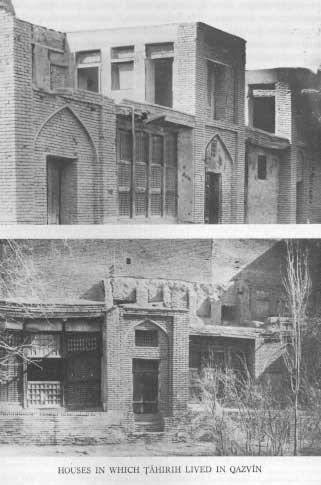
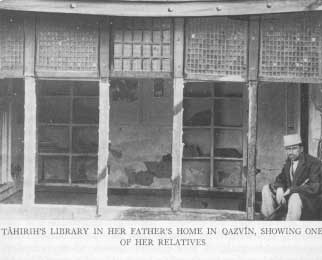
On her arrival at the house of her father, her cousin, the
haughty and false-hearted Mulla Muhammad, son of Mulla
Taqi, who esteemed himself, next to his father and his uncle,
the most accomplished of all the mujtahids of Persia, sent
certain ladies of his own household to persuade Tahirih to
transfer her residence from her father's house to his own.
"Say to my presumptuous and arrogant kinsman," was her
bold reply to the messengers: "`If your desire had really
been to be a faithful mate and companion to me, you would
have hastened to meet me in Karbila and would on foot have
S THE appointed hour approached
when, according to the dispensations of Providence, the veil which
still concealed the fundamental verities of the Faith
was to be rent asunder, there blazed forth in the
heart of Khurasan a flame of such consuming intensity that
the most formidable obstacles standing in the way of the
ultimate recognition of the Cause melted away and vanished.(1)
That fire caused such a conflagration in the hearts of men
that the effects of its quickening power were felt in the most
outlying provinces of Persia. It obliterated every trace of
the misgivings and doubts which had still lingered in the
hearts of the believers, and had hitherto hindered them from
apprehending the full measure of its glory. The decree of
the enemy had condemned to perpetual isolation Him who
was the embodiment of the beauty of God, and sought thereby
to quench for all time the flame of His love. The hand of
Omnipotence, however, was busily engaged, at a time when
the host of evil-doers were darkly plotting against Him, in
confounding their schemes and in nullifying their efforts. In
the easternmost province of Persia, the Almighty had, through
the hand of Quddus, lit a fire that glowed with the hottest
flame in the breasts of the people of Khurasan. And in
Karbila, beyond the western confines of that land, He had
kindled the light of Tahirih, a light that was destined to
shed its radiance upon the whole of Persia. From the east
In pursuance of the Divine decree, in the days when
Quddus was still residing in Mashhad, there was revealed
from the pen of the Bab a Tablet addressed to all the believers
of Persia, in which every loyal adherent of the Faith
was enjoined to "hasten to the Land of Kha," the province
of Khurasan.(2) The news of this high injunction spread with
marvellous rapidity and aroused universal enthusiasm. It
reached the ears of Tahirih, who, at that time, was residing
in Karbila and was bending every effort to extend the scope
of the Faith she had espoused.(3) She had left her native
town of Qazvin and had arrived, after the death of Siyyid
Kazim, at that holy city, in eager expectation of witnessing
the signs which the departed siyyid had foretold. In the
foregoing pages we have seen how instinctively she had been
led to discover the Revelation of the Bab and how spontaneously
she had acknowledged its truth. Unwarned and uninvited,
she perceived the dawning light of the promised Revelation
breaking upon the city of Shiraz, and was prompted
to pen her message and plead her fidelity to Him who was
the Revealer of that light.
The Bab's immediate response to her declaration of faith
which, without attaining His presence, she was moved to
make, animated her zeal and vastly increased her courage.
She arose to spread abroad His teachings, vehemently denounced
the corruption and perversity of her generation, and
fearlessly advocated a fundamental revolution in the habits
She was able to win to the Cause the revered widow of
Siyyid Kazim, who was born in Shiraz, and was the first
among the women of Karbila to recognise its truth. I have
heard Shaykh Sultan describe her extreme devotion to
Tahirih, whom she revered as her spiritual guide and esteemed
as her affectionate companion. He was also a fervent admirer
of the character of the widow of the Siyyid, to whose
gentleness of manner he often paid a glowing tribute. "Such
was her attachment to Tahirih," Shaykh Sultan was often
heard to remark, "that she was extremely reluctant to allow
that heroine who was a guest in her house to absent herself,
though it were for an hour, from her presence. So great an
attachment on her part did not fail to excite the curiosity
and quicken the faith of her women friends, both Persian
and Arab, who were constant visitors in her home. In the
first year of her acceptance of the Message, she suddenly
Among the men who in Karbila eagerly embraced, through
the efforts of Tahirih, the Cause of the Bab, was a certain
Shaykh Salih, an Arab resident of that city who was the
first to shed his blood in the path of the Faith, in Tihran.
She was so profuse in her praise of Shaykh Salih that a few
suspected him of being equal in rank to Quddus. Shaykh
Sultan was also among those who fell under the spell of
Tahirih. On his return from Shiraz, he identified himself
with the Faith, boldly and assiduously promoted its interests,
and did his utmost to execute her instructions and wishes.
Another admirer was Shaykh Muhammad-i-Shibl, the father
of Muhammad-Mustafa, an Arab native of Baghdad who
ranked high among the ulamas of that city. By the aid of
this chosen band of staunch and able supporters, Tahirih
was able to fire the imagination and to enlist the allegiance
of a considerable number of the Persian and Arab inhabitants
of Iraq, most of whom were led by her to join forces with
those of their brethren in Persia who were soon to be called
upon to shape by their deeds the destiny, and to seal with
their life-blood the triumph, of the Cause of God.
The Bab's appeal, which was originally addressed to His
followers in Persia, was soon transmitted to the adherents of
His Faith in Iraq. Tahirih gloriously responded. Her example
was followed immediately by a large number of her
faithful admirers, all of whom expressed their readiness to
journey forthwith to Khurasan. The ulamas of Karbila
sought to dissuade her from undertaking that journey. Perceiving
immediately the motive which prompted them to
tender her such advice, and aware of their malignant design,
she addressed to each of these sophists a lengthy epistle in
which she set forth her motives and exposed their dissimulation.(1)
From Karbila she proceeded to Baghdad.(1) A representative
delegation, consisting of the ablest leaders among the
shi'ah, the sunni, the Christian and Jewish communities of
that city, sought her presence and endeavoured to convince
her of the folly of her actions. She was able, however, to
silence their protestations, and astounded them with the
force of her argument. Disillusioned and confused, they
retired, deeply conscious of their own impotence.(2)
The ulamas of Kirmanshah respectfully received her and
presented her with various tokens of their esteem and admiration.(3)
In Hamadan,(4) however, the ecclesiastical leaders
On her arrival at the house of her father, her cousin, the
haughty and false-hearted Mulla Muhammad, son of Mulla
Taqi, who esteemed himself, next to his father and his uncle,
the most accomplished of all the mujtahids of Persia, sent
certain ladies of his own household to persuade Tahirih to
transfer her residence from her father's house to his own.
"Say to my presumptuous and arrogant kinsman," was her
bold reply to the messengers: "`If your desire had really
been to be a faithful mate and companion to me, you would
have hastened to meet me in Karbila and would on foot have
 So stern and unyielding a reply roused both Mulla Muhammad
and his father to a burst of fury. They immediately
pronounced her a heretic, and strove day and night to undermine
her position and to sully her fame. Tahirih vehemently
defended herself and persisted in exposing the depravity of
their character.(2) Her father, a peace-loving and fair-minded
This state of tension continued until the time when a
certain Mulla Abdu'llah, a native of Shiraz and fervent admirer
of both Shaykh Ahmad and Siyyid Kazim, arrived in
Qazvin at the beginning of the month of Ramadan, in the
year 1263 A.H.(1) Subsequently, in the course of his trial in
Tihran, in the presence of the Sahib-Divan, this same Mulla
Abdu'llah recounted the following: "I have never been a
convinced Babi. When I arrived at Qazvin, I was on my
way to Mah-Ku, intending to visit the Bab and investigate
the nature of His Cause. On the day of my arrival at Qazvin,
I became aware that the town was in a great state of turmoil.
As I was passing through the market-place, I saw a crowd of
ruffians who had stripped a man of his head-dress and shoes,
had wound his turban around his neck, and by it were dragging
him through the streets. An angry multitude was tormenting
him with their threats, their blows and curses. `His
unpardonable guilt,' I was told in answer to my enquiry,
`is that he has dared to extol in public the virtues of Shaykh
Ahmad and Siyyid Kazim. Accordingly, Haji Mulla Taqi,
the Hujjatu'l-Islam, has pronounced him a heretic and decreed
his expulsion from the town.'"
I was amazed at the explanation given me. How could
a shaykhi, I thought to myself, be regarded as a heretic and
be deemed worthy of such cruel treatment? Desirous of
ascertaining from Mulla Taqi himself the truth of this report,
I betook myself to his school and asked whether he
had actually pronounced such a condemnation against him.
`Yes,' he bluntly replied, `the god whom the late Shaykh
Ahmad-i-Bahrayni worshipped is a god in whom I can never
believe. Him as well as his followers I regard as the very
embodiments of error.' I was moved that very moment to
smite his face in the presence of his assembled disciples. I
restrained myself, however, and vowed that, God willing, I
would pierce his lips with my spear so that he would never
be again able to utter such blasphemy.
"I straightway left his presence and directed my steps
"I ascended immediately the roof of the masjid and
watched the frenzy and agitation of the multitude. A crowd
rushed in and, placing him upon a litter, transported him
to his house. Unable to identify the murderer, the people
seized the occasion to gratify their basest instincts. They
rushed at one another's throats, violently attacked and
mutually accused one another in the presence of the governor.
Finding out that a large number of innocent people
had been gravely molested and thrown into prison, I was
impelled by the voice of my conscience to confess my act.
I accordingly besought the presence of the governor and said
to him: `If I deliver into your hands the author of this
murder, will you promise me to set free all the innocent
people who are suffering his place?' No sooner had I obtained
from him the necessary assurance than I confessed
to him that I had committed the deed. He was not disposed
at first to believe me. At my request, he summoned
the old woman who had spread the rug in the mihrab, but
refused to be convinced by the evidence which she gave. I
was finally conducted to the bedside of Mulla Taqi, who was
on the point of death. As soon as he saw me, he recognised
my features. In his agitation, he pointed with his finger to
The candour and sincerity of Mulla Abdu'llah greatly
pleased the Sahib-Divan. He gave secret orders to his attendants
to enable him to escape from prison. At the hour
of midnight, the prisoner took refuge in the home of Rida
Khan-i-Sardar, who had recently been married to the sister
of the Sipah-Salar, and remained concealed in that house
until the great struggle or Shaykh Tabarsi, when he determined
to throw in his lot with the heroic defenders of the
fort. He, as well as Rida Khan, who followed him to Mazindaran,
quaffed eventually the cup of martyrdom.
The circumstances of the murder fanned to fury the
wrath of the lawful heirs of Mulla Taqi, who now determined
to wreak their vengeance upon Tahirih. They succeeded in
having her placed in the strictest confinement in the house
of her father, and charged those women whom they had
selected to watch over her, not to allow their captive to
leave her room except for the purpose of performing her daily
ablutions. They accused her of really being the instigator
of the crime. "No one else but you," they asserted, "is
guilty of the murder of our father. You issued the order
for his assassination." Those whom they had arrested and
confined were conducted by them to Tihran and were incarcerated
in the home of one of the kad-khudas(1) of the
capital. The friends and heirs of Mulla Taqi scattered themselves
in all directions, denouncing their captives as the repudiators
of the law of Islam and demanding that they be
immediately put to death.
Baha'u'llah who was at that time residing in Tihran, was
informed of the plight of these prisoners who had been the
companions and supporters of Tahirih. As He was already
acquainted with the kad-khuda in whose home they were incarcerated,
He decided to visit them and intervene in their
behalf. That avaricious and deceitful official, who was fully
aware of the extreme generosity of Baha'u'llah, greatly exaggerated
These officials were in their turn tempted to derive every
possible advantage from the liberality of Baha'u'llah. They
summoned Him to their presence, protested against His action,
and accused Him of complicity in the act for which
the captives had been condemned. "The kad-khuda," replied
Baha'u'llah, "pleaded their cause before Me and enlarged
upon their sufferings and needs. He himself bore
witness to their innocence and appealed to Me for help. In
return for the aid which, in response to his invitation, I was
impelled to extend, you now charge Me with a crime of
which I am innocent." Hoping to intimidate Baha'u'llah by
threatening immediate punishment, they refused to allow
Him to return to His home. The confinement to which He
was subjected was the first affliction that befell Baha'u'llah
in the path of the Cause of God; the first imprisonment He
suffered for the sake of His loved ones. He remained in
captivity for a few days, until Ja'far-Quli Khan, the brother
of Mirza Aqa Khan-i-Nuri, who at a later time was appointed
Grand Vazir of the Shah, and a number of other friends intervened
in His behalf and, threatening the kad-khuda in severe
a language, were able to effect His release. Those who had
been responsible for His confinement had confidently hoped
to receive, in return for His deliverance, the sum of one
thousand tumans,(1)
but they soon found out that they were
forced to comply with the wishes of Ja'far-Quli Khan without
The heirs of Mulla Taqi were in the meantime bending
every effort to avenge the blood of their distinguished kinsman.
Unsatisfied with what they had already accomplished,
they directed their appeal to Muhammad Shah himself, and
endeavoured to win his sympathy to their cause. The Shah
is reported to have returned this answer: "Your father, Mulla
Taqi, surely could not have claimed to be superior to the
Imam Ali, the Commander of the Faithful. Did not the
latter instruct his disciples that, should he fall a victim to the
sword of Ibn-i-Muljam, the murderer alone should, by his
death, be made to atone for his act, that no one else but
he should be put to death? Why should not the murder of
your father be similarly avenged? Declare to me his murderer,
and I will issue my orders that he be delivered into
your hands in order that you may inflict upon him the punishment
which he deserves."
The uncompromising attitude of the Shah induced them
to abandon the hopes which they had cherished. They declared
Shaykh Salih to be the murderer of their father, obtained
his arrest, and ignominiously put him to death. He
was the first to shed his blood on Persian soil in the path of
the Cause of God; the first of that glorious company destined
to seal with their life-blood the triumph of God's holy Faith.
As he was being conducted to the scene of his martyrdom, his
face glowed with zeal and joy. He hastened to the foot of
the gallows and met his executioner as if he were welcoming
a dear and lifelong friend. Words of triumph and hope fell
unceasingly from his lips. "I discarded," he cried, with
exultation, as his end approached, "the hopes and the beliefs
of men from the moment I recognised Thee, Thou who art
my Hope and my Belief!" His remains were interred in the
courtyard of the shrine of the Imam-Zadih Zayd in Tihran.
The unsatiable hatred that animated those who had been
responsible for the martyrdom of Shaykh Salih impelled them
to seek additional instruments for the furtherance of their
designs. Haji Mirza Aqasi, whom the Sahib-Divan had succeeded
in convincing of the treacherous conduct of the heirs
The Sadr-i-Ardibili was sore afraid, and in his impotence
sought to beguile his sovereign. He addressed the following
request to Muhammad Shah: "I would humbly implore your
Majesty to allow the captives to accompany the heirs of that
martyred leader on their return to Qazvin, that these may,
of their own accord, forgive them publicly their action, and
enable them to recover their freedom. Such a gesture on
their part will considerably enhance their position and will
win them the esteem of their countrymen." The Shah,
wholly unaware of the mischievous designs of that crafty
plotter, immediately granted his request, on the express condition
that a written statement be sent to him from Qazvin
assuring him that the condition of the prisoners after their
freedom was entirely satisfactory, and that no harm was
likely to befall them in the future.
No sooner were the captives delivered into the hands of
the mischief-makers than they set about gratifying their feelings
of implacable hatred towards them. On the first night
after they had been handed over to their enemies, Haji
Asadu'llah, the brother of Haji Allah-Vardi and paternal
uncle of Muhammad-Hadi and Muhammad-Javad-i-Farhadi,
a noted merchant of Qazvin who had acquired a reputation
for piety and uprightness which stood as high as that of his
illustrious brother, was mercilessly put to death. Knowing
The rest of his companions, among whom were Mulla
Tahir-i-Shirazi and Mulla Ibrahim-i-Mahallati, both of whom
were greatly esteemed for their learning and character, were
savagely put to death immediately after their arrival at
Qazvin. The entire population, which had been sedulously
instigated beforehand, clamoured for their immediate execution.
A band of shameless scoundrels, armed with knives,
swords, spears, and axes, fell upon them and tore them to
pieces. They mutilated their bodies with such wanton barbarity
that no fragment of their scattered members could
be found for burial.
Gracious God! Acts of such incredible savagery have
been perpetrated in a town like Qazvin, which prides itself
on the fact that no less than a hundred of the highest ecclesiastical
leaders of Islam dwell within its gates, and yet none
could be found among all its inhabitants to raise his voice
in protest against such revolting murders! No one seemed
to question their right to perpetrate such iniquitous and
shameless deeds. No one seemed to be aware of the utter
incompatibility between such ferocious deeds committed by
those who claimed to be the sole repositories of the mysteries
of Islam, and the exemplary conduct of those who first manifested
its light to the world. No one was moved to exclaim
indignantly: "O evil and perverse generation! To what
depths of infamy and shame you have sunk! Have not the
abominations which you have wrought surpassed in their
ruthlessness the acts of the basest of men? Will you not
recognise that neither the beasts of the field nor any moving
thing on earth has ever equalled the ferociousness of your
acts? How long is your heedlessness to last? Is it not your
So stern and unyielding a reply roused both Mulla Muhammad
and his father to a burst of fury. They immediately
pronounced her a heretic, and strove day and night to undermine
her position and to sully her fame. Tahirih vehemently
defended herself and persisted in exposing the depravity of
their character.(2) Her father, a peace-loving and fair-minded
This state of tension continued until the time when a
certain Mulla Abdu'llah, a native of Shiraz and fervent admirer
of both Shaykh Ahmad and Siyyid Kazim, arrived in
Qazvin at the beginning of the month of Ramadan, in the
year 1263 A.H.(1) Subsequently, in the course of his trial in
Tihran, in the presence of the Sahib-Divan, this same Mulla
Abdu'llah recounted the following: "I have never been a
convinced Babi. When I arrived at Qazvin, I was on my
way to Mah-Ku, intending to visit the Bab and investigate
the nature of His Cause. On the day of my arrival at Qazvin,
I became aware that the town was in a great state of turmoil.
As I was passing through the market-place, I saw a crowd of
ruffians who had stripped a man of his head-dress and shoes,
had wound his turban around his neck, and by it were dragging
him through the streets. An angry multitude was tormenting
him with their threats, their blows and curses. `His
unpardonable guilt,' I was told in answer to my enquiry,
`is that he has dared to extol in public the virtues of Shaykh
Ahmad and Siyyid Kazim. Accordingly, Haji Mulla Taqi,
the Hujjatu'l-Islam, has pronounced him a heretic and decreed
his expulsion from the town.'"
I was amazed at the explanation given me. How could
a shaykhi, I thought to myself, be regarded as a heretic and
be deemed worthy of such cruel treatment? Desirous of
ascertaining from Mulla Taqi himself the truth of this report,
I betook myself to his school and asked whether he
had actually pronounced such a condemnation against him.
`Yes,' he bluntly replied, `the god whom the late Shaykh
Ahmad-i-Bahrayni worshipped is a god in whom I can never
believe. Him as well as his followers I regard as the very
embodiments of error.' I was moved that very moment to
smite his face in the presence of his assembled disciples. I
restrained myself, however, and vowed that, God willing, I
would pierce his lips with my spear so that he would never
be again able to utter such blasphemy.
"I straightway left his presence and directed my steps
"I ascended immediately the roof of the masjid and
watched the frenzy and agitation of the multitude. A crowd
rushed in and, placing him upon a litter, transported him
to his house. Unable to identify the murderer, the people
seized the occasion to gratify their basest instincts. They
rushed at one another's throats, violently attacked and
mutually accused one another in the presence of the governor.
Finding out that a large number of innocent people
had been gravely molested and thrown into prison, I was
impelled by the voice of my conscience to confess my act.
I accordingly besought the presence of the governor and said
to him: `If I deliver into your hands the author of this
murder, will you promise me to set free all the innocent
people who are suffering his place?' No sooner had I obtained
from him the necessary assurance than I confessed
to him that I had committed the deed. He was not disposed
at first to believe me. At my request, he summoned
the old woman who had spread the rug in the mihrab, but
refused to be convinced by the evidence which she gave. I
was finally conducted to the bedside of Mulla Taqi, who was
on the point of death. As soon as he saw me, he recognised
my features. In his agitation, he pointed with his finger to
The candour and sincerity of Mulla Abdu'llah greatly
pleased the Sahib-Divan. He gave secret orders to his attendants
to enable him to escape from prison. At the hour
of midnight, the prisoner took refuge in the home of Rida
Khan-i-Sardar, who had recently been married to the sister
of the Sipah-Salar, and remained concealed in that house
until the great struggle or Shaykh Tabarsi, when he determined
to throw in his lot with the heroic defenders of the
fort. He, as well as Rida Khan, who followed him to Mazindaran,
quaffed eventually the cup of martyrdom.
The circumstances of the murder fanned to fury the
wrath of the lawful heirs of Mulla Taqi, who now determined
to wreak their vengeance upon Tahirih. They succeeded in
having her placed in the strictest confinement in the house
of her father, and charged those women whom they had
selected to watch over her, not to allow their captive to
leave her room except for the purpose of performing her daily
ablutions. They accused her of really being the instigator
of the crime. "No one else but you," they asserted, "is
guilty of the murder of our father. You issued the order
for his assassination." Those whom they had arrested and
confined were conducted by them to Tihran and were incarcerated
in the home of one of the kad-khudas(1) of the
capital. The friends and heirs of Mulla Taqi scattered themselves
in all directions, denouncing their captives as the repudiators
of the law of Islam and demanding that they be
immediately put to death.
Baha'u'llah who was at that time residing in Tihran, was
informed of the plight of these prisoners who had been the
companions and supporters of Tahirih. As He was already
acquainted with the kad-khuda in whose home they were incarcerated,
He decided to visit them and intervene in their
behalf. That avaricious and deceitful official, who was fully
aware of the extreme generosity of Baha'u'llah, greatly exaggerated
These officials were in their turn tempted to derive every
possible advantage from the liberality of Baha'u'llah. They
summoned Him to their presence, protested against His action,
and accused Him of complicity in the act for which
the captives had been condemned. "The kad-khuda," replied
Baha'u'llah, "pleaded their cause before Me and enlarged
upon their sufferings and needs. He himself bore
witness to their innocence and appealed to Me for help. In
return for the aid which, in response to his invitation, I was
impelled to extend, you now charge Me with a crime of
which I am innocent." Hoping to intimidate Baha'u'llah by
threatening immediate punishment, they refused to allow
Him to return to His home. The confinement to which He
was subjected was the first affliction that befell Baha'u'llah
in the path of the Cause of God; the first imprisonment He
suffered for the sake of His loved ones. He remained in
captivity for a few days, until Ja'far-Quli Khan, the brother
of Mirza Aqa Khan-i-Nuri, who at a later time was appointed
Grand Vazir of the Shah, and a number of other friends intervened
in His behalf and, threatening the kad-khuda in severe
a language, were able to effect His release. Those who had
been responsible for His confinement had confidently hoped
to receive, in return for His deliverance, the sum of one
thousand tumans,(1)
but they soon found out that they were
forced to comply with the wishes of Ja'far-Quli Khan without
The heirs of Mulla Taqi were in the meantime bending
every effort to avenge the blood of their distinguished kinsman.
Unsatisfied with what they had already accomplished,
they directed their appeal to Muhammad Shah himself, and
endeavoured to win his sympathy to their cause. The Shah
is reported to have returned this answer: "Your father, Mulla
Taqi, surely could not have claimed to be superior to the
Imam Ali, the Commander of the Faithful. Did not the
latter instruct his disciples that, should he fall a victim to the
sword of Ibn-i-Muljam, the murderer alone should, by his
death, be made to atone for his act, that no one else but
he should be put to death? Why should not the murder of
your father be similarly avenged? Declare to me his murderer,
and I will issue my orders that he be delivered into
your hands in order that you may inflict upon him the punishment
which he deserves."
The uncompromising attitude of the Shah induced them
to abandon the hopes which they had cherished. They declared
Shaykh Salih to be the murderer of their father, obtained
his arrest, and ignominiously put him to death. He
was the first to shed his blood on Persian soil in the path of
the Cause of God; the first of that glorious company destined
to seal with their life-blood the triumph of God's holy Faith.
As he was being conducted to the scene of his martyrdom, his
face glowed with zeal and joy. He hastened to the foot of
the gallows and met his executioner as if he were welcoming
a dear and lifelong friend. Words of triumph and hope fell
unceasingly from his lips. "I discarded," he cried, with
exultation, as his end approached, "the hopes and the beliefs
of men from the moment I recognised Thee, Thou who art
my Hope and my Belief!" His remains were interred in the
courtyard of the shrine of the Imam-Zadih Zayd in Tihran.
The unsatiable hatred that animated those who had been
responsible for the martyrdom of Shaykh Salih impelled them
to seek additional instruments for the furtherance of their
designs. Haji Mirza Aqasi, whom the Sahib-Divan had succeeded
in convincing of the treacherous conduct of the heirs
The Sadr-i-Ardibili was sore afraid, and in his impotence
sought to beguile his sovereign. He addressed the following
request to Muhammad Shah: "I would humbly implore your
Majesty to allow the captives to accompany the heirs of that
martyred leader on their return to Qazvin, that these may,
of their own accord, forgive them publicly their action, and
enable them to recover their freedom. Such a gesture on
their part will considerably enhance their position and will
win them the esteem of their countrymen." The Shah,
wholly unaware of the mischievous designs of that crafty
plotter, immediately granted his request, on the express condition
that a written statement be sent to him from Qazvin
assuring him that the condition of the prisoners after their
freedom was entirely satisfactory, and that no harm was
likely to befall them in the future.
No sooner were the captives delivered into the hands of
the mischief-makers than they set about gratifying their feelings
of implacable hatred towards them. On the first night
after they had been handed over to their enemies, Haji
Asadu'llah, the brother of Haji Allah-Vardi and paternal
uncle of Muhammad-Hadi and Muhammad-Javad-i-Farhadi,
a noted merchant of Qazvin who had acquired a reputation
for piety and uprightness which stood as high as that of his
illustrious brother, was mercilessly put to death. Knowing
The rest of his companions, among whom were Mulla
Tahir-i-Shirazi and Mulla Ibrahim-i-Mahallati, both of whom
were greatly esteemed for their learning and character, were
savagely put to death immediately after their arrival at
Qazvin. The entire population, which had been sedulously
instigated beforehand, clamoured for their immediate execution.
A band of shameless scoundrels, armed with knives,
swords, spears, and axes, fell upon them and tore them to
pieces. They mutilated their bodies with such wanton barbarity
that no fragment of their scattered members could
be found for burial.
Gracious God! Acts of such incredible savagery have
been perpetrated in a town like Qazvin, which prides itself
on the fact that no less than a hundred of the highest ecclesiastical
leaders of Islam dwell within its gates, and yet none
could be found among all its inhabitants to raise his voice
in protest against such revolting murders! No one seemed
to question their right to perpetrate such iniquitous and
shameless deeds. No one seemed to be aware of the utter
incompatibility between such ferocious deeds committed by
those who claimed to be the sole repositories of the mysteries
of Islam, and the exemplary conduct of those who first manifested
its light to the world. No one was moved to exclaim
indignantly: "O evil and perverse generation! To what
depths of infamy and shame you have sunk! Have not the
abominations which you have wrought surpassed in their
ruthlessness the acts of the basest of men? Will you not
recognise that neither the beasts of the field nor any moving
thing on earth has ever equalled the ferociousness of your
acts? How long is your heedlessness to last? Is it not your
 The news of this
outrage reached Tihran and spread with
bewildering rapidity throughout the city. Haji Mirza Aqasi
vehemently protested. "In what passage of the Qur'an," he
is reported to have exclaimed, "in which tradition of Muhammad,
has the massacre of a number of people been justified
in order to avenge the murder of a single person?"
Muhammad Shah also expressed his strong disapproval of
the treacherous conduct of the Sadr-i-Ardibili and his confederates.
He denounced his cowardice, banished him from
the capital, and condemned him to a life of obscurity in
Qum. His degradation from office pleased immensely the
Grand Vazir, who had hitherto laboured in vain to bring
about his downfall, and whom his sudden removal from
Tihran relieved of the apprehensions which the extension of
his authority had inspired. His own denunciation of the
massacre of Qazvin was prompted, not so much by his sympathy
with the Cause of the defenceless victims, as by his
hope of involving the Sadr-i-Ardibili in such embarrassments
as would inevitably disgrace him in the eyes of his sovereign.
The failure of the Shah and of his government to inflict
immediate punishment upon the malefactors encouraged
them to seek further means for the gratification of their relentless
hatred towards their opponents. They now directed
their attention to Tahirih herself, and resolved that she
should suffer at their hands the same fate that had befallen
her companions. While still in confinement, Tahirih, as soon
as she was informed of the designs of her enemies, addressed
the following message to Mulla Muhammad, who had succeeded
to the position of his father and was now recognised
In those days, ere the hour which Tahirih had fixed for
her deliverance had struck, Baha'u'llah signified His wish
that she should be delivered from her captivity and brought
to Tihran. He determined to establish, in the eyes of the
adversary, the truth of her words, and to frustrate the schemes
which her enemies had conceived for her death. Muhammad-Hadiy-i-Farhadi
was accordingly summoned by Him and was
entrusted with the task of effecting her immediate transference
to His own home in Tihran. Muhammad-Hadi was
charged to deliver a sealed letter to his wife, Khatun-Jan,
and instruct her to proceed, in the guise of a beggar, to the
house where Tahirih was confined; to deliver the letter into
her hands; to wait awhile at the entrance of her house, until
she should join her, and then to hasten with her and commit
her to his care. "As soon as Tahirih has joined you,"
Baha'u'llah urged the emissary, "start immediately for
Tihran. This very night, I shall despatch to the neighbourhood
of the gate of Qazvin an attendant, with three horses,
that you will take with you and station at a place that you
will appoint outside the walls of Qazvin. You will conduct
Tahirih to that spot, will mount the horses, and will, by an
unfrequented route, endeavour to reach at daybreak the outskirts
of the capital. As soon as the gates are opened, you
must enter the city and proceed immediately to My house.
You should exercise the utmost caution lest her identity be
disclosed. The Almighty will assuredly guide your steps and
will surround you with His unfailing protection."
285
Fortified by the assurance of Baha'u'llah, Muhammad-Hadi
set out immediately to carry out the instructions he had
received. Unhampered by any obstacle, he, ably and faithfully,
acquitted himself of his task, and was able to conduct
Tahirih safely, at the appointed hour, to the home of his
Master. Her sudden and mysterious removal from Qazvin
filled her friends and foes alike with consternation. The
whole night, they searched the houses and were baffled in
their efforts to find her. The fulfilment of the prediction
she had uttered astounded even the most sceptical among
her opponents. A few were made to realise the supernatural
character of the Faith she had espoused, and submitted willingly
to its claims. Mirza Abdu'l-Vahhab, her own brother,
acknowledged, that very day, the truth of the Revelation,
but failed to demonstrate subsequently by his acts the sincerity
of his belief.(1)
The hour which Tahirih had fixed for her deliverance
found her already securely established under the sheltering
shadow of Baha'u'llah. She knew full well into whose presence
she had been admitted; she was profoundly aware of
the sacredness of the hospitality she had been so graciously
accorded.(2) As it was with her acceptance of the Faith proclaimed
by the Bab when she, unwarned and unsummoned,
had hailed His Message and recognised its truth, so did she
perceive through her own intuitive knowledge the future glory
of Baha'u'llah. It was in the year '60, while in Karbila, that
she alluded in her odes to her recognition of the Truth He
was to reveal. I have myself been shown in Tihran, in the
A few days after Tahirih's arrival at Tihran, Baha'u'llah
decided to send her to Khurasan in the company of the believers
who were preparing to depart for that province. He
too had determined to leave the capital and take the same
direction a few days later. He accordingly summoned
Aqay-i-Kalim and instructed him to take immediately the
necessary measures to ensure the removal of Tahirih, together
with her woman attendant, Qanitih, to a place outside the
gate of the capital, from whence they were, later on, to proceed
to Khurasan. He cautioned him to exercise the utmost
care and vigilance lest the guards who were stationed at the
entrance of the city, and who had been ordered to refuse the
passage of women through the gates without a permit, should
discover her identity and prevent her departure.
I have heard Aqay-i-Kalim recount the following: "Putting
our trust in God, we rode out, Tahirih, her attendant,
and I, to a place in the vicinity of the capital. None of the
guards who were stationed at the gate of Shimiran raised
the slightest objection, nor did they enquire regarding our
destination. At a distance of two farsangs(1) from the capital,
we alighted in the midst of an orchard abundantly watered
and situated at the foot of a mountain, in the centre of which
was a house that seemed completely deserted. As I went
about in search of the proprietor, I chanced to meet an old
"Upon my arrival at Tihran, I despatched Mulla Baqir,
one of the Letters of the Living, together with an attendant,
to join Tahirih. I informed Baha'u'llah of her safe departure
from the capital. He was greatly pleased at the information
I gave Him, and named that orchard `Bagh-i-Jannat.'(1) `That
house,' He remarked, `has been providentially prepared for
your reception, that you may entertain in it the loved ones
of God.'
"Tahirih tarried seven days in that spot, after which she
set out, accompanied by Muhammad-Hasan-i-Qazvini, surnamed
Fata, and a few others, in the direction of Khurasan.
I was commanded by Baha'u'llah to arrange for her departure
and to provide whatever might be required for her journey."
The news of this
outrage reached Tihran and spread with
bewildering rapidity throughout the city. Haji Mirza Aqasi
vehemently protested. "In what passage of the Qur'an," he
is reported to have exclaimed, "in which tradition of Muhammad,
has the massacre of a number of people been justified
in order to avenge the murder of a single person?"
Muhammad Shah also expressed his strong disapproval of
the treacherous conduct of the Sadr-i-Ardibili and his confederates.
He denounced his cowardice, banished him from
the capital, and condemned him to a life of obscurity in
Qum. His degradation from office pleased immensely the
Grand Vazir, who had hitherto laboured in vain to bring
about his downfall, and whom his sudden removal from
Tihran relieved of the apprehensions which the extension of
his authority had inspired. His own denunciation of the
massacre of Qazvin was prompted, not so much by his sympathy
with the Cause of the defenceless victims, as by his
hope of involving the Sadr-i-Ardibili in such embarrassments
as would inevitably disgrace him in the eyes of his sovereign.
The failure of the Shah and of his government to inflict
immediate punishment upon the malefactors encouraged
them to seek further means for the gratification of their relentless
hatred towards their opponents. They now directed
their attention to Tahirih herself, and resolved that she
should suffer at their hands the same fate that had befallen
her companions. While still in confinement, Tahirih, as soon
as she was informed of the designs of her enemies, addressed
the following message to Mulla Muhammad, who had succeeded
to the position of his father and was now recognised
In those days, ere the hour which Tahirih had fixed for
her deliverance had struck, Baha'u'llah signified His wish
that she should be delivered from her captivity and brought
to Tihran. He determined to establish, in the eyes of the
adversary, the truth of her words, and to frustrate the schemes
which her enemies had conceived for her death. Muhammad-Hadiy-i-Farhadi
was accordingly summoned by Him and was
entrusted with the task of effecting her immediate transference
to His own home in Tihran. Muhammad-Hadi was
charged to deliver a sealed letter to his wife, Khatun-Jan,
and instruct her to proceed, in the guise of a beggar, to the
house where Tahirih was confined; to deliver the letter into
her hands; to wait awhile at the entrance of her house, until
she should join her, and then to hasten with her and commit
her to his care. "As soon as Tahirih has joined you,"
Baha'u'llah urged the emissary, "start immediately for
Tihran. This very night, I shall despatch to the neighbourhood
of the gate of Qazvin an attendant, with three horses,
that you will take with you and station at a place that you
will appoint outside the walls of Qazvin. You will conduct
Tahirih to that spot, will mount the horses, and will, by an
unfrequented route, endeavour to reach at daybreak the outskirts
of the capital. As soon as the gates are opened, you
must enter the city and proceed immediately to My house.
You should exercise the utmost caution lest her identity be
disclosed. The Almighty will assuredly guide your steps and
will surround you with His unfailing protection."
285
Fortified by the assurance of Baha'u'llah, Muhammad-Hadi
set out immediately to carry out the instructions he had
received. Unhampered by any obstacle, he, ably and faithfully,
acquitted himself of his task, and was able to conduct
Tahirih safely, at the appointed hour, to the home of his
Master. Her sudden and mysterious removal from Qazvin
filled her friends and foes alike with consternation. The
whole night, they searched the houses and were baffled in
their efforts to find her. The fulfilment of the prediction
she had uttered astounded even the most sceptical among
her opponents. A few were made to realise the supernatural
character of the Faith she had espoused, and submitted willingly
to its claims. Mirza Abdu'l-Vahhab, her own brother,
acknowledged, that very day, the truth of the Revelation,
but failed to demonstrate subsequently by his acts the sincerity
of his belief.(1)
The hour which Tahirih had fixed for her deliverance
found her already securely established under the sheltering
shadow of Baha'u'llah. She knew full well into whose presence
she had been admitted; she was profoundly aware of
the sacredness of the hospitality she had been so graciously
accorded.(2) As it was with her acceptance of the Faith proclaimed
by the Bab when she, unwarned and unsummoned,
had hailed His Message and recognised its truth, so did she
perceive through her own intuitive knowledge the future glory
of Baha'u'llah. It was in the year '60, while in Karbila, that
she alluded in her odes to her recognition of the Truth He
was to reveal. I have myself been shown in Tihran, in the
A few days after Tahirih's arrival at Tihran, Baha'u'llah
decided to send her to Khurasan in the company of the believers
who were preparing to depart for that province. He
too had determined to leave the capital and take the same
direction a few days later. He accordingly summoned
Aqay-i-Kalim and instructed him to take immediately the
necessary measures to ensure the removal of Tahirih, together
with her woman attendant, Qanitih, to a place outside the
gate of the capital, from whence they were, later on, to proceed
to Khurasan. He cautioned him to exercise the utmost
care and vigilance lest the guards who were stationed at the
entrance of the city, and who had been ordered to refuse the
passage of women through the gates without a permit, should
discover her identity and prevent her departure.
I have heard Aqay-i-Kalim recount the following: "Putting
our trust in God, we rode out, Tahirih, her attendant,
and I, to a place in the vicinity of the capital. None of the
guards who were stationed at the gate of Shimiran raised
the slightest objection, nor did they enquire regarding our
destination. At a distance of two farsangs(1) from the capital,
we alighted in the midst of an orchard abundantly watered
and situated at the foot of a mountain, in the centre of which
was a house that seemed completely deserted. As I went
about in search of the proprietor, I chanced to meet an old
"Upon my arrival at Tihran, I despatched Mulla Baqir,
one of the Letters of the Living, together with an attendant,
to join Tahirih. I informed Baha'u'llah of her safe departure
from the capital. He was greatly pleased at the information
I gave Him, and named that orchard `Bagh-i-Jannat.'(1) `That
house,' He remarked, `has been providentially prepared for
your reception, that you may entertain in it the loved ones
of God.'
"Tahirih tarried seven days in that spot, after which she
set out, accompanied by Muhammad-Hasan-i-Qazvini, surnamed
Fata, and a few others, in the direction of Khurasan.
I was commanded by Baha'u'llah to arrange for her departure
and to provide whatever might be required for her journey."



|