
 IYYID HUSAYN-I-YAZDI
has been heard to relate the following: "During the first ten days of
the Bab's incarceration in Tabriz, no one knew
what would next befall Him. The wildest conjectures
were current in the city. One day I ventured to ask
Him whether He would continue to remain where He was or
would be transferred to still another place. `Have you forgotten,'
was His immediate reply, `the question you asked
me in Isfahan? For a period of no less than nine months,
we shall remain confined in the Jabal-i-Basit,(1) from whence
we shall be transferred to the Jabal-i-Shadid.(2) Both these
places are among the mountains of Khuy and are situated
on either side of the town bearing that name.' Five days
after the Bab had uttered this prediction, orders were issued
to transfer Him and me to the castle of Mah-Ku and to
deliver us into the custody of Ali Khan-i-Mah-Ku'i."
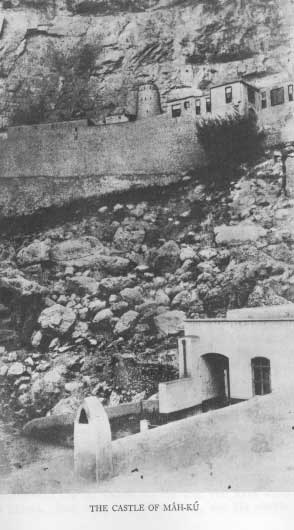
The castle, a solid, four-towered stone edifice, occupies
the summit of a mountain at the foot of which lies the town
of Mah-Ku. The only road that leads from it passes into
that town, ending at a gate which adjoins the seat of government
and is invariably kept closed. This gate is distinct
from that of the castle itself. Situated on the confines of
both the Ottoman and Russian empires, this castle has been
used, in view of its commanding position and strategic advantages,
as a centre for reconnoitring purposes. The officer
in charge of that station observed, in time of war, the movements
of the enemy, surveyed the surrounding regions, and
reported to his government such cases of emergency as came
Haji Mirza Aqasi had deliberately contrived to relegate
the Bab to so remote, so inhospitable and dangerously situated
a corner of the territory of the Shah, with the sole purpose
of stemming the tide of His rising influence and of
severing every tie that bound Him to the body of His disciples
throughout the country. Confident that few, if any,
would venture to penetrate that wild and turbulent region,
occupied by so rebellious a people, he fondly imagined that
this forced seclusion of his Captive from the pursuits and
interests of His followers would gradually tend to stifle the
Movement at its very birth and would lead to its final extinction.(3)
He was soon made to realise, however, that he
had gravely mistaken the nature of the Revelation of the
Bab and had underrated the force of its influence. The
turbulent spirits of this unruly people were soon subdued by
the gentle manners of the Bab, and their hearts were softened
"For the first two weeks," Siyyid Husayn further related,
"no one was permitted to visit the Bab. My brother and I
alone were admitted to His presence. Siyyid Hasan would,
every day, accompanied by one of the guards, descend to
the town and purchase our daily necessities. Shaykh Hasan-i-Zunuzi,
who had arrived at Mah-Ku, spent the nights in a
masjid outside the gate of the town. He acted as an intermediary
between those of the followers of the Bab who
occasionally visited Mah-Ku and Siyyid Hasan, my brother,
who would in turn submit the petitions of the believers to
their Master and would acquaint Shaykh Hasan with His
reply.
"One day the Bab charged my brother to inform Shaykh
Hasan that He would Himself request Ali Khan to alter
his attitude towards the believers who visited Mah-Ku and
to abandon his severity. `Tell him,' He added, `I will to-morrow
instruct the warden to conduct him to this place.'
I was greatly surprised at such a message. How could the
domineering and self-willed Ali Khan, I thought to myself,
be induced to relax the severity of his discipline? Early the
next day, the gate of the castle being still closed, we were
surprised by a sudden knock at the door, knowing full well
that orders had been given that no one was to be admitted
before the hour of sunrise. We recognised the voice of Ali
Khan, who seemed to be expostulating with the guards, one
of whom presently came in and informed me that the warden
of the castle insisted on being allowed admittance into the
presence of the Bab. I conveyed his message and was commanded
to usher him at once into His presence. As I was
stepping out of the door of His antechamber, I found Ali
Khan standing at the threshold in an attitude of complete
submission, his face betraying an expression of unusual humility
and wonder. His self-assertiveness and pride seemed
to have entirely vanished. Humbly and with extreme courtesy,
he returned my salute and begged me to allow him to
enter the presence of the Bab. I conducted him to the room
which my Master occupied. His limbs trembled as he followed
me. An inner agitation which he could not conceal
This marvellous experience completely changed the heart
of Ali Khan. Those words had calmed his agitation and
subdued the fierceness of his animosity. By every means in
his power, he determined to atone for his past behaviour.
`A poor man, a shaykh, he hastily informed the Bab, "is
yearning to attain Your presence. He lives in a masjid
outside the gate of Mah-Ku. I pray You that I myself be
Ali Khan set out, within the limits imposed upon him,
to provide whatever would tend to alleviate the rigour of
the captivity of the Bab. At night the gate of the castle
was still closed; in the daytime, however, those whom the
Bab desired to see were allowed to enter His presence, were
able to converse with Him and to receive His instructions.
As He lay confined within the walls of the castle, He devoted
His time to the composition of the Persian Bayan, the
most weighty, the most illuminating and comprehensive of all
His works.(1) In it He laid down the laws and precepts of
His Dispensation, plainly and emphatically announced the
advent of a subsequent Revelation, and persistently urged
His followers to seek and find "Him whom God would make
manifest,"(2) warning them lest they allow the mysteries and
allusions in the Bayan to interfere with their recognition of
His Cause.(3)
I have heard Shaykh Hasan-i-Zunuzi bear witness to the
following: "The voice of the Bab, as He dictated the teachings
and principles of His Faith, could be clearly heard by
those who were dwelling at the foot of the mountain. The
melody of His chanting, the rhythmic flow of the verses
which streamed from His lips caught our ears and penetrated
into our very souls. Mountain and valley re-echoed the
majesty of His voice. Our hearts vibrated in their depths
to the appeal of His utterance."(1)
The gradual relaxation of the stern discipline imposed
upon the Bab encouraged an increasing number of His disciples
from the different provinces of Persia to visit Him in
the castle of Mah-Ku. An unceasing stream of eager and
devout pilgrims was directed to its gates through the gentleness
and leniency of Ali Khan.(1) After a stay of three days,
they would invariably be dismissed by the Bab, with instructions
to return to their respective fields of service and to
resume their labours for the consolidation of His Faith. Ali
In this manner the Bab spent the summer and autumn
within the walls of that castle. A winter followed of such
In one of His writings revealed in the year '60 A.H., the
Bab declares the following: "The spirit of prayer which animates
My soul is the direct consequence of a dream which
I had in the year before the declaration of My Mission. In
My vision I saw the head of the Imam Husayn, the Siyyidu'sh-Shuhada',
which was hanging upon a tree. Drops of
blood dripped profusely from His lacerated throat. With
feelings of unsurpassed delight, I approached that tree and,
stretching forth My hands, gathered a few drops of that
sacred blood, and drank them devoutly. When I awoke, I
felt that the Spirit of God had permeated and taken possession
of My soul. My heart was thrilled with the joy of His
Divine presence, and the mysteries of His Revelation were
unfolded before My eyes in all their glory."
No sooner had Muhammad Shah condemned the Bab to
captivity amid the mountain fastnesses of Adhirbayjan than
he became afflicted with a sudden reverse of fortune, such
as he had never known before and which struck at the very
foundations of his State. Appalling disaster surprised his
forces that were engaged in maintaining internal order
throughout the provinces.(1) The standard of rebellion was
Mulla Husayn was at that time residing at Mashhad,(1)
and was endeavouring, despite the tumult which that revolt
had occasioned, to spread the knowledge of the new Revelation.
No sooner had he discovered that the Salar, in his
desire to extend the scope of the rebellion, had determined
to approach him and obtain his support, than he promptly
decided to leave the city in order to avoid implicating himself
On his way to Tihran, Mulla Husayn was enthusiastically
greeted by the believers in the different towns through which
he passed. They addressed to him the same request and
received from him the same reply. I have heard the following
testimony from the lips of Aqay-i-Kalim: "When Mulla
Husayn arrived at Tihran, I, together with a large number
of believers, went to visit him. He seemed to us the very
embodiment of constancy, of piety and virtue. He inspired
us with his rectitude of conduct and passionate loyalty.
Such were the force of his character and the ardour of his
faith that we felt convinced that he, unaided and alone,
would be capable of achieving the triumph of the Faith of
God." He was, with secrecy, ushered into the presence of
Baha'u'llah, and, soon after his interview, proceeded to
Adhirbayjan.
The night before his arrival at Mah-Ku, which was the
eve of the fourth Naw-Ruz after the declaration of the
This strange experience of Ali Khan brought about a
IYYID HUSAYN-I-YAZDI
has been heard to relate the following: "During the first ten days of
the Bab's incarceration in Tabriz, no one knew
what would next befall Him. The wildest conjectures
were current in the city. One day I ventured to ask
Him whether He would continue to remain where He was or
would be transferred to still another place. `Have you forgotten,'
was His immediate reply, `the question you asked
me in Isfahan? For a period of no less than nine months,
we shall remain confined in the Jabal-i-Basit,(1) from whence
we shall be transferred to the Jabal-i-Shadid.(2) Both these
places are among the mountains of Khuy and are situated
on either side of the town bearing that name.' Five days
after the Bab had uttered this prediction, orders were issued
to transfer Him and me to the castle of Mah-Ku and to
deliver us into the custody of Ali Khan-i-Mah-Ku'i."
The castle, a solid, four-towered stone edifice, occupies
the summit of a mountain at the foot of which lies the town
of Mah-Ku. The only road that leads from it passes into
that town, ending at a gate which adjoins the seat of government
and is invariably kept closed. This gate is distinct
from that of the castle itself. Situated on the confines of
both the Ottoman and Russian empires, this castle has been
used, in view of its commanding position and strategic advantages,
as a centre for reconnoitring purposes. The officer
in charge of that station observed, in time of war, the movements
of the enemy, surveyed the surrounding regions, and
reported to his government such cases of emergency as came
Haji Mirza Aqasi had deliberately contrived to relegate
the Bab to so remote, so inhospitable and dangerously situated
a corner of the territory of the Shah, with the sole purpose
of stemming the tide of His rising influence and of
severing every tie that bound Him to the body of His disciples
throughout the country. Confident that few, if any,
would venture to penetrate that wild and turbulent region,
occupied by so rebellious a people, he fondly imagined that
this forced seclusion of his Captive from the pursuits and
interests of His followers would gradually tend to stifle the
Movement at its very birth and would lead to its final extinction.(3)
He was soon made to realise, however, that he
had gravely mistaken the nature of the Revelation of the
Bab and had underrated the force of its influence. The
turbulent spirits of this unruly people were soon subdued by
the gentle manners of the Bab, and their hearts were softened
"For the first two weeks," Siyyid Husayn further related,
"no one was permitted to visit the Bab. My brother and I
alone were admitted to His presence. Siyyid Hasan would,
every day, accompanied by one of the guards, descend to
the town and purchase our daily necessities. Shaykh Hasan-i-Zunuzi,
who had arrived at Mah-Ku, spent the nights in a
masjid outside the gate of the town. He acted as an intermediary
between those of the followers of the Bab who
occasionally visited Mah-Ku and Siyyid Hasan, my brother,
who would in turn submit the petitions of the believers to
their Master and would acquaint Shaykh Hasan with His
reply.
"One day the Bab charged my brother to inform Shaykh
Hasan that He would Himself request Ali Khan to alter
his attitude towards the believers who visited Mah-Ku and
to abandon his severity. `Tell him,' He added, `I will to-morrow
instruct the warden to conduct him to this place.'
I was greatly surprised at such a message. How could the
domineering and self-willed Ali Khan, I thought to myself,
be induced to relax the severity of his discipline? Early the
next day, the gate of the castle being still closed, we were
surprised by a sudden knock at the door, knowing full well
that orders had been given that no one was to be admitted
before the hour of sunrise. We recognised the voice of Ali
Khan, who seemed to be expostulating with the guards, one
of whom presently came in and informed me that the warden
of the castle insisted on being allowed admittance into the
presence of the Bab. I conveyed his message and was commanded
to usher him at once into His presence. As I was
stepping out of the door of His antechamber, I found Ali
Khan standing at the threshold in an attitude of complete
submission, his face betraying an expression of unusual humility
and wonder. His self-assertiveness and pride seemed
to have entirely vanished. Humbly and with extreme courtesy,
he returned my salute and begged me to allow him to
enter the presence of the Bab. I conducted him to the room
which my Master occupied. His limbs trembled as he followed
me. An inner agitation which he could not conceal
This marvellous experience completely changed the heart
of Ali Khan. Those words had calmed his agitation and
subdued the fierceness of his animosity. By every means in
his power, he determined to atone for his past behaviour.
`A poor man, a shaykh, he hastily informed the Bab, "is
yearning to attain Your presence. He lives in a masjid
outside the gate of Mah-Ku. I pray You that I myself be
Ali Khan set out, within the limits imposed upon him,
to provide whatever would tend to alleviate the rigour of
the captivity of the Bab. At night the gate of the castle
was still closed; in the daytime, however, those whom the
Bab desired to see were allowed to enter His presence, were
able to converse with Him and to receive His instructions.
As He lay confined within the walls of the castle, He devoted
His time to the composition of the Persian Bayan, the
most weighty, the most illuminating and comprehensive of all
His works.(1) In it He laid down the laws and precepts of
His Dispensation, plainly and emphatically announced the
advent of a subsequent Revelation, and persistently urged
His followers to seek and find "Him whom God would make
manifest,"(2) warning them lest they allow the mysteries and
allusions in the Bayan to interfere with their recognition of
His Cause.(3)
I have heard Shaykh Hasan-i-Zunuzi bear witness to the
following: "The voice of the Bab, as He dictated the teachings
and principles of His Faith, could be clearly heard by
those who were dwelling at the foot of the mountain. The
melody of His chanting, the rhythmic flow of the verses
which streamed from His lips caught our ears and penetrated
into our very souls. Mountain and valley re-echoed the
majesty of His voice. Our hearts vibrated in their depths
to the appeal of His utterance."(1)
The gradual relaxation of the stern discipline imposed
upon the Bab encouraged an increasing number of His disciples
from the different provinces of Persia to visit Him in
the castle of Mah-Ku. An unceasing stream of eager and
devout pilgrims was directed to its gates through the gentleness
and leniency of Ali Khan.(1) After a stay of three days,
they would invariably be dismissed by the Bab, with instructions
to return to their respective fields of service and to
resume their labours for the consolidation of His Faith. Ali
In this manner the Bab spent the summer and autumn
within the walls of that castle. A winter followed of such
In one of His writings revealed in the year '60 A.H., the
Bab declares the following: "The spirit of prayer which animates
My soul is the direct consequence of a dream which
I had in the year before the declaration of My Mission. In
My vision I saw the head of the Imam Husayn, the Siyyidu'sh-Shuhada',
which was hanging upon a tree. Drops of
blood dripped profusely from His lacerated throat. With
feelings of unsurpassed delight, I approached that tree and,
stretching forth My hands, gathered a few drops of that
sacred blood, and drank them devoutly. When I awoke, I
felt that the Spirit of God had permeated and taken possession
of My soul. My heart was thrilled with the joy of His
Divine presence, and the mysteries of His Revelation were
unfolded before My eyes in all their glory."
No sooner had Muhammad Shah condemned the Bab to
captivity amid the mountain fastnesses of Adhirbayjan than
he became afflicted with a sudden reverse of fortune, such
as he had never known before and which struck at the very
foundations of his State. Appalling disaster surprised his
forces that were engaged in maintaining internal order
throughout the provinces.(1) The standard of rebellion was
Mulla Husayn was at that time residing at Mashhad,(1)
and was endeavouring, despite the tumult which that revolt
had occasioned, to spread the knowledge of the new Revelation.
No sooner had he discovered that the Salar, in his
desire to extend the scope of the rebellion, had determined
to approach him and obtain his support, than he promptly
decided to leave the city in order to avoid implicating himself
On his way to Tihran, Mulla Husayn was enthusiastically
greeted by the believers in the different towns through which
he passed. They addressed to him the same request and
received from him the same reply. I have heard the following
testimony from the lips of Aqay-i-Kalim: "When Mulla
Husayn arrived at Tihran, I, together with a large number
of believers, went to visit him. He seemed to us the very
embodiment of constancy, of piety and virtue. He inspired
us with his rectitude of conduct and passionate loyalty.
Such were the force of his character and the ardour of his
faith that we felt convinced that he, unaided and alone,
would be capable of achieving the triumph of the Faith of
God." He was, with secrecy, ushered into the presence of
Baha'u'llah, and, soon after his interview, proceeded to
Adhirbayjan.
The night before his arrival at Mah-Ku, which was the
eve of the fourth Naw-Ruz after the declaration of the
This strange experience of Ali Khan brought about a
 Until that time no one of the disciples of the Bab but
Siyyid Husayn-i-Yazdi and his brother had been allowed to
spend the night within the castle. That day Ali Khan
went to the Bab and said: "If it be Your desire to retain
One day, as the Bab, in the company of Mulla Husayn,
was looking out over the landscape of the surrounding country
from the roof of the castle, He gazed towards the west and,
as He saw the Araxes winding its course far away below
Him, turned to Mulla Husayn and said: "That is the river,
and this is the bank thereof, of which the poet Hafiz has
thus written: `O zephyr, shouldst thou pass by the banks
of the Araxes, implant a kiss on the earth of that valley and
make fragrant thy breath. Hail, a thousand times hail, to
thee, O abode of Salma! How dear is the voice of thy camel-drivers,
how sweet the jingling of thy bells!'(1) The days of
your stay in this country are approaching their end. But
for the shortness of your stay, we would have shown you
the `abode of Salma,' even as we have revealed to your eyes
the `banks of the Araxes.'" By the "abode of Salma" the
Bab meant the town of Salmas, which is situated in the
neighbourhood of Chihriq and which the Turks designate as
Salmas. Continuing His remarks, the Bab said: "It is the
immediate influence of the Holy Spirit that causes words
such as these to stream from the tongue of poets, the significance
of which they themselves are oftentimes unable to
apprehend. The following verse is also divinely inspired:
`Shiraz will be thrown into a tumult; a Youth of sugar-tongue
will appear. I fear lest the breath of His mouth should
agitate and upset Baghdad.' The mystery enshrined
within this verse is now concealed; it will be revealed in the
year after Hin."(2) The Bab subsequently quoted this well-known
tradition: "Treasures lie hidden beneath the throne
The prediction which the Bab had uttered was promptly
fulfilled. Those who had been charged to watch secretly
the movements and conduct of Ali Khan submitted to
Haji Mirza Aqasi a detailed report in which they expatiated
upon his extreme devotion to his Prisoner and described such
incidents as tended to confirm their statements. "Day and
night," they wrote him, "the warden of the castle of Mah-Ku
is to be seen associating with his captive in conditions of
unrestrained freedom and friendliness. Ali Khan, who obstinately
refused to wed his daughter with the heir to the
throne of Persia, pleading that such an act would so infuriate
the sunni relatives of his mother that they would unhesitatingly
put him and his daughter to death, now with the keenest
eagerness desires that same daughter to be espoused to the
Bab. The latter has refused, but Ali Khan still persists in
his entreaty. But for the prisoner's refusal, the nuptials of
the maiden would have been already celebrated." Ali Khan
had actually made such a request and had even begged Mulla
Husayn to intercede in his behalf with the Bab but had
failed to obtain His consent.
These malevolent reports had an immediate influence
upon Haji Mirza Aqasi. Fear and resentment again impelled
that capricious minister to issue a peremptory order for the
transference of the Bab to the castle of Chihriq.
Twenty days after Naw-Ruz, the Bab bade farewell to
the people of Mah-Ku, who, in the course of His nine months'
captivity, had recognised to a remarkable degree the power
On the morning of the ninth day after Naw-Ruz, Mulla
Husayn set forth, as bidden by his Master, on his journey
to Mazindaran. To Qambar-'Ali the Bab addressed these
parting words: "The Qambar-'Ali of a bygone age would
glory in that his namesake has lived to witness a Day for
which even He(1) who was the Lord of his lord sighed in
vain; of which He, with keen longing, has spoken: `Would
that My eyes could behold the faces of My brethren who
have been privileged to attain unto His Day!'"
Until that time no one of the disciples of the Bab but
Siyyid Husayn-i-Yazdi and his brother had been allowed to
spend the night within the castle. That day Ali Khan
went to the Bab and said: "If it be Your desire to retain
One day, as the Bab, in the company of Mulla Husayn,
was looking out over the landscape of the surrounding country
from the roof of the castle, He gazed towards the west and,
as He saw the Araxes winding its course far away below
Him, turned to Mulla Husayn and said: "That is the river,
and this is the bank thereof, of which the poet Hafiz has
thus written: `O zephyr, shouldst thou pass by the banks
of the Araxes, implant a kiss on the earth of that valley and
make fragrant thy breath. Hail, a thousand times hail, to
thee, O abode of Salma! How dear is the voice of thy camel-drivers,
how sweet the jingling of thy bells!'(1) The days of
your stay in this country are approaching their end. But
for the shortness of your stay, we would have shown you
the `abode of Salma,' even as we have revealed to your eyes
the `banks of the Araxes.'" By the "abode of Salma" the
Bab meant the town of Salmas, which is situated in the
neighbourhood of Chihriq and which the Turks designate as
Salmas. Continuing His remarks, the Bab said: "It is the
immediate influence of the Holy Spirit that causes words
such as these to stream from the tongue of poets, the significance
of which they themselves are oftentimes unable to
apprehend. The following verse is also divinely inspired:
`Shiraz will be thrown into a tumult; a Youth of sugar-tongue
will appear. I fear lest the breath of His mouth should
agitate and upset Baghdad.' The mystery enshrined
within this verse is now concealed; it will be revealed in the
year after Hin."(2) The Bab subsequently quoted this well-known
tradition: "Treasures lie hidden beneath the throne
The prediction which the Bab had uttered was promptly
fulfilled. Those who had been charged to watch secretly
the movements and conduct of Ali Khan submitted to
Haji Mirza Aqasi a detailed report in which they expatiated
upon his extreme devotion to his Prisoner and described such
incidents as tended to confirm their statements. "Day and
night," they wrote him, "the warden of the castle of Mah-Ku
is to be seen associating with his captive in conditions of
unrestrained freedom and friendliness. Ali Khan, who obstinately
refused to wed his daughter with the heir to the
throne of Persia, pleading that such an act would so infuriate
the sunni relatives of his mother that they would unhesitatingly
put him and his daughter to death, now with the keenest
eagerness desires that same daughter to be espoused to the
Bab. The latter has refused, but Ali Khan still persists in
his entreaty. But for the prisoner's refusal, the nuptials of
the maiden would have been already celebrated." Ali Khan
had actually made such a request and had even begged Mulla
Husayn to intercede in his behalf with the Bab but had
failed to obtain His consent.
These malevolent reports had an immediate influence
upon Haji Mirza Aqasi. Fear and resentment again impelled
that capricious minister to issue a peremptory order for the
transference of the Bab to the castle of Chihriq.
Twenty days after Naw-Ruz, the Bab bade farewell to
the people of Mah-Ku, who, in the course of His nine months'
captivity, had recognised to a remarkable degree the power
On the morning of the ninth day after Naw-Ruz, Mulla
Husayn set forth, as bidden by his Master, on his journey
to Mazindaran. To Qambar-'Ali the Bab addressed these
parting words: "The Qambar-'Ali of a bygone age would
glory in that his namesake has lived to witness a Day for
which even He(1) who was the Lord of his lord sighed in
vain; of which He, with keen longing, has spoken: `Would
that My eyes could behold the faces of My brethren who
have been privileged to attain unto His Day!'"



|